
Someone handling piles of forms
You regularly process several membership forms at once and want to reload the paper less often. Compare feeder capacity and duplex scanning capabilities.


For recurring piles of double-sided membership forms, an automatic document feeder with duplex scanning is a practical starting point. Canon lists a 60-sheet, 80 g/m² feeder for the imageFORMULA R30, while compact USB models such as the Canon imageFORMULA R10 and Brother ADS-1300 have a 20-sheet feeder. If you mainly scan small batches, a compact USB model may be a better fit. For shared use, you should also decide in advance where scans will be stored and who will have access, as Wi-Fi won’t manage that for you.
You regularly process several membership forms at once and want to reload the paper less often. Compare feeder capacity and duplex scanning capabilities.
You scan smaller quantities and want to be able to put the scanner away or use it on a small work surface. Check whether it’s USB-powered, its dimensions and how much room the paper path needs while scanning.
Several authorised residents process forms. Compare the connection options and agree where scans will be stored and who can access them.
First, consider how often you scan batches and how much space the scanner takes up in use. Then look at the connection options and how you’ll find and protect your digital forms.
| Buying concern | What should you look for? | Who is this important for? |
|---|---|---|
| Processing batches | Check the capacity for your paper and whether the scanner supports duplex scanning. | I regularly process a pile of forms and don’t want to feed in or turn over sheets one at a time. Around 29% of consumers put batch processing first. |
| Limited space | Measure the space available while scanning and decide whether you’ll put the device away afterwards. | I have a small work surface and don’t want the paper path to get in the way while I scan. Around 29% of consumers put limited space first. |
| Shared use | Check the connection options, scan destination and who has read or edit permissions. | I want to use the scanner in a convenient location for several authorised residents, without sharing scans unintentionally. Around 21% of consumers put shared use first. |
| Finding and keeping scans | Check whether the software can create searchable PDFs and set appropriate access permissions and retention periods. | I want to be able to find forms later without making them available for longer than necessary or to more people than necessary. Around 21% of consumers put easy-to-find archiving first. |
A scanner may need more space in use than it does with the tray closed. Canon gives separate dimensions for the R30 with the tray open and closed; Epson describes the ES-C320W as having a U-shaped paper path.
Measure the space where you’ll actually scan and allow room for paper to feed in and come out.
A wireless connection doesn’t determine who can view stored membership details.
Before scanning, decide where files will be stored and which authorised people will have access. The Dutch Data Protection Authority explains that unauthorised people must not be able to access personal data.
The warranty period stated by the manufacturer is separate from your statutory rights when you buy as a consumer in the Netherlands.
Compare any additional terms with your statutory rights. ACM ConsuWijzer explains that the statutory guarantee exists alongside a guarantee from the retailer or manufacturer.
Canon offers compact USB document feeders as well as larger models for recurring batches.
Brother describes the ADS-1300 as a compact USB-C document feeder for smaller batches next to a computer.
According to Epson, the ES-C320W combines Wi-Fi with a U-shaped paper path. Epson ScanSmart can convert scans from this model into searchable PDFs.
This selection includes compact USB scanners for small batches, models with a U-shaped paper path for limited workspace, and scanners with a larger feeder for recurring batches.
 No image available
A compact USB scanner for small piles of forms next to a computer.
Automatic 20-sheet feeder; scans both sides. USB-powered, with speeds of up to 30 ipm when scanning both sides.
 No image available
A compact USB scanner for small batches that you process next to a computer.
20-sheet feeder and duplex scanning. The scanner connects to a computer via USB.
 No image available
A document feeder with a U-shaped paper path for processing individual documents in a small workspace.
The product information lists support for PDF, JPG and TIFF.
 No image available
A Wi-Fi model with a U-shaped paper path for flexible scanning and limited workspace.
Scans both sides automatically. The product description warns against scanning documents with staples, paper clips or wet ink, as these can damage the rollers and scanner glass.
 No image available
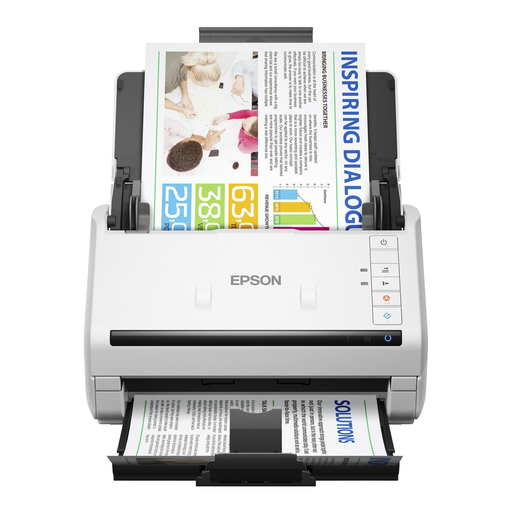
A document feeder for recurring batches of double-sided forms.
Automatic 50-page feeder and duplex scanning in a single pass. The product information lists speeds of up to 35 ppm and 70 ipm, with USB 3.0.
If the forms contain personal data, digitising them also counts as processing, which requires a valid legal basis and compliance with the GDPR principles. Consent is one possible legal basis, but it isn’t automatically required or appropriate for every form.
Not necessarily. The organisation must prevent unauthorised access to personal data and determine appropriate security measures based on the processing and its risks. The Dutch Data Protection Authority explains that unauthorised people must not be able to access the data; a Wi-Fi scanner won’t manage these access permissions for you.
The GDPR doesn’t set one general retention period. The Dutch Data Protection Authority states that personal data must not be kept for longer than necessary for its purpose; also check whether a different statutory retention requirement applies to certain data.
Follow the maintenance instructions for the exact model. The Epson ES-C320W manual covers cleaning the inside, scanner glass and sensor, as well as replacing the roller kit. Don’t apply these instructions to another model without checking first.
Not necessarily. When you buy as a consumer in the Netherlands, you have a statutory guarantee if the product doesn’t provide what you could reasonably expect under normal use; the retailer must then offer a solution. ACM ConsuWijzer distinguishes the statutory guarantee from a guarantee provided by the retailer or manufacturer. Compare any additional rights offered by a paid plan with your statutory rights.