For loose, double-sided lecture handouts, a sheet-fed scanner with a duplex ADF is a practical choice; match the feeder capacity to the size of your piles. In a small hobby room, the paper path and the space needed while scanning matter too, while searchable files depend on how you handle OCR. A sheet-fed scanner is not necessarily suitable for delicate or bound material, so consider a flatbed as an alternative.
Who is a sheet-fed scanner suitable for?
Scanning piles of handouts
You want to digitise lots of loose sheets, which may be double-sided, with as little manual handling as possible. Compare the duplex ADF, feeder capacity and the conditions under which scan speeds are quoted. Brother lists a 20-sheet ADF for the ADS-1300; Canon gives the imageFORMULA R30 a capacity of 60 sheets at 80 g/m².
Sharing a small hobby table
You want to use the scanner alongside other hobbies, or put it away when you’re finished. Look beyond the device’s dimensions to consider the paper path and the space taken up by the trays and output sheets during use. Epson describes the DS-C330 as having a U-turn paper path; Canon gives the R30 a depth of 600 mm with the tray open.
Finding text later
You want to be able to search digital handouts for specific topics. Compare the OCR feature and how the software creates searchable files. Canon lists built-in OCR for the R30; Epson mentions optical character recognition via ScanSmart for the ES-590W.
Which buying considerations matter most?
When choosing a sheet-fed scanner for lecture handouts in a hobby room, handling a pile of sheets, available workspace, searchable text and careful treatment of originals can all be deciding factors.
| Consideration |
What to look for when buying |
Who is this important for? |
| Handling piles of sheets |
Check for duplex feeding, ADF capacity and whether the speed is quoted in pages or images per minute. |
If I want to scan lots of loose handouts, including double-sided ones, without turning each sheet over by hand, handling a pile is my priority. Around 33% of consumers put this need first. |
| Workspace |
Measure the space with the trays open and consider the direction in which paper is fed in and output. |
If I also need my hobby table for other activities, I want to know how much space the scanner takes up while in use and whether I can put it away afterwards. Around 27% of consumers prioritise keeping their workspace clear. |
| Searchable files |
Check whether the exact model offers OCR and whether it produces a searchable file. |
If I want to find names or topics in my handouts later, a scan with searchable text is more useful than an image alone. Around 27% of consumers prioritise being able to find text. |
| Delicate sheets |
Check which sizes and paper conditions are supported, and whether a straight-through path or carrier sheet is needed. |
If my originals are folded, damaged or delicate, I want to check first that they can safely go through a feeder; if not, I’ll consider a flatbed. Around 13% of consumers prioritise protecting their originals. |
What should you watch out for?
-
Assuming different speed measurements are equivalent
Pages per minute and images or sides per minute don’t mean the same thing. Canon also quotes different speeds for colour and black-and-white scanning on the R30.
Only compare speeds when the colour mode, resolution and unit are the same.
-
Measuring only the scanner with its trays closed
The space required can change during scanning when trays are open and paper is fed out. Canon lists the R30 as 600 mm deep with the tray open.
Measure the available space, including room for input and output, as well as the paper path.
-
Assuming every original can go through an ADF
Delicate, folded or unusual sheets need to be assessed individually. Having a choice of paper paths doesn’t automatically mean every original is suitable for feeding through the scanner.
Check the guidance for the exact type of paper and consider a flatbed for originals that shouldn’t go through the feeder.
A damaged sheet could mean extra work if you have to digitise it again.
Brands with relevant document scanners
The features mentioned apply to the specific models and product ranges below; they are not an assessment of the brand as a whole.
Brother
According to Brother, the ADS-1300 is designed for compact piles, while the ADS-1800W adds Wi-Fi and a touchscreen.
- Brother lists a 20-sheet ADF for both models. The brand specifies USB-C power for the ADS-1300.
- A 20-sheet feeder may need refilling more often when handling larger piles. Wireless features may be unnecessary if you only scan next to a computer.
Epson
According to Epson, the DS-C330 offers both U-turn and straight-through feeding, while the WorkForce ES-590W is designed for larger piles and wireless scan destinations.
- Epson lists a 100-sheet ADF for the ES-590W. The brand describes two paper paths for the DS-C330.
- The right paper path depends on the material you want to scan; check that the software works with your computer too.
Canon
According to Canon, the imageFORMULA R30 is a desktop scanner for larger piles, with built-in OCR.
- Canon specifies a 60-sheet ADF at 80 g/m² and CaptureOnTouch Lite with OCR.
- The quoted depth is 600 mm with the tray open. The quoted black-and-white and colour speeds differ.
Ricoh ScanSnap
Ricoh describes the iX1300 as a compact scanner with a U-turn feeder and a separate return feeder for other documents.
- Ricoh lists Wi-Fi and a maximum speed of 30 ppm for A4, colour, duplex and 300 dpi.
- The speed is a manufacturer’s figure for the stated conditions. Check the specification and compatibility of the exact product on offer.
Plustek
According to Plustek Europe, the SmartOffice PS286 Plus is a scanner with an ADF and included OCR.
- Plustek Europe specifies a capacity of 50 sheets at A4/Letter and 70 g/m².
- The quoted colour speed is 6 ppm at A4 and 300 dpi. The black-and-white speed is quoted at 200 dpi; as these figures use different test conditions, they can’t be compared directly.
Joybuy products for scanning handouts
This selection includes sheet-fed scanners for loose handouts, with models for different pile sizes and a flatbed option for anyone who also wants to digitise other originals.
 No image available
Canon imageFORMULA DR-F120 A4 flatbed and ADF scanner
The combination of a flatbed and ADF suits anyone who wants to digitise loose handouts as well as books or delicate documents.
Features stated in the product name: A4, 600 × 600 dpi and black.
View on Joybuy
 No image available
Canon imageFORMULA R10 A4 sheet-fed scanner
A sheet-fed model for scanning loose handouts in smaller batches; check that the connection and workflow suit your computer.
Features stated in the product name: A4, 600 × 600 dpi and white.
View on Joybuy
 No image available
Epson DS-C330 A4 scanner
The paper path can make a difference if your hobby table is small. Epson describes both U-turn and straight-through feeding for the DS-C330; check which path is suitable for your sheets.
Features stated in the product name: A4, 600 × 600 dpi, black and white.
View on Joybuy
 No image available
Epson DS-770 II A4 sheet-fed scanner
A sheet-fed model for anyone who values handling piles of sheets. Check the feeder capacity and supported paper conditions for your handouts.
Features stated in the product name: A4, 600 × 600 dpi and white.
View on Joybuy
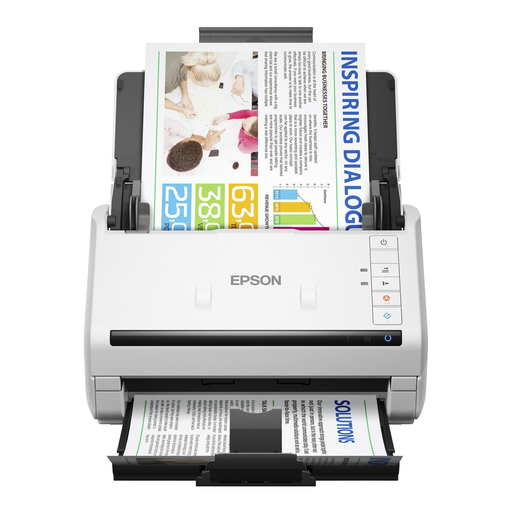 No image available
Epson WorkForce DS-530 II A4 sheet-fed scanner
If you want to scan double-sided handouts in piles, it’s worth checking the capacity and software compatibility of the exact model.
Features stated in the product name: A4, 600 × 600 dpi, black and white.
View on Joybuy
Frequently asked questions
Where should I start if my handouts are printed on both sides?
Check whether the exact model has duplex feeding and how many sheets its ADF can handle under the stated paper conditions. Brother lists a capacity of 20 sheets for the ADS-1300; Canon lists 60 sheets at 80 g/m² for the R30.
How can I make my scans searchable?
Choose a workflow that uses OCR and check with a test file that the text is actually searchable. Canon lists built-in OCR for the R30; Epson mentions optical character recognition via ScanSmart for the ES-590W.
Can I scan delicate or bound handouts with a sheet-fed scanner?
Not without first checking that the original is suitable for the paper path. Check the guidance for the material and consider a flatbed for items that shouldn’t go through the feeder.
Can I scan handouts for my own use and share the files?
The Dutch government allows you to make a private copy for your own use, but it must not be distributed or made public. So don’t assume that a scan made for personal use can also be shared with a group.
What should I consider if handouts contain personal data?
Protect files containing personal data carefully and check documents before sharing them. The Dutch Data Protection Authority highlights information such as addresses and sensitive data.


