For regular batches of loose, double-sided contract pages, a scanner with an automatic document feeder fits the workflow; choose a flatbed if you prefer to scan originals flat. In a shared studio, the scan destination and access permissions matter just as much as the network connection, while compact mobile models are best suited to small volumes and limited space.
Who is this buying guide for?
Studio handling confidential contracts
You share the workspace, but that doesn’t necessarily mean everyone should have access to every contract scan. Decide on the scan destination and access permissions before treating a network feature as a benefit. The Dutch Data Protection Authority stresses that organisations must protect personal data against unauthorised access.
Team handling regular batches of contracts
You want to process loose, often double-sided pages one after another. So compare the automatic feeder, duplex scanning and shared controls on the exact model you’re considering.
User with limited permanent space
You scan smaller volumes and want to move or put the device away after use. In that case, portability matters more than a large input tray.
What should you look for?
Network scanner with automatic document feeder
Best for: regularly scanning loose, double-sided contract pages and a shared workflow for authorised users.
Trade-off: a larger input tray can be useful for batches, but takes up space; network access doesn’t automatically control who can open saved scans.
Scanner with a flatbed and document feeder
Best for: scanning both loose pages and documents or attachments that you’d rather place flat.
Trade-off: check that the flatbed, feeder, software and space required suit your documents and studio.
Compact or mobile scanner
Best for: scanning small volumes, putting the device away or occasionally working away from the studio.
Trade-off: a compact feeder is less suitable for large stacks; also check the power source used by the model.
| Consideration |
What should you check? |
Who is this important for? |
| Confidential storage |
Check the scan destination, access permissions for each user and how files are managed after scanning. |
I want only authorised colleagues to be able to open contract scans, so I’ll sort out storage and permissions first. Around 36% of consumers prioritise confidential storage in a shared space. |
| Batches of contracts |
Compare ADF capacity and duplex scanning; check whether speed is measured in pages or images per minute. |
For regular stacks, I want to feed fewer pages by hand and process double-sided documents quickly. Around 29% of consumers prioritise processing batches. |
| Fragile originals |
Decide which documents you’d rather place on a flatbed and check scans for signatures and reverse sides. |
If I want to handle signed originals with care, I’ll look for a flatbed and check the retention requirements for each document type. Around 21% of consumers prioritise careful handling of originals. |
| Space and scanning location |
Check the space needed during use, the power source and whether the feeder suits loose pages or batches. |
I want to be able to move or put the device away, so I’m happy to sacrifice some convenience when processing stacks. Around 14% of consumers prioritise limited space or portability. |
Common pitfalls
-
Confusing a network connection with access security
A network feature doesn’t determine who can open saved contracts. If your organisation processes personal data, you must protect it against unauthorised access; the appropriate measures depend on the processing and the risks involved.
Decide in advance who needs access, then set up scan destinations and permissions accordingly.
-
Planning to scan a large stack with a compact scanner
Compact and desktop models vary in how they feed paper and in their ADF capacity. With a smaller feeder, you may need to split a batch into smaller sections and check it more often.
Compare the size of your usual batches with the feeder capacity of the exact model.
-
Assuming a scan replaces every paper original
The Dutch Tax and Customs Administration sets out conditions for keeping scanned invoices and receipts digitally; these don’t automatically apply to every signed contract.
Check that each scan is complete, and assess whether the original needs to be kept for each type of contract.
Relevant brands to consider
Brother
The ADS-4300N is a wired option for shared document workflows, while the ADS-1800W is a more compact choice.
- Brother lists an 80-sheet ADF and a wired network connection for the ADS-4300N.
- For the ADS-1800W, Brother lists a 20-sheet ADF and USB-C power.
- These features apply to the models listed, not to every Brother scanner.
Epson
The WorkForce DS-1760WN combines a flatbed with an automatic document feeder, while the ES-60W is designed for more mobile use.
- Epson lists a flatbed and network connectivity for the DS-1760WN.
- According to Epson, the ES-60W has a built-in battery.
- The models suit different scanning volumes and workspaces.
Ricoh ScanSnap
The iX2500 is a desktop option for scanning from the device itself, a computer or a mobile device.
- The Dutch ScanSnap product information mentions Wi-Fi, custom scan profiles and searchable PDFs, including when saving to a NAS.
- Check that the version on offer and your chosen storage services meet your studio’s policies.
Canon
The imageFORMULA R40 is a USB desktop scanner for loose sheets.
- Canon specifies a 60-sheet ADF and a USB 2.0 connection for the R40.
- If you’re looking for a standalone network scanner for shared use, bear in mind that this model connects via USB.
Document scanners at Joybuy
These models are suited to scanning contract pages: they offer automatic feeding for batches and, in one case, a flatbed too, for originals you’d rather place flat.
 No image available
Canon imageFORMULA DR-F120
With both automatic feeding and a flatbed, you have two ways to scan contract pages.
ADF for up to 50 sheets; duplex scanning; flatbed; 600 × 600 DPI; A4.
View at Joybuy
 No image available
Epson DS-C490
The automatic duplex feeder is designed for loose pages you want to scan one after another.
Feeder capacity: 10 sheets per feed; automatic duplex scanning. The product description mentions Paper Protection and an ultrasonic sensor.
View at Joybuy
 No image available
Epson WorkForce DS-970
The automatic feeder and duplex scanning are suited to regular batches of double-sided documents.
100-sheet ADF; duplex scanning. The flatbed scanner and network interface are described as optional; check whether they’re included with the version you choose.
View at Joybuy
 No image available
Epson DS-770 II
The ADF and duplex scanning are designed for processing loose document pages.
100-sheet ADF; duplex scanning; slow scanning mode for delicate documents. The setup described connects the scanner to a computer via USB.
View at Joybuy
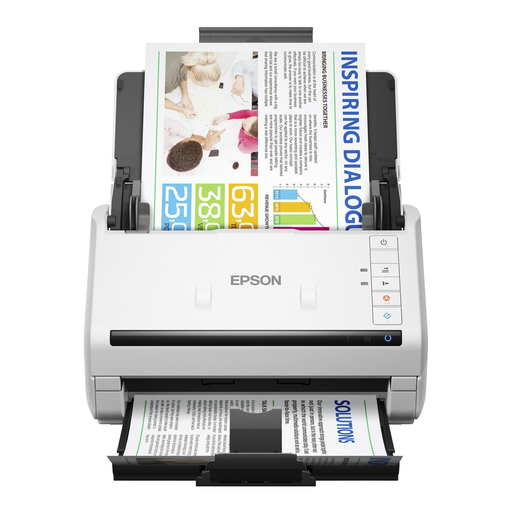 No image available
Epson WorkForce DS-530 II
The automatic feeder and duplex scanning are designed for batches of double-sided documents.
50-sheet ADF; duplex scanning; USB 3.0; compatible with Windows and Mac. The product description lists crumpled, long or delicate documents as possible use cases.
View at Joybuy
Frequently asked questions
How do I set up a scanner for a shared studio?
First decide who can open which contract scans, then set up the scan destinations. The Dutch Data Protection Authority says organisations must protect personal data against unauthorised access; the appropriate measures depend on the processing and the risks involved.
Should I factor maintenance or extra parts into my choice?
Check which parts can be replaced on each model and what’s included with the version you choose. Brother lists a separate feed roller kit for the ADS-4300N; for the ADS-1800W, Brother mentions an optional output tray and power adapter.
Can I throw away a signed paper contract after scanning it?
Not simply because you’ve scanned it. The Dutch Tax and Customs Administration sets out conditions for keeping invoices and receipts digitally, but this doesn’t automatically apply to every contract. Check the relevant retention and evidential requirements for the contract in question.
Do I need a data processing agreement for a connected cloud service?
If the service provider processes personal data on behalf of your organisation as a processor, the Dutch Data Protection Authority says a written data processing agreement is required. Whether this applies to your service and contract data depends on the roles involved and the processing.


