If you often write out several calculation steps on paper, start by looking at an adjustable document camera, and check that its base and arm fit beside your exercise book. If you’re usually on camera yourself and only need to show your paper occasionally, a webcam with a downward-facing mode could be an option. First, test whether your handwriting is legible on screen from where you sit at your monitor. A flexible camera can switch between your paper and your face, but you may need to reposition it or refocus.
Who is this for?
Teacher writing out sums
If you show your working in an exercise book as you explain, you’ll want to know whether pupils can follow it on screen. One maths teacher describes this use of a document camera as a practical example; it is not a representative measurement.
Presenter with a small desk
If you want to show paper without a large permanent setup beside your keyboard and monitor, it’s worth checking how much room the camera takes up when in use. The dimensions when a camera is folded up don’t tell you how much space its arm and base need while you’re writing.
Presenter switching between their face and paper
If you want to alternate between showing yourself and handwritten work during a conversation, a camera that can be adjusted to the right angle may be useful. Logitech describes a downward-tilting mode for the Brio 500; HUE and CZUR describe adjustable cameras.
What should you look for when choosing?
| What to consider |
What to look for when buying |
Who is this important for? |
| Legible working |
View a real worked example from the camera’s intended distance, including while you’re writing. Check how much of the exercise book is visible and whether the text is in focus. |
I want to be able to read exponents and working as I write, not just see a sharp still photo. Around 36% of consumers in this setup give legible working top priority. |
| Clear desk space |
Put your exercise book, keyboard and mouse in their usual places, then check where the camera’s base and arm will sit. Compare the space needed when it’s in use, not just its folded dimensions. |
I want to be able to move my exercise book and writing hand freely without the camera base getting in the way. Around 29% of consumers prioritise clear desk space. |
| Switching between your face and paper |
Try both camera angles during a video call. Check that the paper is clearly visible from your chosen position and remains in focus after you switch. |
If I switch between my face and paper during a call, I want to be able to change the view easily. Around 21% of consumers prioritise this flexibility. |
| Connectivity and lighting |
Check that your computer and video-calling app recognise the camera as a video source. Test your paper using the lighting you’ll actually have when explaining. |
I want the camera to work with my computer setup and the paper to remain visible in the available light. Around 14% of consumers give connectivity and lighting top priority. |
Common pitfalls
-
Confusing folded dimensions with the space needed to use the camera
A camera’s stated dimensions when folded don’t tell you how much room its arm and base need while you’re writing. IPEVO gives the folded dimensions for the V4K; Epson lists separate dimensions for the ELPDC07 when folded and set up.
Before buying, mark out the available space at full size and leave room for your exercise book and writing hand.
You may need to rearrange your exercise book, keyboard or camera.
-
Assuming a webcam’s downward-facing mode will make handwriting legible
Logitech describes a mode for the Brio 500 that tilts the camera downwards, but the viewing angle depends on where your monitor and paper are positioned.
View a real worked example in your video-calling app from the position where you plan to use the camera.
-
Confusing a manufacturer’s warranty with your statutory rights
The Dutch government states that the Netherlands has no fixed statutory warranty period and that a manufacturer’s warranty is in addition to your statutory rights.
Keep your proof of purchase and contact the seller if there’s a problem with the product.
Brands to consider
IPEVO
IPEVO describes the V4K as a USB document camera for people who want paper to be the main view.
- IPEVO lists autofocus, USB Video Class and up to 30 fps at Full HD. The stated maximum shooting area is 342 × 255 mm.
- The folded dimensions of 277 × 78 × 48 mm don’t indicate how much clear desk space the arm needs while you’re writing.
Logitech
Logitech positions the Brio 500 as a monitor webcam for people who are usually on camera themselves and occasionally want to show something on their desk.
- Logitech describes Show Mode, which lets you tilt the monitor-mounted camera downwards.
- The tilting mode doesn’t prove that small handwritten characters will be legible from every monitor position; test it with your setup.
HUE
HUE describes the HD Pro as a flexible USB camera that can be adjusted to show paper or the speaker.
- HUE lists Full HD 1080p, LED lighting, a microphone and compatibility with apps that recognise a USB camera.
- The HD Pro has manual focus. Check the focus again after moving its neck.
CZUR
CZUR describes the Fancy S Pro as a document camera and webcam on an adjustable arm.
- CZUR lists four adjustable joints, 12 MP, up to 1080p at 60 fps and 4K at 15 fps for the Fancy S Pro.
- These are manufacturer specifications, not a measurement of handwriting legibility. Check the exact variant and how much space the extended arm takes up.
Epson
Epson describes the ELPDC07 as a portable USB visualiser for people who want to position a separate camera above teaching materials.
- Epson Netherlands lists Full HD at 30 fps, autofocus, LED lighting and separate dimensions for the camera when folded and set up.
- A note saying it connects to newer Epson projectors doesn’t confirm that the camera will work with every projector or computer setup.
Joybuy products
This selection includes a document camera/scanner for paper and a webcam for a desktop or laptop setup. Check whether each model can show handwritten work the way you want during your video calls.
 No image available
CZUR Shine 800 A3 Pro document camera
The product name describes this model as a portable document camera and scanner; check that its live view and software suit your video calls.
The product name lists A3 as the maximum size, OCR and compatibility with Windows and macOS.
Joybuy
 No image available
Philips 4000 Series SPL6408BT/00 webcam
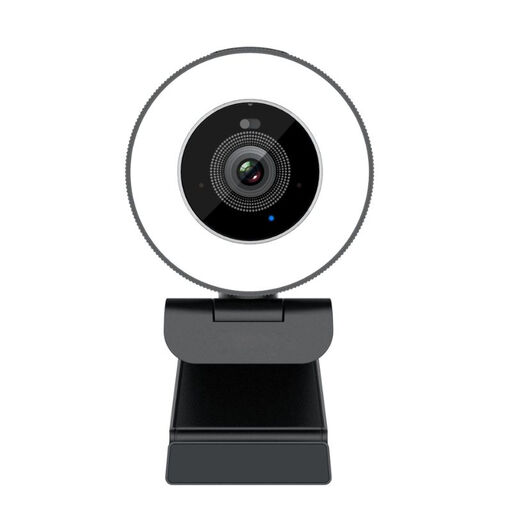
According to the product name, this webcam is designed for a desktop or laptop setup; first check that its position will show your paper clearly.
The product name lists 8 MP, autofocus, two built-in microphones, a privacy cover and a clip mount. This is the black EU version.
Joybuy
Frequently asked questions
How can I check whether my working is legible?
Write out a sample sum on the paper you usually use, position the camera where it will be during your explanation, then watch the video while you write. Don’t just check a still photo or the stated maximum sensor resolution; also make sure the working stays visible as you write.
Can I use the camera in a video call without separate software?
That depends on the camera, your operating system and the app. HUE says the HD Pro works with apps that recognise a USB camera; IRIS says the Visualizer 7 works as a video source when an app recognises a UVC camera. Also check whether any additional features require the manufacturer’s own software.
What can I do if a camera I bought online turns out to be faulty?
According to the Dutch government, a product must meet reasonable expectations, and you can contact the seller if there’s a problem. The Netherlands has no fixed statutory warranty period; what you can expect from a product depends on the product and the circumstances. If you buy online from a business, you’ll also often have a 14-day cooling-off period; check whether it applies to your purchase.
Can I record pupils or their work during online lessons?
That depends on the teaching situation and the education provider’s policies. The Dutch Data Protection Authority advises agreeing who will appear on screen, whether recordings will be made and kept, and how those involved will be informed. Follow your institution’s privacy policy before filming or recording pupils or work that could identify them.


