
Vandaag of morgen in huis

Kwaliteit gegarandeerd

Welkomstaanbiedingen ontgrendelen: GRATIS bezorging | Tot 80% korting | Gratis 30 dagen JoyPlus-proefperiode
Download de app
If you’re looking for disposable incontinence underwear for adults, you’ll usually want three things at once: reliable protection, a comfortable fit and no unpleasant surprises during the day or night. But a term such as “heavy absorbency” doesn’t tell you everything. How well a product suits you also depends on its size, the shape of its absorbent core and when you plan to use it.
This guide helps adults, carers and healthcare professionals compare absorbent incontinence underwear and find the right option.
“Maximum absorbency” or “heavy absorbency” sounds clear, but doesn’t tell you how much fluid the product can handle in your specific situation. Check the width of the core, the leg cuffs and how the fluid is distributed, too. For overnight use, extra coverage and a close fit are often more important than a marketing term on the packaging.
Adult incontinence pants are usually best chosen by waist or hip measurement, rather than by S, M, L or XL alone. Pants that are too loose can leak around the legs. A model that’s too small can feel tight, shift out of place or fail to keep the absorbent core where it needs to be.
Always check the product’s size guide. Exact sizing can vary between brands and models.
A product with odour control may help to bind or reduce odours, according to its product description. That doesn’t guarantee that odours will disappear in every situation. Regular changes, good ventilation and correct disposal remain important.
For moderate to heavy leakage, a superabsorbent polymer, a multi-layer core or an extra-wide core are useful specifications to look for. According to the product descriptions, several SUNKISS models use a dual-core system with superabsorbent polymer. This material can absorb and bind liquid, but how long the product lasts in use depends on the amount of fluid and the wearer’s movement.
For daytime use, flexibility and discreet comfort are often key. For overnight incontinence protection, a wide core, inner leg cuffs and extra rear coverage are practical features to consider.
Look for:
For incontinence underwear for men, an ergonomic shape at the front can be useful. Incontinence underwear for women is sometimes shaped more closely around the hips and waist. Unisex models can be handy when several people in a household use the same product range, but always check how well the individual model fits.
A soft, breathable outer layer can help make a product more comfortable to wear. According to the product descriptions, some models in the range are made with FSC-certified pulp and materials free from natural rubber latex, lotion and perfume. This may be a practical choice for people who want to avoid certain materials.
A material claim isn’t a medical guarantee. Stop using the product if irritation occurs, and contact a doctor or healthcare professional if skin problems persist.
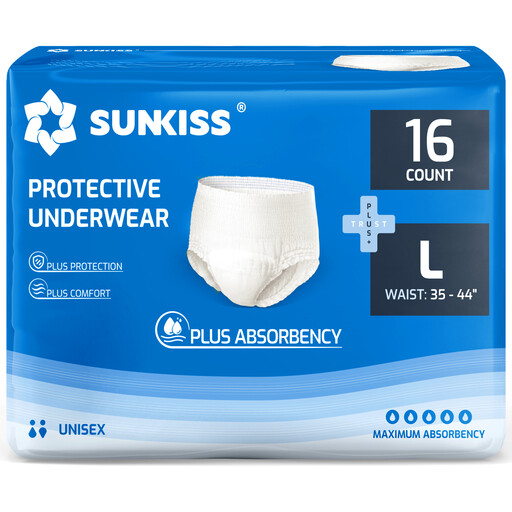
Why it suits this profile: A unisex model in a pack of 16 is a practical way to try the fit and absorbency before choosing a larger pack.
The product description mentions an absorbent core, anti-leak side barriers and flexible leg openings. Be sure to check the size guide before ordering.
According to the product information: breathable fabric, an elasticated waistband, odour control and a single-use design.
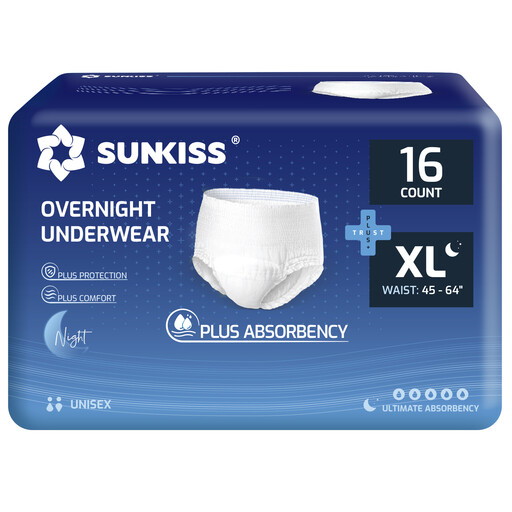
Why it suits this profile: Designed for people who want to use one flexible model during the day and overnight, and value extra coverage.
The description mentions an extra-wide core, inner leg cuffs and a back that’s less likely to sag. These features can be useful when turning in bed.
According to the product information: a dual-core system, superabsorbent polymer, odour control and latex-, lotion- and perfume-free fabric.
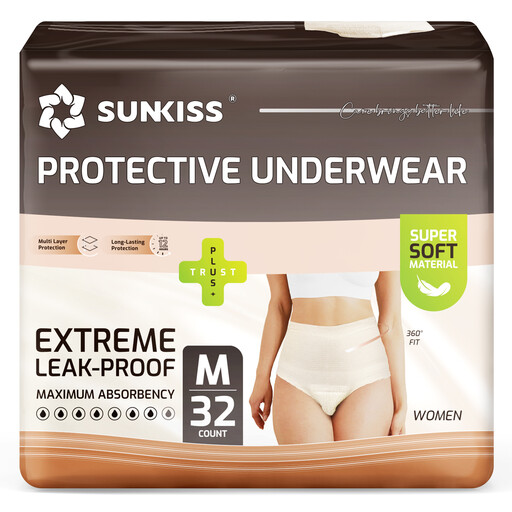
Why it suits this profile: According to the product description, this model is designed for women and may be suitable for everyday use or postpartum fluid loss.
The description mentions 360-degree coverage, a close-fitting waistband and an absorbent core. Compare your hip measurement with the size guide for a secure fit.
According to the product information: lightweight, breathable materials, an odour control system and a pack of 32.
Put the pants on as you would normal underwear and pull them up evenly. Check that the leg cuffs sit flat without folding over. Change the product as soon as it becomes saturated, leaks or feels uncomfortable. The stated wear time on the packaging is a manufacturer’s product claim, not a fixed guarantee for every wearer.
These products are for single use. Do not wash or reuse them, and do not flush them down the toilet. Dispose of used incontinence underwear according to your local waste disposal rules.
We’ve put together a complete, up-to-date list of products that meet these strict selection criteria and the applicable European safety requirements.
Measure your waist and hips at their widest points, then compare both measurements with the size guide for the model you’ve chosen. If you’re unsure, a size that fits well around the legs and waist is usually more practical than simply choosing a larger size.
Change it when it’s saturated, starts to leak or feels damp and uncomfortable. How often you need to change it varies depending on the person, their activity and the amount of fluid. A product in a larger pack may seem better value, but a good fit helps prevent waste caused by leaks or choosing the wrong size.
It can be, if the product description specifies overnight use, a wide absorbent core and leak barriers. Also check the size, rear coverage and fit when lying down and moving. If leaks continue, it’s worth trying a different model or size.
