
Student with limited kitchen space
You want to wash your mugs in a machine, but first need to check whether there’s room on the worktop or floor.


Start by checking the space available, the water supply and drainage, and how many mugs and other dishes you usually want to wash at once. A countertop model takes up worktop space. A model with a reservoir can operate without a fixed water supply, but still needs drainage. Larger freestanding models need floor space and suitable connections. If you usually only have a few mugs to wash, Milieu Centraal suggests washing them by hand using a small amount of hot water as an alternative.
You want to wash your mugs in a machine, but first need to check whether there’s room on the worktop or floor.
You’re looking for a suitable way to add water, and also need to arrange appropriate drainage and a safe set-up.
You want to wash mugs along with other dishes. So look at the usable rack space, not just the number of place settings.
A good fit if: you have worktop space and suitable water-supply and drainage connections, but would rather not have an appliance on the floor.
Keep in mind: a countertop model takes up worktop space. Check that your mugs fit securely in the rack.
A good fit if: there’s no fixed water supply and you can arrange drainage in line with the model’s instructions. Klarstein states that the Melville 3 has a built-in reservoir.
Keep in mind: you’ll need to fill the reservoir by hand, and drainage is still required. Also check the space available for the appliance and its rack.
A good fit if: your housemates also want to wash plates and cutlery, and you have floor space and suitable connections.
Keep in mind: this type needs floor space. Extra capacity is only useful if you can load the machine appropriately.
A good fit if: several people regularly build up a larger load of dishes to wash together, and there’s enough room and the right connections.
Keep in mind: a standard-size model won’t automatically fit in a small kitchen. Check the external dimensions and compare label figures on a like-for-like basis.
A good fit if: you usually only wash a few mugs and don’t build up a suitable load for a machine.
Keep in mind: it takes manual effort. Milieu Centraal says washing up by hand is usually better for the environment if you use a small amount of hot water, use a washing-up bowl and turn off the hot tap.
| What to consider | What should you look for? | Who should weigh this up most carefully? |
|---|---|---|
| Space and appliance type | Measure the space and room needed to open the door. Also check the dimensions of the rack and your mugs. | If I have limited kitchen space, I want to know whether the appliance will fit without making my worktop or walkways unusable. Around 29% of consumers prioritise available space. |
| Water supply and drainage | Check how the appliance is supplied with water, how it drains and the installation instructions for the exact model. | If there’s no fixed water supply, I want to know in advance whether filling and draining the appliance will work in my space. For around 29% of consumers, the connections are their main concern. |
| Usable rack space | Compare the rack layout with your mugs and the other dishes you want to wash at the same time. | If my housemates want to wash their dishes together, I want to know whether mugs and plates will fit in one load. Around 24% of consumers put this first. |
| Consumption per load | Compare kWh per 100 eco cycles and litres per eco cycle with the capacity and expected load size. | If you mostly wash a few mugs, you’ll want to know how consumption compares with the dishes you’ll actually be washing. Around 12% of consumers say consumption relative to the load is their main consideration. |
| Noise and controls | Check the stated noise level and whether the programmes and controls suit shared use. | If the machine is close to where I live or study, I want to take noise and controls into account. For around 6% of consumers, quiet operation or ease of everyday use is the deciding factor. |
A place setting includes different types of dishes, so it doesn’t tell you how many of your mugs will fit securely in the rack.
Check the height and shape of your mugs, the cup holders and the space left for the rest of the dishes.
Adding water by hand replaces the fixed water supply, not the need to drain wastewater.
Before buying, check the manual and make sure drainage can be arranged at the intended location in line with the instructions.
Capacity and consumption per eco cycle measure different things. A smaller machine may need to run more often to wash the same amount of dishes.
Compare the label figures with the amount of dishes you can actually wash each time. If you only have a few mugs, you could also consider washing them by hand with a small amount of hot water.
The VVW5520 is a compact model with 6 place settings; the slimline VVW4530AW is rated for 10 place settings. These models offer a useful basis for comparing worktop and floor-standing set-ups.
The TDW5501W is a freestanding countertop model with fixed water-supply and drainage connections, designed for smaller kitchens where these connections are available.
According to Klarstein, the Melville 3 is a mini dishwasher with a built-in reservoir for situations where there’s no fixed water supply.
The BDFS26046XQ is a slimline freestanding model for those who want to wash a larger shared load than would fit in a countertop model.
The MDWEF1433GW-W is a standard-size freestanding model for larger shared loads, provided you have enough space for it.
The Joybuy products below include countertop dishwashers with a water tank and freestanding models for larger loads. Check the connections, drainage and rack for each model.
 No image available
A compact option if you want to machine-wash dishes without a fixed water supply. The product information states that it has a 5-litre tank, space for 4 place settings and a drain hose that empties into a sink or container. Place settings don’t guarantee a particular number of mugs.
The product name mentions 5+1 wash cycles and a double-tempered glass door.
 No image available
A countertop model for a small kitchen, which can use its tank or connect to a tap, according to the product information. The stated capacity is up to 4 place settings, not a guaranteed number of mugs.
The product name mentions a built-in 5-litre tank, 9 programmes and a D energy rating. The description says an adapter may be needed to connect it to a tap.
 No image available
A compact option with both a built-in tank and a direct tap connection, according to the product information. Its stated capacity of 3 place settings doesn’t guarantee how many mugs will fit in the rack.
The product name mentions 7 programmes, a noise level of 56,3 dB and a C energy rating.
 No image available
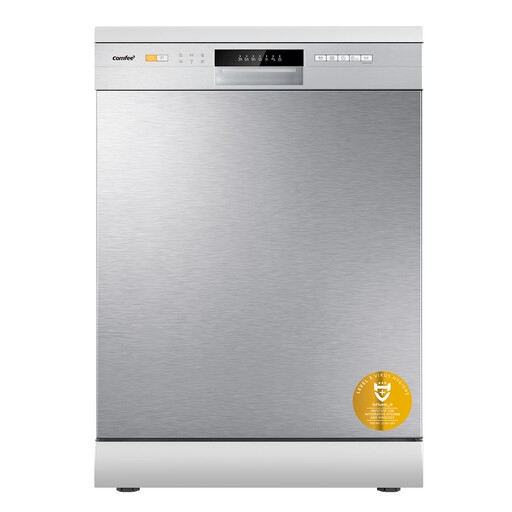
A freestanding model for a shared load; the product information also mentions a half-load function. Its stated capacity of 12 place settings doesn’t mean it can hold 12 mugs.
The product name mentions a noise level of 49 dB, flexible racks and an E energy rating.
 No image available
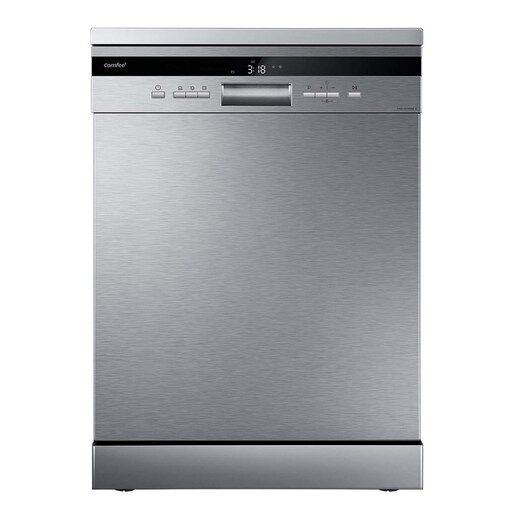
A full-size freestanding model for those who want to wash mugs with a larger shared load. Its stated capacity of 14 place settings doesn’t guarantee a particular number of mugs. Also check whether the width of 598 mm will fit in the available space.
The product name mentions a D energy rating, 44 dB and a half-load function.
No. A place setting doesn’t count mugs on their own. Inventum describes a place setting as the tableware for one person for one meal, including a cup. Check the rack against the dimensions of your mugs and the other dishes you want to wash.
No. A reservoir replaces the fixed water supply, not the need to drain wastewater. Check the manual for the exact model and make sure the intended drainage point is suitable.
Milieu Centraal generally advises against pre-rinsing. Do remove any debris that could block the filter, and choose a programme that suits the load.
According to the European Commission, since 1 March 2021 the EU energy label for household dishwashers has used a scale from A to G. The label includes information such as energy consumption per 100 eco cycles, water consumption per eco cycle, capacity and noise. Compare models on a like-for-like basis.
No. Two years isn’t the fixed statutory warranty period for every product in the Netherlands. According to the Dutch government, what you can expect from a product depends on the product and the circumstances. If a product is faulty, contact the seller. A manufacturer’s warranty or an extended warranty you’ve bought doesn’t replace your statutory rights.