Who is a dishwasher for small loads suitable for?

Small household with daily washing-up

You want to wash dinner plates and other dishes in a machine regularly, but don’t always have enough to fill a large one. Milieu Centraal and the Consumers’ Association stress that your typical load is an important factor when choosing.

Cook with limited kitchen space

You have little room on the worktop or for an appliance, so you need to consider its dimensions, space for plates and the connections it requires. Measure your plates before choosing a model, as Inventum advises.

Energy-conscious dishwasher user

You can save up your dishes and want to match the size and eco programme to how you actually use the appliance. Milieu Centraal and the Consumers’ Association point out that a machine is only suitable if you can fill it sufficiently.

What should you look for when washing small loads?

Slimline dishwasher, around 45 cm wide

Choose this if: you can collect cutlery and other dishes alongside your dinner plates, and have room for a taller machine. The Consumers’ Association lists slimline models with around 8 to 10 place settings as an option.

Trade-off: the machine takes up more space than a countertop model. Half-load functionality varies by model and doesn’t necessarily mean it uses the same amount of energy as a full eco cycle.

Compact countertop model

Choose this if: there’s no room for a full-height machine but you still want to wash your plates in a dishwasher. Measure your plates and check the space and connections needed for the exact model.

Trade-off: a compact model has less capacity. Milieu Centraal advises against mini dishwashers because of their relatively high consumption and often poorer test results.

Standard-size model, around 60 cm wide

Choose this if: you can save up enough dishes to usually run the machine full. Milieu Centraal and the Consumers’ Association cite a full-size standard model as an energy-efficient option when fully loaded.

Trade-off: if you only have small loads of dinner plates, you may not usually make full use of its capacity.

Wash a few plates by hand

Choose this if: machine washing isn’t essential and you usually only have a few plates to wash.

Trade-off: according to Milieu Centraal, washing up in a bowl with a small amount of hot water can use less energy and water. This doesn’t necessarily apply if you leave the hot tap running.

What to consider What should you check? Who is this most relevant to?
Room for dinner plates Measure the plate diameter and check the basket layout. Make sure the plates fit without blocking the spray arms. I want my own plates to fit without having to fill a larger machine than necessary. Around 36% of consumers prioritise space for a small load.
Space and connections Measure the space available and follow the chosen model’s installation instructions for water, drainage and electricity. If my kitchen has limited space, I first need to know which design and connections are possible at home. Around 29% of consumers prioritise the space available and connections.
Energy and water consumption Compare kWh per 100 eco cycles and litres per eco cycle. Also consider the capacity and how often you can run a full load. I want to weigh consumption against the amount of washing-up I actually save up. Around 21% of consumers prioritise consumption alongside a suitable load size.
Programmes and ease of use Check the eco programme duration and noise level in dB, and see which drying function the exact model has. If I need my dishes quickly or my kitchen opens onto the living area, programmes, noise and drying all matter. Around 14% of consumers prioritise these practical features.

Common pitfalls when choosing a small dishwasher

  • Assuming a countertop model is automatically the most economical choice

    A smaller appliance isn’t automatically more economical. Milieu Centraal points to the relatively high consumption of mini dishwashers; the Consumers’ Association and Milieu Centraal also highlight the importance of a full load.

    Choose a size that suits both the space available and the amount of washing-up you can actually collect. Then compare the stated figures for the eco programme.

  • Assuming place settings guarantee room for your dinner plates

    The number of place settings doesn’t tell you whether your own plates will fit in the basket. Plate diameter and the basket layout also make a difference.

    Measure your plates and check the plate dimensions and basket layout for the exact model.

  • Assuming the energy label shows consumption for every small wash

    The figures on the label apply to the eco programme. The Consumers’ Association explains that the label information is based on a maximum load, so a partial load or a different programme won’t necessarily use the same amount of energy.

    Use the label figures to compare eco programmes, and check the manual for information on other programmes and usage scenarios.

Brands to consider as a guide

Inventum

The freestanding VVW5520 is a compact model with 6 place settings, designed for situations where a full-height dishwasher won’t fit.

  • Inventum lists energy class D, an eco programme and automatic door opening for the VVW5520.
  • According to Inventum, this model doesn’t have a half-load option.

ETNA

The freestanding VWV147SWIT is a slimline model for spaces around 45 cm wide.

  • ETNA lists 9 place settings, an adjustable upper basket and a half-load function.
  • Its stated energy class is E. A half-load function alone doesn’t prove that it saves energy with small loads.

Beko

The freestanding BDFS26046XQ is a slimline model with 10 place settings, giving you room for dishes alongside dinner plates.

  • Beko lists energy class C, a noise level of 44 dBA and an automatically opening door for this model.
  • These specifications don’t show how well the machine washes a single small load of plates.

Bosch

The freestanding compact SKS2ITW00E is a countertop model with 6 place settings, for spaces where a full-height machine won’t fit.

  • Bosch lists energy class E, 55 kWh per 100 eco cycles, 8,0 litres per eco cycle and 49 dB(A) for this model.
  • The eco figures don’t prove that a partial load is just as economical.

Joybuy products for small dishwasher loads

These product picks are compact countertop models for anyone who wants to machine-wash a small load of dishes.

AIRMSEN countertop dishwasher for 4 place settings

AIRMSEN countertop dishwasher, 4 place settings

A compact option if you want to machine-wash small amounts of washing-up.

The product information lists capacity for 4 place settings, a built-in 5 l water tank and a mains water connection as an alternative. Use the appliance indoors on a flat, stable surface and follow the installation and earthing instructions.

View at Joybuy

AIRMSEN countertop dishwasher, 37 × 50 cm, for up to 4 place settings

AIRMSEN countertop dishwasher, 37 × 50 cm, 4 place settings

Worth considering if you’re looking for a compact machine for a small load.

The product information lists a capacity of up to 4 place settings, a 5 l tank and two water supply options: the tank or a tap connection. The stated dimensions are 37 × 50 cm. Follow the instructions for a stable surface and electrical connection when positioning the appliance.

View at Joybuy
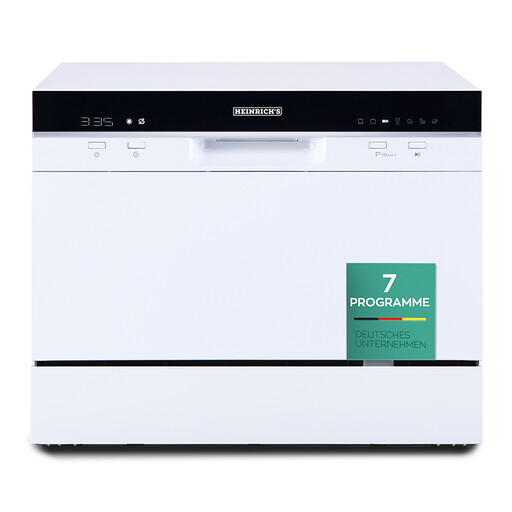
Heinrich's HTG 8840 Weiss countertop dishwasher

Heinrich's HTG 8840 Weiss

A countertop model to consider if you’re looking for a compact machine with room for up to 6 place settings.

The product information lists 49 kWh per 100 washes, 6,5 l per wash and energy class D. The product title states a noise level of 47 dB.

View at Joybuy

Heinrich's HTG 8855 countertop dishwasher for 3 place settings

Heinrich's HTG 8855, 3 place settings

A small capacity could be a good fit if you only want to wash a few dishes at a time.

The product title lists 3 place settings, energy class C and 56,3 dB. The product information mentions a 5 l tank or a direct tap connection.

View at Joybuy
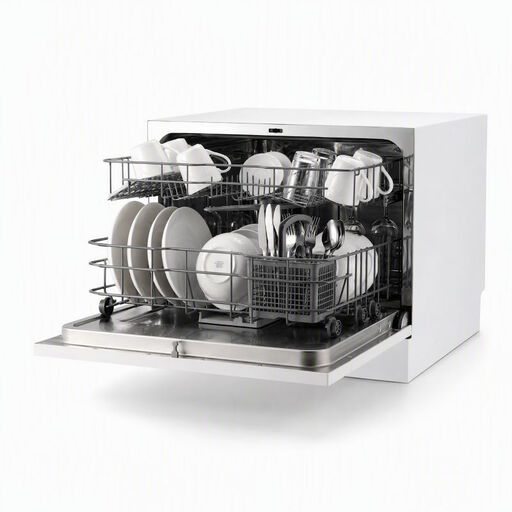
ochama countertop dishwasher for 6 standard place settings

ochama countertop dishwasher, 6 standard place settings

An option to compare if you’re looking for a compact countertop model with room for up to 6 standard place settings.

The product title lists a 30-minute quick programme and a 24-hour delay start.

View at Joybuy

Frequently asked questions

Does a new dishwasher in the Netherlands need an energy label?

New dishwashers covered by EU energy labelling rules must have an energy label. Among other things, the label shows consumption in kWh per 100 eco cycles, water consumption, the number of place settings, eco programme duration and noise level. According to the European Union, these labelling rules don’t apply to second-hand products.

Can I install a countertop model without checking anything first?

No. First check the space available and the installation instructions for the exact model. For example, the Inventum VVW5520 manual says to disconnect the appliance from the mains during installation; this instruction applies to that model.

Should I rinse dinner plates before loading them?

According to Milieu Centraal, pre-rinsing is generally unnecessary. Remove food scraps before loading the dishwasher, though, to prevent the filter from getting blocked.

Who can help if the dishwasher develops a fault after purchase?

According to the Dutch government, the seller must offer a solution if the product doesn’t meet what you were entitled to expect. The Netherlands has no fixed statutory guarantee period; what you can expect depends, among other things, on the product and the information you received when buying it.

Do I have a cooling-off period when I buy online?

According to the Dutch government, online purchases from a business usually come with a 14-day cooling-off period. Check the terms of your particular purchase; online purchases from a private individual aren’t covered by distance-selling rules in the same way.
