
Cook with limited worktop space
You want to machine-wash your plates after a meal, but have to choose between worktop space and a spot on the floor.


Start by measuring the space you have, then measure your largest dinner plate: the number of place settings doesn’t tell you whether it will fit in the rack. A countertop model takes up worktop space, while a slimline freestanding dishwasher needs floor space and can usually hold more dishes. Milieu Centraal generally advises against compact mini dishwashers because of their energy and water use, test results and ease of use. However, a lack of space may still make one worth considering.
You want to machine-wash your plates after a meal, but have to choose between worktop space and a spot on the floor.
You want to know whether your plates and any pans will fit in the rack, not just how many place settings the appliance can hold.
You want to check in advance what water supply and drainage options are available where you plan to put the dishwasher.
First, measure the available space and your largest dinner plate. Then check whether installation is possible and compare energy and water use and noise levels based on how you plan to use the machine.
| What to consider | What should you check? | Who is this important for? |
|---|---|---|
| Placement | Measure the width, height and depth of the space, and allow for the room needed when the door is open. | If space is tight, I want to know whether a countertop model will fit on the worktop or a slimline model on the floor; placement is the top priority for around 33% of consumers. |
| Plate and loading space | Measure your largest dinner plate and check the maximum plate diameter and rack layout for the exact model. | I want to fit my plates and the rest of the meal’s dishes in one load; plate and loading space is the top priority for around 27% of consumers. |
| Connections | Check the manual for the exact model to see how it takes in water and where and how the wastewater is drained. | If there isn’t a standard water connection where I want to put the appliance, I want to know what water supply and drainage it needs; connections are the top priority for around 20% of consumers. |
| Energy and water use, and noise | Compare kWh per 100 eco cycles, water use per eco cycle, capacity and the stated noise level. | I want to weigh energy and water use and noise against how many dishes I can actually fit in at once; these factors matter most to around 20% of consumers. |
Place settings give you an idea of the standard load, but not the maximum plate diameter. So your dinner plate might still not fit in the rack.
Measure your largest plate and check the maximum plate size and rack layout for the exact model before ordering.
Milieu Centraal generally advises against compact mini dishwashers based on their energy and water use, test results and ease of use. A small size alone doesn’t tell you enough about how much energy and water the appliance uses for each load.
Compare the figures on the energy label and think about how often you can run the model with a full load. Weigh this against the space you actually have available.
A different way of supplying water doesn’t automatically mean the wastewater can be drained wherever you put the appliance.
Check the manual for the exact model for both the water supply and drainage, and follow the installation instructions.
The VVW5520 is a countertop model, while the VVW4530AW is a slimline freestanding model. Which type is right for you depends on the worktop or floor space available.
The BDFS26046XQ is a slimline freestanding dishwasher for anyone with floor space for an appliance who wants to wash several place settings at once.
The SPS4HKW49E is a 45 cm slimline freestanding dishwasher, designed for a space with enough floor room.
The Aquatica is a small countertop model with a tap connection, for spaces where a larger appliance won’t fit.
The VW47SM is a fully integrated slimline model for a kitchen with a suitable cabinet space and a furniture door panel.
This selection focuses on dishwashers for small kitchens: mainly countertop models with water tanks, plus a slimline freestanding model for anyone with floor space.
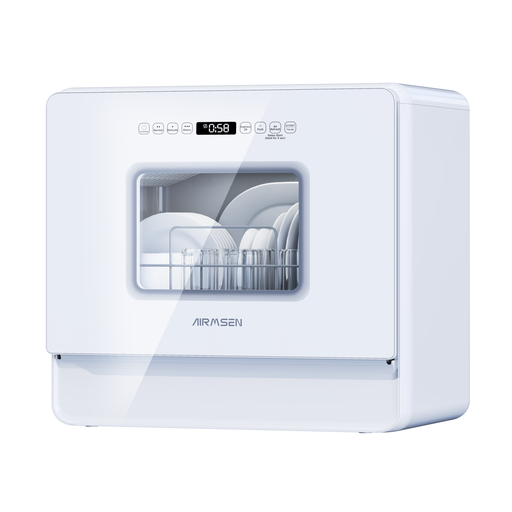 No image available
A countertop model for anyone short on floor space but with room to spare on the worktop.
The description lists a capacity of up to 4 place settings and a 5 L water tank. The title lists 9 wash programmes and dimensions of 37 × 50 cm.
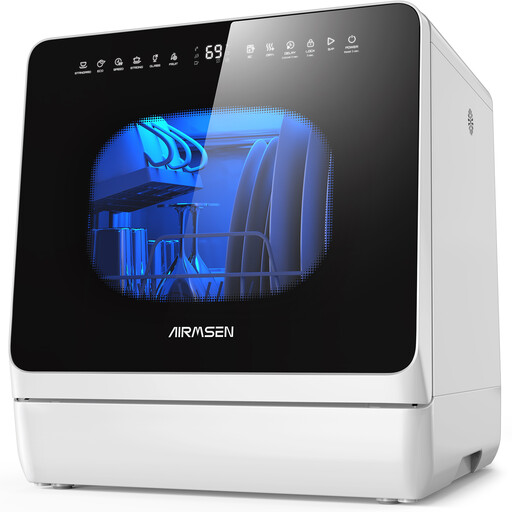 No image available
A small countertop model to compare if you have limited floor space.
The title lists a capacity of 3 place settings. The product description mentions a 5 L water tank and a tap water connection; check the drainage and installation instructions too.
 No image available
A countertop model with a water tank for a kitchen where a larger dishwasher won’t fit.
The title lists a 5 L tank, 9 programmes, dimensions of 37 × 50 cm and energy class D. According to the description, it can fit plates up to 300 mm when the upper basket is removed.
 No image available
A countertop model to consider if you’re looking for a small dishwasher and its stated plate size suits your crockery.
The product description lists plates up to 26 cm, a 5 L water tank and a direct tap connection. Check the capacity of the exact version and the drainage requirements.
 No image available
A slimline freestanding model to compare if you have floor space available.
Bosch lists dimensions of 845 × 450 × 600 mm, energy class E and a noise level of 44 dB for the SPS4HKW49E. Bosch Netherlands marks this model as no longer available; check that the model code and version on offer match.
You can’t tell from the number of place settings alone. Measure your largest plate and check the maximum plate diameter and rack layout for the exact model; Inventum also recommends measuring your plates in advance.
It depends on the model: check whether the appliance can use a reservoir or needs a tap connection. In either case, check the drainage too and follow the installation instructions for the exact version.
Milieu Centraal recommends loading the dishwasher properly and choosing the eco programme. Remove food scraps, but generally don’t rinse dishes in hot water beforehand; follow the manual for cleaning the filters and using salt and rinse aid.
If the dishwasher doesn’t meet what you could reasonably expect under normal use, the retailer is responsible for providing an appropriate solution under the statutory guarantee. According to the Dutch government, the Netherlands has no fixed statutory guarantee period; a manufacturer’s guarantee does not replace your statutory rights.