
Cook with large dinner plates
Most interested in knowing whether their plates will fit in the rack. Measure the diameter before comparing compact models.


First, measure your largest dinner plate and the space available for the appliance: the number of place settings doesn’t guarantee that your plates will fit. A countertop model needs worktop space and suitable connections; a model with a water tank may avoid the need for a mains water supply, but it still needs a drain. A slimline machine needs floor space or a suitable built-in space. Also compare consumption per eco cycle with the amount of washing-up you can actually fit in each load.
Most interested in knowing whether their plates will fit in the rack. Measure the diameter before comparing compact models.
Weighs up a countertop model on the worktop against a slimline machine that needs floor or built-in space.
Looking for a solution for the water supply and drainage, while also checking that the plates will fit and the appliance can be installed safely.
First, measure your plates and the space available. Then check the connections, the usable capacity for your evening washing-up and consumption per load.
| Point to consider | What should you check? | Which consumers? |
|---|---|---|
| Fit for dinner plates | Measure the diameter of your largest plate and check the maximum plate size and rack layout for the exact model. | If I want to wash large dinner plates, I need to know whether they’ll fit in the rack. Around 29% of consumers prioritise plate fit above all else. |
| Space for the machine | Measure the width, height and depth of the intended space, and check the installation instructions. | With limited worktop space, I don’t want to give up an area I need for cooking. Around 23% of consumers make placement their top priority. |
| Capacity for your evening washing-up | Compare your own washing-up with the rack layout; the number of place settings doesn’t guarantee that specific plates or pans will fit. | If I want to wash plates, glasses and cutlery together, I need to see how much will actually fit in the machine at once. Around 18% of consumers prioritise fitting one useful evening load. |
| Water supply, drainage and connections | Check the water supply, drain hose, power supply and installation instructions for each model. | If there’s no fixed water supply, I need to know whether both the water supply and drainage can be managed where I plan to put the machine. Around 18% of consumers make connection options their top consideration. |
| Consumption per usable load | Compare kWh per 100 eco cycles and litres per eco cycle with the amount of washing-up you can fit in each cycle. | If I want to weigh up consumption for the amount of washing-up I have, I need to look beyond the consumption for a single cycle. Around 12% of consumers make consumption their top priority. |
Place settings give you an indication of capacity, but they don’t tell you whether your dinner plates will fit in the rack.
Measure your largest plate and check the maximum plate size for the exact model. Tomado lists a maximum plate diameter of Ø 25 cm for the TDW5501W; Klarstein gives 26 cm for the Melville.
If your plates don’t fit, you may have to wash some of the dishes by hand.
A tank can replace a mains water supply, but it doesn’t automatically solve the drainage issue. Klarstein also lists a drain hose for the Melville.
Check the water supply, drainage and installation instructions separately before choosing a location.
You’ll also need a suitable solution for the drain hose at your chosen location.
Lower consumption per cycle doesn’t necessarily mean lower consumption for a full evening’s washing-up if you need to run more cycles.
Compare the energy label figures with the amount of washing-up you can actually fit in each load. Milieu Centraal recommends running a full machine on the eco programme and advises against a compact mini dishwasher if a larger, suitable alternative is available.
Running several cycles to wash the same amount of dishes means using the appliance more often.
Installation requirements can vary by model. For the Tomado TDW5501W, the manual specifies, among other things, a firm, level surface and prohibits using an extension lead or multi-socket adaptor.
Before buying, check the manual for the exact model and make sure the intended location meets its requirements.
You may need to adjust the location or connections to meet the installation requirements.
The TDW5501W is a countertop model for a kitchen space with a fixed water supply and drain.
The Melville is a compact countertop option with a water tank, for kitchens without a fixed water supply to the appliance.
The freestanding SPS4HKW49E is a slimline machine for a space with suitable floor or built-in capacity.
The VVW5520 is a countertop model for anyone looking for a stated capacity of 6 place settings.
The freestanding BDFS26046XQ is a slimline machine for anyone looking for a higher stated capacity than the countertop models reviewed.
This selection includes countertop models with a water tank or fixed water supply, as well as slimline freestanding dishwashers. Check the plate size and available connections for the exact model.
 No image available
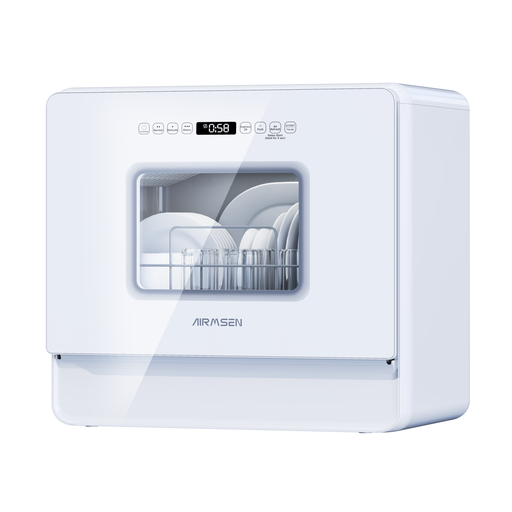
An option to consider if you’re looking for a compact machine with a built-in water tank.
Built-in 5-litre water tank; two-tier rack. The stated plate size of up to 300 mm applies when the upper rack is removed.
 No image available
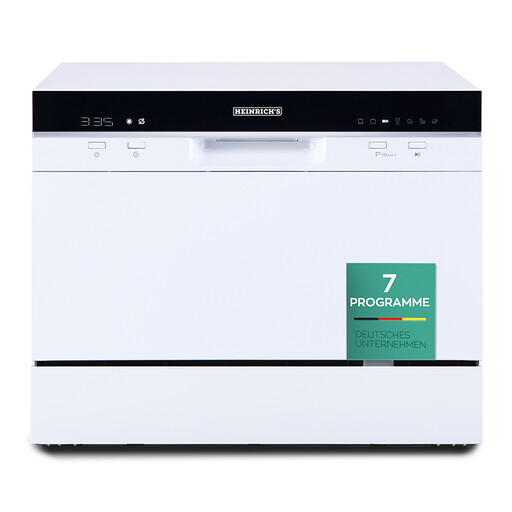
A countertop model to consider if you’re looking for a compact machine with a stated capacity of 6 place settings.
The product name lists 7 programmes, energy class D and 47 dB.
 No image available
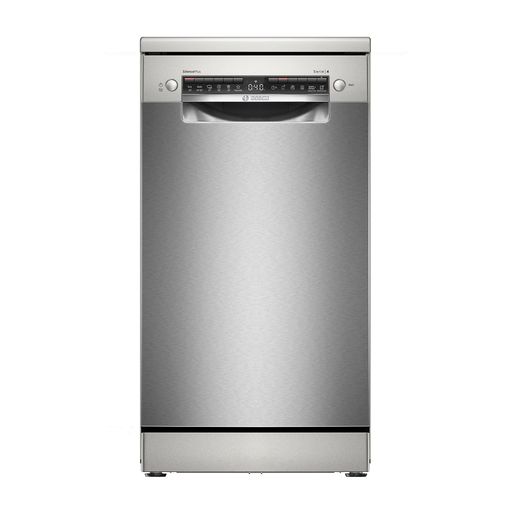
A slimline freestanding option if you have a suitable space at floor level and want to wash more dishes per load.
The product name lists a width of 45 cm and a capacity of 13 place settings. Check that your own plates fit in the racks.
 No image available
A countertop model to consider if a built-in water tank suits the water supply available to you.
The product name lists a built-in 5-litre tank, 6+3 programmes and energy class D. The maximum plate diameter is 25 cm.
 No image available
A slimline freestanding machine to consider if you have floor space and want to wash a larger load than you could fit in a small countertop model.
The product name lists a width of 45 cm. Bosch Netherlands lists 10 place settings, 44 dB(A), 76 kWh per 100 eco cycles and 8,9 litres per eco cycle for this model; you’ll need to check the plate size separately.
Measure the diameter of your largest dinner plate and compare it with the maximum plate size for the exact model. Also check that there’s enough room left for the rest of your washing-up. Tomado lists Ø 25 cm for the TDW5501W; Klarstein gives 26 cm for the Melville.
A water tank replaces the water supply, not necessarily the drain. Klarstein also lists a drain hose for the Melville; follow the installation and drainage instructions for the machine you choose.
Milieu Centraal recommends filling the machine properly, using the eco programme and removing food scraps instead of pre-rinsing with warm water as standard. Follow the manual for cleaning the filter and any other model-specific maintenance.
The EU energy label includes information such as electricity consumption per 100 eco cycles, water consumption per eco cycle, capacity and noise level. Your own usage also depends on how often you run the machine and how much washing-up you can fit in each cycle; running extra cycles can change the comparison.
According to the Dutch government, a product must be fit for purpose, but the Netherlands doesn’t have a fixed statutory warranty period. If a product doesn’t meet reasonable expectations, contact the seller to find a solution. A manufacturer’s warranty or any additional warranty you buy comes on top of your statutory rights.