Start by considering a slimline freestanding model or a slimline built-in dishwasher if you have floor space or a suitable cabinet niche. This keeps your worktop clear and generally offers more room for dishes than a countertop model. Choose a countertop model mainly if a floor-standing or built-in model won’t fit and you can spare the worktop space. If a full-size model would also fit, compare it with smaller options based on how much washing-up you usually accumulate and the eco figures.
Which size is right for you?
Small kitchen, everyday washing-up
Want to keep plates, glasses and cutlery out of the way regularly without giving up much floor or cupboard space? Compare a slimline freestanding model with a slimline built-in dishwasher, and check the space available and the basket layout.
No floor space available
If there’s no suitable floor space or built-in niche, a countertop model could be an option if you have a stable spot on your worktop. Bear in mind that it has less capacity and takes up worktop space you can’t use for other things.
Weigh up space and energy use
Can you fit different sizes? Think about how much washing-up you usually accumulate and compare the eco figures. The Consumentenbond notes that a full-size dishwasher can be energy-efficient when you fill it properly; if you usually can’t, a smaller model may suit you better.
What should you consider when choosing?
Slimline freestanding dishwasher
Suitable for: a floor space around 45 cm wide, without a suitable built-in niche.
Bear in mind: the full depth, door clearance, connections and space for the basket.
Slimline built-in dishwasher
Suitable for: a suitable slimline niche and a kitchen door panel that works with the chosen hinge system.
Bear in mind: all niche dimensions, the door panel and door fixing; measuring the width alone isn’t enough.
Compact countertop model
Suitable for: situations where a floor-standing or built-in model won’t fit, but there’s worktop space available.
Bear in mind: less capacity and lost worktop space. Milieu Centraal advises against mini dishwashers because of their relatively high energy use and limited ease of use.
Full-size dishwasher
Suitable for: a kitchen with room for a larger model, which you can usually fill properly.
Bear in mind: the extra space it needs; compare its size with the amount of washing-up you usually have.
Milieu Centraal and the Consumentenbond highlight that the right option for you depends on both the size of the dishwasher and how you load it. Then make your choice based on the space available, your everyday washing-up and the energy label figures.
| What to consider |
What should you look for? |
Who should give this more weight? |
| A suitable space |
Measure the width, height and depth, as well as the space needed to open the door. For built-in models, check the niche and hinge system too. |
If I have limited floor or cupboard space, I want to avoid the appliance making a walkway, cupboard or worktop unusable. Around 36% of consumers prioritise where it will go. |
| Room for your everyday washing-up |
Compare the number of place settings and the basket layout; also measure the diameter of your largest plates. |
If I want to wash my usual dishes without large plates or pans making the layout awkward, I look beyond the number of place settings alone. Around 29% of consumers prioritise capacity for everyday washing-up. |
| Water and electricity use |
Compare capacity and figures for the eco cycle on a like-for-like basis, including kWh per 100 eco cycles and litres of water per eco cycle. |
If I mainly want to consider the energy and water used for the dishes I actually wash, I look at both the eco figures and how full I can get the machine. Around 21% of consumers prioritise running costs. |
| Noise in your living space |
Compare the stated noise level of models that suit you in terms of size and capacity; an energy label rating isn’t the same as listening to the machine in your own kitchen. |
If my kitchen is next to where I sit or work, I want to consider the stated noise level after checking that the model fits and has enough capacity. Around 14% of consumers give noise the greatest weight. |
Avoid common buying mistakes
-
Measuring only the appliance width
A model may fit width-wise but still get in the way of a door, cupboard or connection. For built-in models, the niche, kitchen door panel and hinge system matter too.
Measure the full space where the appliance will go, including door clearance. For built-in models, compare all the stated niche dimensions and check which hinge system the model uses.
-
Assuming place settings tell you how much washing-up will fit
The number of place settings doesn’t automatically tell you whether your large plates, bowls and pans will fit comfortably in the basket.
Check the basket and cutlery layout, and measure the diameter of the largest plates you use every day.
-
Assuming a mini dishwasher is automatically more energy-efficient
A smaller model isn’t necessarily more energy-efficient for the same amount of washing-up. How full you load it and which programme you use also make a difference. Milieu Centraal points out that mini dishwashers have relatively high energy use.
Compare capacity and eco figures, and think about how often you’re likely to fill each size properly.
Brands and models to compare
Beko
Worth comparing if you’re looking for a slimline freestanding model for everyday washing-up.
- Beko lists 10 place settings, energy class C, 8,9 litres per cycle and 44 dBA for the BDFS26046XQ.
- These are the manufacturer’s figures for this model, not an independent performance assessment. Check that your plates and pans fit in the basket, and measure the available space.
ETNA
A relevant option if you’re looking for a slimline built-in dishwasher to fit a suitable niche.
- ETNA says its fully integrated VW47SM is 45 cm wide, holds 9 place settings and has a door-on-door hinge.
- ETNA lists energy class E and a niche height of 820–880 mm for this model. Check the other niche dimensions too, and make sure the kitchen door panel will fit.
Inventum
Worth comparing if the only option is a compact freestanding countertop model.
- Inventum lists a width of 55 cm and space for 6 place settings for the VVW5520.
- Inventum says this model has energy class D and uses 6,5 litres per wash. It takes up worktop space and has less capacity; Milieu Centraal advises against mini dishwashers because of their relatively high energy use and limited ease of use.
Bosch
A brand to compare if you’re looking for a slimline freestanding dishwasher.
- Bosch lists a width of 450 mm, energy class D and 6,7 litres per eco cycle for the SPS4EMW61E.
- The stated appliance depth is 600 mm. The water figure is for the eco cycle and doesn’t show the consumption of every programme.
Joybuy products for small kitchens
This selection includes slimline freestanding dishwashers and compact countertop models. Compare the space they need and their stated capacity in particular.
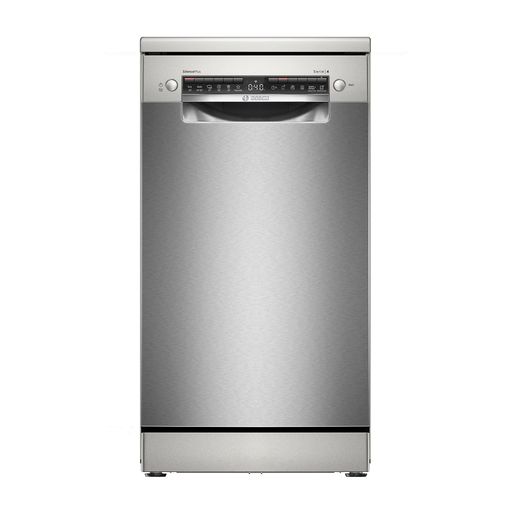 Image unavailable
Bosch SPS4EMI17E, 45 cm, 13 place settings
Worth comparing if you’re looking for a slimline freestanding dishwasher and have room for the stated appliance depth.
The Joybuy product listing gives energy class B, 8,7 litres per cycle, six programmes, an adjustable upper basket and VarioDrawer.
View at Joybuy
 Image unavailable
Bosch SPS4HKW49E Series 4, 45 cm, white
A slimline freestanding model to compare if you have floor space and a capacity of 10 place settings suits your washing-up.
The Joybuy product listing gives energy class B, 51 kWh per 100 cycles, 8,7 litres per cycle and six programmes. The stated depth is 60 cm.
View at Joybuy
 Image unavailable
AIRMSEN countertop dishwasher, 5+1 wash cycles
Worth comparing if you don’t have floor space for a dishwasher, but do have worktop space and a small daily load.
The Joybuy product listing gives a capacity of 4 place settings, dimensions of 45,8 × 42,8 × 42,5 cm and a built-in water tank. Its limited capacity and the worktop space it needs are important factors to consider.
View at Joybuy
 Image unavailable
AIRMSEN countertop dishwasher, 37 × 50 cm
A compact countertop model to compare if you have a suitable spot on your worktop and wash only a few place settings at a time.
The Joybuy product listing gives a capacity of up to 4 place settings, a 5-litre water tank, two water supply methods, nine programmes and energy class D. The model takes up worktop space.
View at Joybuy
 Image unavailable
Heinrich’s HTG 8855, 3 place settings
Worth comparing if a small load and a spot on your worktop suit the way you use a dishwasher.
The Joybuy product listing gives 3 place settings, seven programmes, 56,3 dB, energy class C and 4,2 litres of water per wash. According to the listing, water can be supplied from a tank or a tap connection; its limited capacity is still worth bearing in mind.
View at Joybuy
Frequently asked questions
Is a countertop model automatically the best choice if cupboard space is limited?
No. A countertop model can save floor or cabinet-niche space, but it takes up worktop space and has less capacity. First check whether a slimline floor-standing or built-in model will fit, and think about how much washing-up you usually accumulate.
What should I check before installing and connecting the dishwasher?
Measure the full appliance and installation space, including door clearance, and check where the water supply and drain can be connected. For built-in models, the niche dimensions, hinge and kitchen door panel must also suit the model you choose. Follow that model’s installation instructions when connecting it.
How can I keep energy and water use down when washing everyday dishes?
Milieu Centraal recommends filling the dishwasher properly, using the eco programme and wiping off food scraps rather than rinsing with hot water first. Compare the label figures on the same eco basis and bear in mind how much washing-up you actually do.
Am I automatically entitled to only a two-year guarantee in the Netherlands?
No. According to ACM ConsuWijzer, statutory consumer rights apply alongside any manufacturer’s or seller’s guarantee; how long you can reasonably expect a product to work properly depends on the circumstances. If a fault is covered by those rights, the seller is responsible for providing an appropriate solution free of charge.
Which energy label scale applies to household dishwashers?
According to the European Commission, household dishwashers have used a scale from A to G since 1 March 2021. The label includes energy use per 100 eco cycles, water use per eco cycle and capacity; compare models using the same label basis.


