
Small household with lots of mugs
You want to wash your everyday mugs along with other dishes. Look at the actual rack layout and the dimensions of your mugs, not just the number of place settings.


First, check that your own mugs fit upside down in the rack without obstructing the spray arm, then measure the space and check the connections. A tabletop model needs worktop space; a slim freestanding model around 45 cm wide needs floor space and room for the door to open. A standard-size model is mainly an option if you can usually fill it properly, as Milieu Centraal advises.
You want to wash your everyday mugs along with other dishes. Look at the actual rack layout and the dimensions of your mugs, not just the number of place settings.
Your choice depends on the worktop or floor space available, as well as the room needed to open the door.
You can save up your dishes and want to choose a size that will usually be well filled. Milieu Centraal links the energy-saving benefits of a standard-size model to this condition.
When: if you have a suitable spot on the worktop and can arrange the required water supply and drainage.
Trade-off: the appliance takes up worktop space; also check the clearance for your tallest mugs.
When: if you have floor space and room for the door to open, and want to wash other dishes as well as mugs regularly.
Trade-off: you’ll need floor space and suitable connections; if you have few dishes, you may need to wait until you have a full load.
When: if you have the space and can usually fill the machine properly.
Trade-off: if you mainly have a few mugs, you may need to save up your dishes before running a cycle.
| What to consider | What to look for when buying | Who is this important for? |
|---|---|---|
| Mug fit | Measure your tallest and widest mug; check the rack height and make sure the spray arm can rotate freely. | I want to be able to place my own mugs upside down without blocking the spray arm. Around 36% of consumers put mug fit first. |
| Kitchen space | Measure the width, height and depth, and allow for the door to open and the installation instructions to be followed. | I need to know whether there’s room on the worktop or floor, including when the door is open. Around 29% of consumers prioritise the space available. |
| Connections | Check the required water supply, drainage and electrical connection for the exact model. | I want to know before buying whether the machine can be connected where I plan to put it. Around 21% of consumers want to check connection requirements first. |
| Consumption per load | Compare kWh per 100 eco cycles and litres per eco cycle on the current label; also consider how often you have a full load. | I want to weigh up consumption against the amount of washing-up I can actually collect. Around 14% of consumers prioritise consumption per usable load. |
A place setting describes the standard dishes for one person at one meal; it doesn’t tell you how many large mugs will fit in a particular rack.
Measure your mugs and check the cup holders, clearance and space around the spray arm before choosing.
If your mugs don’t fit properly, you may need to run an extra cycle or wash them by hand.
Milieu Centraal generally advises against compact mini dishwashers because of their relatively high consumption and often disappointing results or ease of use in consumer tests. This is not a test finding about every individual model.
Compare the figures on the current energy label with the amount of washing-up you can actually collect; don’t choose based solely on the appliance’s external dimensions.
The installation will only work if the door can open and the necessary connections are within reach.
Check the manual and measure the space with the door open before you order.
The freestanding Inventum VVW5520 is a tabletop model, 55 cm wide, with space for six place settings.
The Tomado TDW5501W is a tabletop model with space for six place settings.
The Bosch SPS2HKW55E is a freestanding floor-standing model, 45 cm wide.
The Siemens SK25IB00TE is a compact freestanding dishwasher with space for six place settings.
These product picks focus on tabletop dishwashers for a small daily load of dishes and mugs. For the exact model, check the rack layout, required connections and whether your mugs will fit.
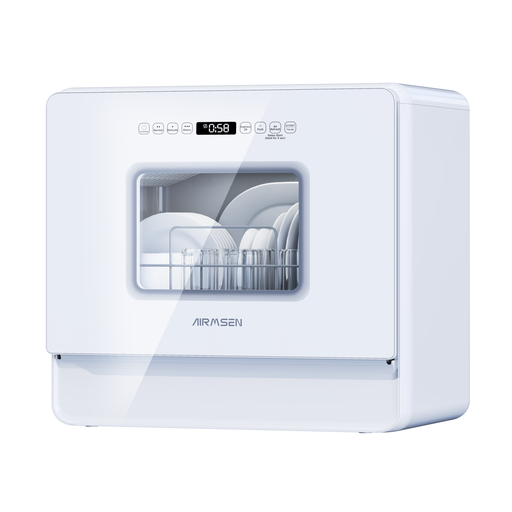 Image unavailable
An option to consider if you’re looking for a tabletop model; check that the rack suits your mugs.
The product information lists five place settings, a two-tier rack and a built-in 5 l water tank; a tap connection is also mentioned.
 Image unavailable
A tabletop model to consider if you’re looking for a compact dishwasher set-up with a water tank.
The product information lists four place settings, a built-in 5 l water tank and 5+1 wash cycles.
 Image unavailable
An option to consider if you’re looking for a tabletop model; measure the space available and check that your mugs will fit.
The product information lists four place settings, a 5 l water tank, nine programmes and an energy rating of D.
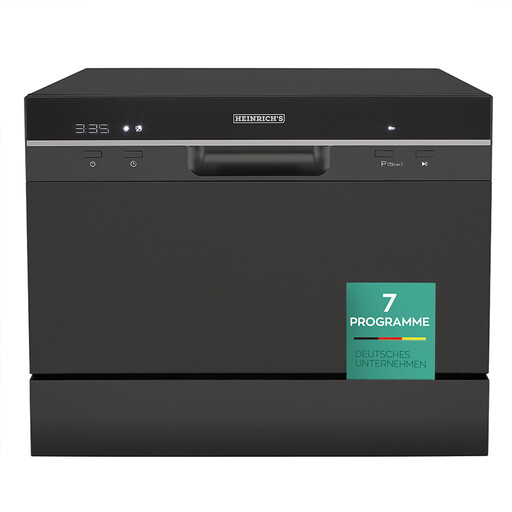 Image unavailable
A tabletop model to assess against the space you have and the dimensions of your mugs.
The product name lists six place settings, seven programmes, a digital display, 47 dB and an energy rating of D.
 Image unavailable
A tabletop model to consider if you want to wash a small amount of dishes; check that your mugs fit in the rack.
The product information lists three place settings, seven programmes, a 5 l water tank, 56.3 dB and an energy rating of C.
Place mugs upside down and check that they don’t obstruct the spray arm. Position items with a rim so that water doesn’t collect in them, and follow the care instructions for your dishes and appliance.
No. The number of place settings describes standard dishes for one person at one meal and doesn’t guarantee space for large mugs. Measure your mugs and check the rack height, cup holders and clearance around the spray arm.
According to Milieu Centraal, pre-rinsing is generally unnecessary; do remove any food scraps. Clean the filter regularly, following the instructions for use.
EU rules set out energy labels for household dishwashers. The current label runs from A to G and includes figures such as kWh per 100 eco cycles and litres per eco cycle. A+++ ratings belong to the labelling system used before 1 March 2021.
When you buy online from a business, you usually have a 14-day cooling-off period, according to the Dutch government. You’re also entitled to a product that works properly; if there’s a fault, contact the seller. The Netherlands does not have a fixed statutory two-year guarantee period for every product.