First measure the available width, height and depth, as well as the space needed to open the door. Then choose between a freestanding model around 45 cm wide, a slimline integrated dishwasher or a tabletop model. A slimline freestanding or integrated model will usually offer more room than a tabletop dishwasher. The latter can be a good solution if you don’t have suitable floor or cupboard space, but it will take up worktop space. Before you buy, check that your own mugs fit securely in the rack and that the spray arms can move freely: the number of place settings does not guarantee a set number of mugs.
Who is this guide for?
For buyers with limited floor space
You want to wash mugs alongside your everyday dishes, but don’t have room for a standard-width machine. The Consumers’ Association of the Netherlands (Consumentenbond) highlights dimensions and capacity as factors to consider when comparing dishwashers.
For buyers without spare floor space
You’re considering whether a tabletop model on the worktop would be more practical than a slimline freestanding or integrated model. Milieu Centraal covers compact worktop models, while the Consumentenbond also looks at slimline freestanding dishwashers.
For buyers with a narrow built-in space
You want a dishwasher behind a kitchen cabinet door and need to check the niche dimensions, door design and available space. For example, ETNA specifies a niche height of 820–880 mm for the VW47SM.
What should you look for when buying?
Start by checking the available space and how the dishwasher will be installed. Then check that your mugs fit and that the connections are suitable. Finally, compare energy and water use based on how you expect to use it.
Slimline freestanding dishwasher
Choose this if: you have around 45 cm of floor width, there’s enough height and space for the door to open, and the water and waste connections are accessible.
The trade-off: a slimline freestanding model may offer more room than a tabletop model, but it takes up floor space.
Slimline integrated dishwasher
Choose this if: you have a suitable narrow niche and want an integrated front.
The trade-off: the niche, cabinet door and hinge system must all be compatible with the exact model.
Compact tabletop dishwasher
Choose this if: a freestanding or integrated model won’t fit, but you have a suitable spot on the worktop and the right connections.
The trade-off: you save floor or cupboard space, but use up worktop space. Milieu Centraal advises against compact mini dishwashers when a larger model that fits is an option.
Wash mugs by hand
Choose this if: you only have a few mugs or don’t have a suitable place or connection for a machine.
The trade-off: washing up by hand takes effort. According to Milieu Centraal, it can generally be better for the environment if you use a washing-up bowl and little hot water, but not necessarily if you leave a hot tap running.
| What to consider |
What should you check? |
Who should consider this? |
| Will the appliance fit, and can the door open? |
Measure the space, walkway and door opening, then compare them with the dimensions and installation instructions for the exact model. |
I want to know whether the appliance will really fit in my narrow kitchen and whether I can open the door properly. Around 36% of consumers prioritise the space available. |
| Will my mugs fit in the rack? |
Compare the height, diameter and handles of your mugs with the rack layout. Also check that the spray arms can rotate freely. |
If I want to wash mugs with other dishes every day, I need to know that they’ll sit securely and won’t get in the way of the spray arms. Around 29% of consumers prioritise how their mugs fit in the rack. |
| Are the location and connections suitable? |
Check the water, waste, electrical and installation requirements for the exact model. For an integrated model, also check the niche height and hinge system. |
I want to know before installation whether water, waste and electricity are available where I plan to put the appliance. Around 21% of consumers prioritise a workable setup with suitable connections. |
| How does energy and water use fit with my needs? |
Compare electricity use per 100 eco cycles, water use per eco cycle, capacity and noise levels for the exact models. Consider how often you’ll be able to fill the machine. |
I want to weigh up eco-cycle consumption against how often I can fill the machine, rather than looking at size alone. Around 14% of consumers prioritise electricity and water use based on their own needs. |
Common buying mistakes
-
Choosing based only on ‘compact’ or ‘slimline’ in the product name
According to Inventum, the Inventum VVW5520 we looked at is 55 cm wide; Bosch lists the SPS4EMI17E model we looked at as 45 cm wide. So the word ‘compact’ alone doesn’t tell you whether a machine will fit in your kitchen.
Measure the external dimensions and check the installation type and the space needed to open the door for the exact model.
-
Assuming place settings equal mug capacity
A place setting is a standardised set of crockery and cutlery, not a fixed number of mugs. Wide mugs and handles can affect how the rack is arranged.
Compare your mugs’ dimensions with the rack and check that the spray arms can rotate freely.
-
Assuming a smaller machine will automatically use less energy and water
Milieu Centraal advises against compact mini dishwashers when a larger model that fits is an option. How often you can fill the machine also matters for your usage.
Compare the energy label information for specific models and consider how often you’re likely to run the dishwasher when it’s full.
-
Relying on a retailer’s listing for capacity without checking
The Joybuy product title for the Bosch SPS4EMI17E says it holds thirteen place settings, while Bosch’s specification sheet for this model lists a maximum of ten.
Ask for clarification about the conflicting information and use the official model details to assess capacity.
Brands to consider
Bosch
The freestanding 45 cm range includes an option for a narrow floor space. The SPS4EMI17E is one specific model to compare.
- Bosch lists adjustable racks, a B energy rating and external dimensions of 845 × 450 × 600 mm for the SPS4EMI17E.
- These are model-specific specifications. They don’t guarantee that every mug will fit or describe the entire Bosch range.
Beko
The BDFS26046XQ is a freestanding slimline model for anyone looking to fit everyday dishes into a limited width.
- Beko lists ten place settings, a C energy rating, 8,9 litres of water per cycle and 44 dBA for this model.
- The intensive zone is a manufacturer’s description; on its own, it doesn’t prove that mugs will be cleaned better.
ETNA
The VW47SM is an example of a fully integrated 45 cm model for a suitable narrow niche.
- ETNA lists nine place settings and a niche height of 820–880 mm for the VW47SM.
- The niche and installation space must be suitable; the number of place settings doesn’t tell you how many of your own mugs will fit.
Inventum
The VVW5520 is a compact freestanding tabletop model for anyone without suitable floor or cupboard space.
- Inventum lists a width of 55 cm, six place settings, a D energy rating and 47 dB for this model.
- Inventum says this model has no half-load option. Its compact design isn’t a narrower alternative to every 45 cm freestanding model.
Joybuy products
This selection of Joybuy products focuses on tabletop models for kitchens with limited floor or cupboard space, plus one 45 cm freestanding Bosch model for a narrow floor space. For every model, you’ll still need to check the space available, the connections and whether your own mugs will fit.
 No image available
AIRMSEN tabletop dishwasher, 37 × 50 cm, 5 L water tank
Worth considering if you’re looking for a tabletop model for a small kitchen and have enough worktop space for it.
- Product title: 37 × 50 cm; the title doesn’t specify which measurement is the width and which is the depth.
- Built-in 5 L water tank and 9 wash programmes.
- White finish, two spray arms and a D energy rating.
View at Joybuy
 No image available
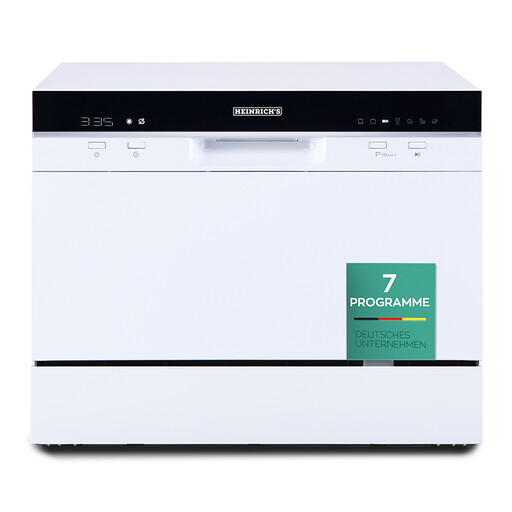
Heinrich's HTG 8840 Weiss tabletop dishwasher, 6 place settings
Worth considering if you want a tabletop model and have a suitable spot on your worktop.
- Product title: 6 place settings, 7 programmes and a digital display.
- Also listed: 24-hour delay start, water softener, 47 dB and a D energy rating.
View at Joybuy
 No image available
Heinrich's HTG 8855 tabletop dishwasher, 3 place settings
Worth considering if a tabletop model suits your available worktop space and its stated capacity meets your needs.
- Product title: 3 place settings, 7 programmes and a digital display.
- Also listed: 24-hour delay start, 56,3 dB and a C energy rating.
- The title says it can be used with or without a water connection; check the manual to see which water-supply option applies to this model.
View at Joybuy
 No image available
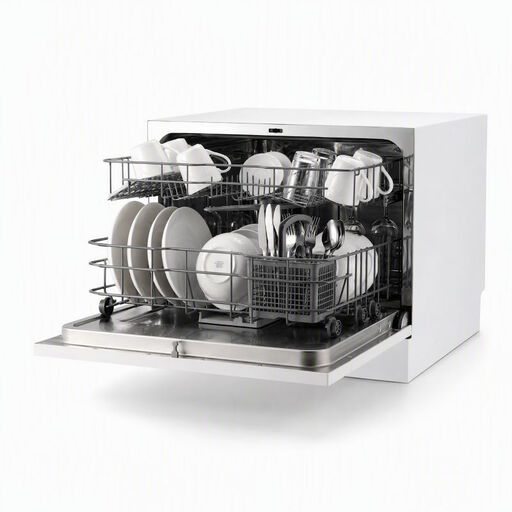
ochama worktop dishwasher, 6 standard place settings
Worth considering if you have a suitable spot for a worktop model and six standard place settings meet your needs.
- Product title: 6 standard place settings, a 30-minute quick wash programme and 24-hour delay start.
- The title lists 8 functions.
View at Joybuy
 No image available
Bosch SPS4HKW49E Series 4 freestanding dishwasher, 45 cm, white
Worth considering if you have room for a 45 cm freestanding model and want to wash mugs alongside other dishes.
- Product title: freestanding, 45 cm and white.
- Also measure the height and depth, and allow room for the door to open. Check the rack with your own mugs.
View at Joybuy
Frequently asked questions
Does a dishwasher that holds six or ten place settings fit six or ten mugs?
No. A place setting describes the crockery and cutlery for one meal. The shape and dimensions of your mugs determine how many will actually fit in the rack. Also check that the spray arms can rotate freely.
Which connections should I check before installation?
Check the installation instructions for your chosen model and make sure water, waste and electrical connections are available. A tabletop model or water tank doesn’t necessarily mean you can do without a safe way to drain the water.
What does the energy label tell me about consumption?
The label includes information such as electricity use per 100 eco cycles and water use per eco cycle. Since 1 March 2021, the European Commission has used an A to G scale for dishwashers. The label values provide a basis for comparison, but won’t predict your bill for every programme and load.
How do I keep the dishwasher clean?
Check and clean the filter when necessary, and follow the model’s maintenance instructions. The Consumentenbond points out that a blocked filter can prevent water from draining properly.
What warranty rights apply to a dishwasher in the Netherlands?
You’re entitled to a product that meets reasonable expectations, and the retailer is your point of contact if the product is faulty. According to the Dutch government, there is no fixed statutory two-year warranty period in the Netherlands. A manufacturer’s warranty may offer additional cover.


