Start by considering how much space your mugs take up in the racks, and whether you have the right water supply and drainage: place settings don’t tell you how many mugs will fit. A countertop model may suit a smaller load; consider a slimline or full-size model if you have the space and enough other dishes to wash. Compare the programme duration and drying phase, too: according to the Consumentenbond, a short programme may not dry as well, while the eco programme takes longer.
Which dishwasher is right for you?
Class organiser with lots of mugs
If you want to wash as many mugs from a group as possible in one go, focus on usable rack space and layout. The Consumentenbond distinguishes between place settings and the items you actually want to load when assessing capacity.
User of a small classroom
If you have limited worktop or floor space, compare the space available with the connection options. A countertop model may need a fixed water supply and drainage, depending on the version; check the installation requirements for your chosen model.
User who needs the mugs again soon
If you want to use the mugs again soon after class, compare the programme duration with the drying phase. The Consumentenbond notes that short programmes may shorten or skip the drying phase.
What should you look for when buying?
Start by checking that your mugs will fit and that the dishwasher can be installed. Then compare the drying time and energy and water use of the programme you expect to use.
Countertop model with a fixed connection
Suitable if: you have a small load of mugs, limited space and can connect the required water supply and drainage.
Trade-off: capacity is more limited, so check that the mugs and their handles fit in the rack.
Slimline freestanding dishwasher
Suitable if: a countertop model doesn’t offer enough usable space, but there isn’t room for a full-size dishwasher.
Trade-off: allow for floor space, height, depth and clearance for the open door.
Full-size or integrated dishwasher
Suitable if: you regularly have other dishes to wash as well as mugs, and can fill the machine efficiently.
Trade-off: an integrated model needs a suitable space and installation; if you only have a small load of mugs, it may be more practical to wait until you have more dishes.
Countertop model with a water tank
Suitable if: there’s no fixed water supply and the specific model has a tank.
Trade-off: check separately how wastewater is drained and how many mugs really fit in the rack.
| Buying concern |
What to look for |
Who is this most relevant to? |
| Space for mugs |
Compare your mugs, their handles and the rack layout; as the Consumentenbond explains, place settings are not a count of mugs. |
If I want to wash a group’s mugs in one go after class, usable rack space comes first. Around 31% of consumers say capacity for mugs is their main buying concern. |
| Installation and connections |
Check the full dimensions, door clearance and whether your chosen model needs a fixed water supply or a tank and drainage. |
If the classroom has limited space or few connection options, the dishwasher needs to be practical to position and use there. Around 25% of consumers put installation and connections first. |
| Speed and drying |
Compare the programme duration and drying option; according to the Consumentenbond, a short programme may shorten or skip the drying phase. |
If I need the mugs again soon, I want to know when they’ll be clean and dry. Around 19% of consumers say speed and drying are their main buying concern. |
| Energy and water use |
Compare kWh per 100 eco cycles and litres per eco cycle on the same basis; the EU energy label gives these figures for the eco programme. |
If you use the dishwasher often after classes, you’ll want to weigh up the consumption per wash against the longer duration of the eco programme. Around 13% of consumers put energy and water use at the top of their list. |
| Noise when using it in the evening |
Compare the noise level in dB(A) and check whether the model has a quiet programme; the European Commission says noise is shown on the EU energy label. |
If the dishwasher is running during a class or evening activity, I want to avoid the noise becoming a distraction. Around 12% of consumers say keeping the classroom quiet is their main buying concern. |
Common buying mistakes
-
Assuming six place settings means six large mugs
A place setting refers to a standard set of dishes, not one mug. The shape of your mugs and their handles can affect how much rack space is actually available.
Measure your largest mugs and check the rack height and cup holders before choosing a model.
Brands to consider
These brands show examples of different sizes and installation types; the features mentioned apply only to the models described.
Tomado
The TDW5501B is a countertop model for a smaller load, designed for a space with a fixed water supply and drainage.
- According to Tomado, this model has 6 place settings, fold-down cup holders and a delay-start function.
- Tomado doesn’t list a half-load option. Check that your mugs fit in the racks.
Inventum
The freestanding VVW5520 is 55 cm wide and, according to Inventum, has a capacity of 6 place settings.
- Inventum lists an eco programme and automatic door opening at the end of the cycle.
- According to Inventum, this model doesn’t have a half-load option; the stated water consumption doesn’t necessarily apply to every programme or load.
Bosch
The freestanding SPS4EMI17E is a slimline model, 45 cm wide.
- The official product specifications state a capacity of 10 place settings; Bosch lists flexible racks and automatic door opening to help with drying.
- Place settings don’t tell you how many of your own mugs will fit. Check the rack layout and full dimensions.
Siemens
The SN63H801ME is a fully integrated 60 cm dishwasher for a suitable kitchen space.
- Siemens lists flexible racks and a one-hour programme for this model.
- This isn’t a freestanding alternative; whether it fits depends on the available space and installation.
Dishwashers on Joybuy
This selection features countertop models for smaller loads. Check whether the stated capacity, water supply and drainage for each model suit your mugs and classroom.
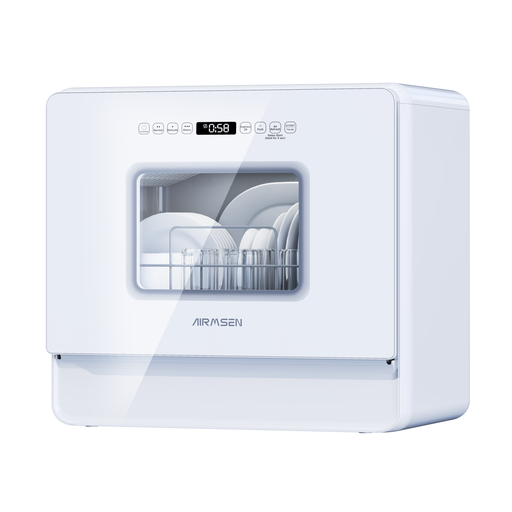 Image unavailable
AIRMSEN A01 countertop dishwasher
Worth considering if you’re looking for a countertop model with a built-in water tank.
Built-in 5 l tank; two rack levels; 3 spray arms; delay start of up to 12 hours.
Joybuy
 Image unavailable
AIRMSEN portable countertop dishwasher
A portable worktop model to consider if you want a built-in tank; when using the tank, the drain hose needs to run into a container.
Built-in 5 l tank; 5+1 wash cycles; double-tempered glass door; according to the product name, no fixed water connection is needed.
Joybuy
 Image unavailable
AIRMSEN countertop dishwasher, 37 × 50 cm
This countertop model is worth considering if its stated dimensions fit your available space; check the other external dimensions, too.
Built-in 5 l tank; 9 programmes; delay start from 1–24 hours; energy rating D.
The product information states 4 place settings; this doesn’t mean 4 mugs will fit in the rack.
Joybuy
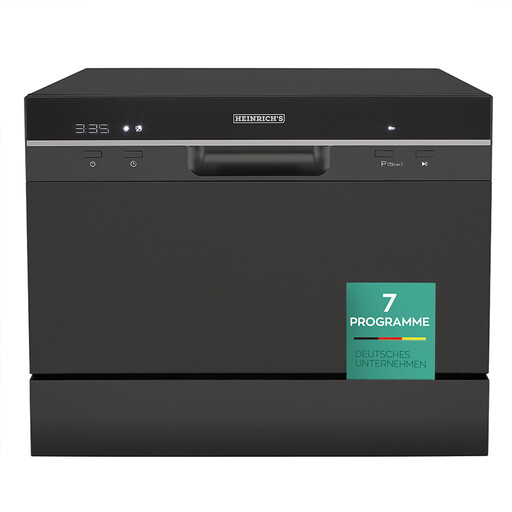 Image unavailable
Heinrich's HTG 8840 Schwarz
This countertop model may suit a smaller load; check that your mugs fit in the stated rack layout.
6 place settings; 7 programmes; delay start of up to 24 hours; automatic door opening; 47 dB; energy rating D.
The stated capacity of 6 place settings doesn’t guarantee that 6 large mugs will fit.
Joybuy
 Image unavailable
Heinrich's HTG 8855
The stated capacity makes this model worth considering for a small load; check how many of your own mugs will actually fit.
3 place settings; 7 programmes; delay start of up to 24 hours; 56.3 dB; energy rating C.
The stated capacity of 3 place settings doesn’t tell you how many large mugs will fit in the rack.
Joybuy
Frequently asked questions
How should you load mugs into the dishwasher?
Place dishwasher-safe mugs upside down, and position mugs with a rim so water can drain away. The Consumentenbond recommends scraping off large food scraps; you generally don’t need to rinse dishes under the tap first. Clean the filter regularly.
Is the eco programme suitable if you need the mugs again the same evening?
It depends on when you need the mugs and how long the eco programme takes on your chosen model. According to the Consumentenbond, the eco programme takes almost four hours on average; a short programme for lightly soiled dishes may have a limited drying phase or none at all.
What do the energy label and warranty tell you when buying in the Netherlands?
The EU energy label includes information such as energy use per 100 eco cycles, water use per eco cycle, capacity and noise, but it doesn’t directly predict the consumption of every short programme. According to the Dutch government, there’s no fixed statutory warranty period for private purchases; if a product doesn’t meet the terms of the agreement, contact the seller. If an organisation is making the purchase, check which terms apply to that purchase.


