
Lunchbox user with limited worktop space
You want to wash one or more lunchboxes every day, but need to weigh up the space a countertop model takes against the room you have on your worktop.


Start by checking the available space and whether you can arrange a suitable water supply and drain. Then make sure your lunchboxes, with their lids open, and any separate parts fit in the rack without blocking the spray arms. A countertop model takes up worktop space, while a slimline dishwasher on the floor can hold more everyday dishes. The Consumers’ Association (Consumentenbond) lists 9–10 place settings for 45 cm slimline models. Compare consumption figures for the same eco programme, and don’t assume plastic parts will be completely dry at the end of the cycle.
You want to wash one or more lunchboxes every day, but need to weigh up the space a countertop model takes against the room you have on your worktop.
You’re looking for a model you can fill by hand. You’ll still need a safe place for the drain hose.
You also want to wash everyday dishes, so you’re comparing a countertop model with a slimline dishwasher.
First, measure the space and check the connections. Then compare the rack with your lunchboxes and the amount of other washing-up you usually do at the same time.
| What to consider | What to check before buying | Who this matters more to |
|---|---|---|
| Will it fit in your kitchen? | Measure the available space, door clearance and distance to the socket, water supply and drain. Compare these with the appliance’s full dimensions. | If I have limited worktop space, I want to know whether a countertop model will fit or whether a floor-standing model would work better. Space is the top priority for around 28% of consumers. |
| Cleaning and drying | Measure the lunchbox with its lid open and any separate parts. Check the care instructions and make sure each part can sit separately without getting in the way of the spray arms. | If I wash boxes with separate lids or dividers, I want to be able to position them properly and let them dry. Cleaning and drying these parts is the main concern for around 22% of consumers. |
| Water supply and drainage | Check the water supply, drain hose and installation instructions for each model. A reservoir doesn’t remove the need for drainage. | If there’s no fixed water supply where I want to put the dishwasher, I’m looking for a model I can fill by hand and drain properly. The available connections determine the choice for around 22% of consumers. |
| How much washing-up? | Compare your usual load with the rack. The number of place settings doesn’t tell you how many lunchboxes or separate lids will fit. | If I want to wash mugs, cutlery or cookware as well as lunchboxes, I want to know what will actually fit in the rack at the same time. Capacity per load matters most to around 17% of consumers. |
| Consumption and maintenance | Following European Commission guidance, compare the same label figures, including energy per 100 eco cycles, water per cycle and noise. Also check how to clean the filters. | If I’m comparing appliances for regular use, I want to take the labelled consumption and maintenance into account. Consumption and maintenance are top priorities for around 11% of consumers. |
A place setting means the tableware for one person and one meal. Wide boxes and separate lids need a different rack layout.
Measure your lunchboxes and check how their parts fit in the rack separately before choosing based on the number of place settings.
A water tank can replace a fixed water supply, but the used water still needs to drain away.
Read the installation instructions for the exact model and plan where the drain hose will go.
The Consumers’ Association (Consumentenbond) points out that a small dishwasher isn’t automatically more economical. A half-load programme may be less efficient per item washed.
Compare label figures for the same eco programme and think about how full the appliance usually is when you use it.
Parts may still be damp. Mepal recommends drying the lid and container separately.
Check the parts when the cycle ends and leave them to dry separately, following the lunchbox manufacturer’s instructions.
The features below apply to the models mentioned; they aren’t a general assessment of the entire brand.
The TSG 5701 is a countertop model with an integrated reservoir, designed for smaller loads without a fixed water supply.
The models mentioned include a freestanding countertop model and a freestanding slimline dishwasher.
The TDW5501B is a countertop model with a fixed water supply and drainage.
The Amazonia Nano is a compact countertop model. Check the water supply for the exact version before assuming it has a reservoir.
This selection focuses on compact countertop dishwashers for smaller loads: models with a reservoir and models with a fixed connection.
 No image available
A model with a reservoir for anyone who wants to wash smaller loads without a fixed water connection.
The product title mentions a 5-litre tank, 5+1 wash cycles and a double-tempered glass door. The product description lists space for 4 place settings.
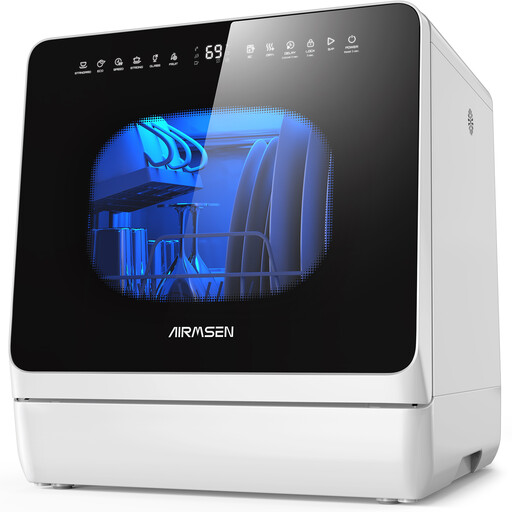 No image available
A countertop model for smaller loads if you’d prefer to use a reservoir instead of a fixed water connection.
The product description lists a 5-litre tank, space for 4 place settings, dual spray arms and a ventilation function.
 No image available
A countertop model for anyone short on worktop space who wants a reservoir that can be filled by hand.
The product title lists a 5-litre tank and dimensions of 37 × 50 cm. The product description lists space for 4 place settings.
 No image available
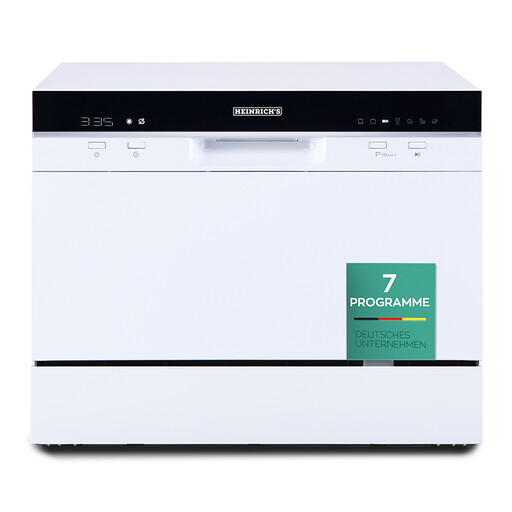
A countertop model with a water connection for anyone who wants to wash other dishes as well as lunchboxes.
The product title lists space for 6 place settings, 7 programmes and a noise level of 47 dB. The product description mentions a water connection kit and hoses.
 No image available
A compact countertop model for smaller loads. The product description mentions both a tank option and a tap connection.
The product title lists space for 3 place settings, 7 programmes and a noise level of 56,3 dB. The product description mentions a 5-litre tank and an optional drying function.
No. Follow the instructions for the specific box and its parts. Klean Kanteen recommends placing the removable divider from its Rise Food Boxes in the upper rack where possible; Mepal recommends drying the container and lid separately.
A model with a reservoir can work without a fixed water supply, but the used water still needs to drain away. Check the drain hose, where the water will drain and the installation instructions for the exact model.
Follow the dishwasher’s maintenance instructions and check the filter regularly. The Consumers’ Association (Consumentenbond) says blocked filters can stop water from draining properly.
The energy label provides information including energy and water consumption. For dishwashers, the European Commission also lists the energy class, energy use per 100 eco cycles, water use per cycle, programme duration, capacity and noise emissions.
No. The legal guarantee is separate from any manufacturer’s or seller’s guarantee. According to ACM ConsuWijzer, the seller is responsible for providing an appropriate solution free of charge if a product breaks down under normal use sooner than you could reasonably expect. There isn’t one fixed time limit that applies to every dishwasher.