
Buyers short on floor space
You want to wash lunch boxes alongside your everyday dishes, but don’t have room for a standard-width dishwasher.


The right choice depends mainly on the space you can spare: a slimline freestanding dishwasher can fit lunch boxes alongside your everyday dishes, while a countertop model takes up worktop space and handles a smaller load. Measure the space available and check the washing instructions for each lunch box. Then compare the basket layout and consumption figures of the models that fit.
You want to wash lunch boxes alongside your everyday dishes, but don’t have room for a standard-width dishwasher.
You’re considering a countertop model because a freestanding dishwasher won’t fit, but you can make room for one on your worktop.
Your choice depends on the space in the basket, the washing instructions for your lunch boxes and the dishwasher’s layout.
| Concern | What to look for | Who should consider this? |
|---|---|---|
| Will the dishwasher fit in the space available? | Measure the width, height and depth, including clearance for the door when open. Also check the water supply and drainage requirements in the installation instructions. | If there’s only one suitable spot in my kitchen, I want to know which type will fit there first. Around 36% of consumers say placement is their main concern. |
| Will the lunch boxes and lids fit? | Check the instructions for each item and compare its dimensions with the basket and the available rack positions. | I want to know whether my lunch boxes and lids will fit on a rack that’s suitable for them and can withstand the programme I choose. Around 29% of consumers prioritise whether their lunch boxes are dishwasher-safe. |
| How much can it hold? | Compare the basket layout and stated capacity with the everyday mix of lunch boxes, lids and regular dishes you wash. Place settings don’t tell you exactly how many lunch boxes will fit. | If I want to wash lunch boxes alongside plates and cups, I want to know whether my usual load will fit in one cycle. Around 21% of consumers focus mainly on load size. |
| What do energy use, drying and noise figures mean? | Compare energy consumption per 100 eco cycles, water consumption per eco cycle, the stated noise level and any drying features of the exact models you’re considering. | Once the size and layout are right, I also want to consider energy use and noise, and understand what a drying feature does. Around 14% of consumers say running costs and noise are their main concerns. |
A countertop model may need more width than a slimline freestanding machine. For example, the Inventum countertop model is 55 cm wide, while the ETNA VWV147SWIT is 44.8 cm wide, according to Inventum and ETNA respectively.
Measure the space available for both types of installation before filtering by terms such as ‘mini’ or ‘slimline’.
A lunch box may only be suitable for the upper rack or for lower temperatures. Using it outside the instructions could damage the box or its lid.
Check the symbol or instructions for each lunch box and lid, then choose a suitable rack and programme.
A place setting refers to the standard cutlery and crockery for one person. The shape and size of lunch boxes determine whether they’ll fit in the basket.
Measure your largest containers and lids, and check the basket layout of the exact model.
According to ACM ConsuWijzer, an additional warranty does not replace your statutory rights.
Check the terms of any additional cover separately, and remember your statutory rights with the retailer.
These brands offer models that differ in size, basket layout and stated features. The features mentioned apply to specific models, not the entire brand range.
Worth considering if you want to compare two slimline freestanding models with different stated energy ratings.
Useful for comparing a slimline freestanding dishwasher with a countertop model.
The BDFS26046XQ is a slimline freestanding model to compare for its basket layout and stated noise level.
The VWV147SWIT is a slimline freestanding model with an adjustable upper basket and a half-load setting.
The products below are mainly countertop models for smaller kitchens, plus one slimline freestanding dishwasher for anyone with enough floor space.
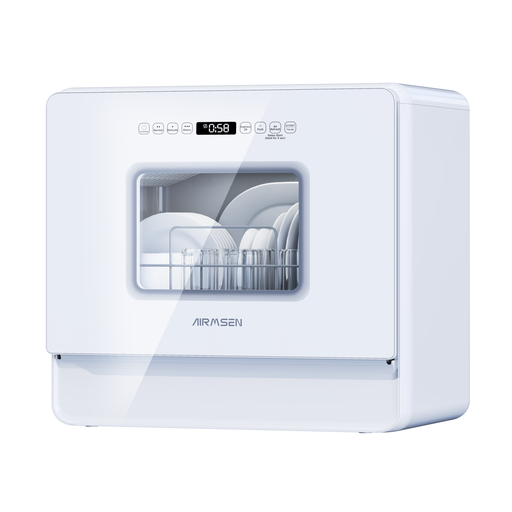 No image available
A good fit if you’re looking for a countertop model with different levels for your dishes.
The product name lists a built-in 5 L water tank, a two-level rack and five layouts.
 No image available
An option to compare if you’re looking for a countertop model with a stated width.
The product name lists dimensions of 37 × 50 cm, a 5 L water tank, 9 wash programmes and energy rating D.
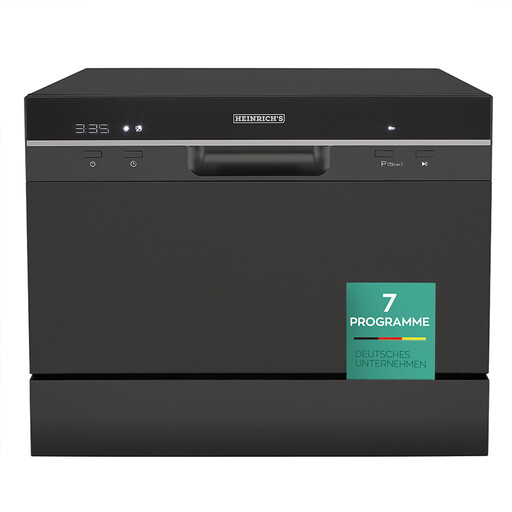 No image available
A good fit if you’re looking to compare countertop models for smaller dishwashing loads.
The product name lists capacity for 6 place settings, 7 programmes, a noise level of 47 dB and energy rating D.
 No image available
A countertop model to compare if your everyday dishwashing load is small.
The product name lists capacity for 3 place settings, 7 programmes, a noise level of 56,3 dB and energy rating C.
 No image available
A good fit if you’re looking for a slimline freestanding machine and have enough floor space.
The product title lists a width of 45 cm. Bosch gives the SPS4EMI17E a width of 450 mm.
No. The symbol or instructions may specify that a lunch box can only go on the upper rack or be washed at a low temperature. Check the instructions for each lunch box and lid.
Check the installation and connection requirements for the exact model before fitting it. Inventum advises reading the manual carefully before installation and not connecting the appliance to the mains during installation.
Compare the energy consumption per 100 eco cycles and water consumption per eco cycle on the EU energy label. Actual costs also depend on your tariffs and the programmes you choose; the label figures are based on the eco programme.
According to ACM ConsuWijzer, you’re entitled to a statutory guarantee in the Netherlands if the product doesn’t meet your reasonable expectations. The retailer must resolve a qualifying fault free of charge, for example by repairing or replacing the product; a paid-for extended warranty doesn’t replace this right.
Yes. The Dutch government states that dishwashers must have an energy label. The EU label ranges from A to G and includes information such as energy consumption per 100 eco cycles and water consumption per cycle.