What should you consider when choosing?
First, measure the space available and check the connections. Then work out how much washing-up builds up between cycles and which cutlery layout will suit you.
| What to consider |
What should you check? |
Who is this important for? |
| Size and kitchen space |
Measure the space and compare the exact model’s external dimensions, door opening and capacity. |
If the kitchen is small, I want to leave enough room for the worktop. Around 31% of consumers prioritise the space available. |
| Capacity and cutlery layout |
Compare the number of place settings, the cutlery basket or drawer, and the space for the rest of the crockery. |
With changing group sizes, I want to be able to load a suitable amount of cutlery and crockery. Around 31% of consumers prioritise loading space and a practical cutlery layout. |
| Connection requirements |
Check the installation space, water supply, drain and electrical connection against the model’s manual. |
If the connection points aren’t readily available, I want to know whether installation is possible before buying. Around 23% of consumers make connection requirements their top buying priority. |
| Consumption with changing occupancy |
Compare kWh per 100 eco cycles, water per eco cycle and capacity; also consider whether the machine is usually full. |
If occupancy varies a lot, I want to weigh consumption against the load I actually expect. Around 15% of consumers prioritise running costs. |
Joybuy products for different kitchen layouts
This selection of Joybuy products includes tabletop models, a fully integrated model and freestanding dishwashers. Compare them with the space available, the size of your group and your existing kitchen layout.
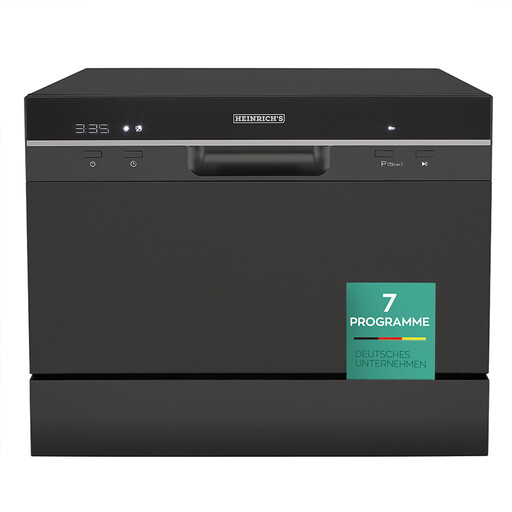 Image unavailable
Heinrich's HTG 8840 Schwarz tabletop dishwasher
A tabletop model for a space where a compact appliance is a better fit than a freestanding floor-standing model.
The stated capacity is 6 place settings and the appliance has a cutlery basket. The product name lists 7 programmes, 6,5 litres of water per cycle, energy rating D and 47 dB.
View at Joybuy
 Image unavailable
Heinrich's HTG 8855 tabletop dishwasher
A compact tabletop model for anyone who only needs to wash a small amount of crockery at a time.
The stated capacity is 3 place settings and it comes with a cutlery basket. The product information lists a built-in water tank or tap connection, 7 programmes, energy rating C and 56,3 dB.
View at Joybuy
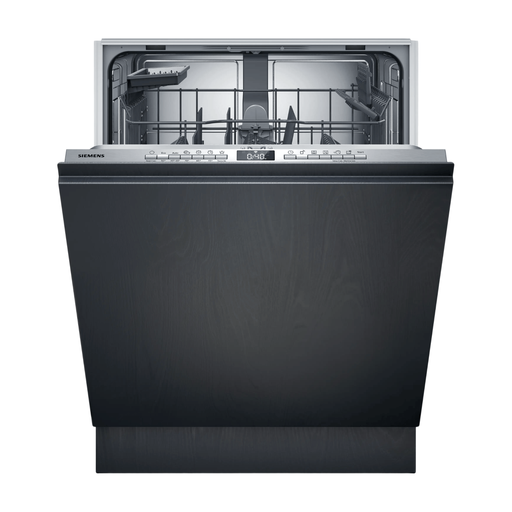 Image unavailable
iQ300 SN73HX04TE fully integrated dishwasher, 60 cm
This model is designed for a kitchen with a suitable built-in space; it isn’t a direct replacement for a freestanding dishwasher.
The product information lists 13 place settings, a half-load option and 9,0 litres of water per eco cycle.
View at Joybuy
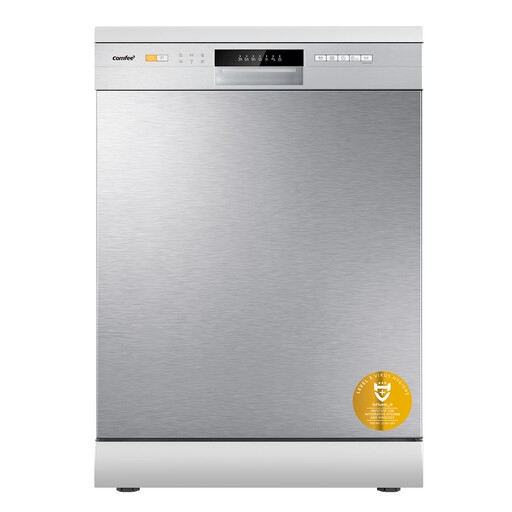 Image unavailable
Comfee' CDWPF1201PS freestanding dishwasher
A freestanding model for anyone who wants to wash more crockery per cycle than will fit in a tabletop model.
The product information lists 12 place settings, a removable cutlery basket and a half-load option. The product name lists energy rating E and 49 dB.
View at Joybuy
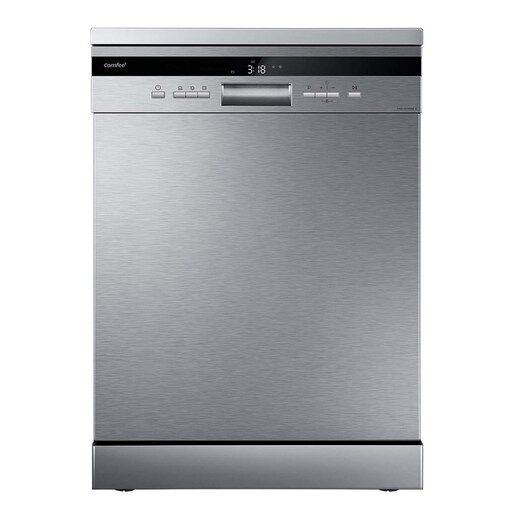 Image unavailable
Comfee' FD1435E-X freestanding dishwasher
A model with a larger capacity for stays when more crockery is regularly used at once.
The product name lists 14 place settings, energy rating D and 44 dB. The product information includes a removable cutlery basket, fold-down supports and a half-load option.
View at Joybuy
Frequently asked questions
How do you check whether a dishwasher will fit in your holiday cottage?
Measure the intended space and check the manual for the exact model to confirm the installation requirements, water supply, drain and electrical connection. A tabletop model won’t automatically solve the problem of a missing or unsuitable connection.
Should dishwasher-safe cutlery be rinsed first?
Pre-rinsing is generally unnecessary; remove food scraps before loading the cutlery. Milieu Centraal also recommends checking the filter regularly and cleaning it when needed.
How can you compare consumption without estimating an annual cost?
Compare the kWh per 100 eco cycles and litres per eco cycle shown on the energy label. Actual annual consumption also depends on the number of cycles, the programme selected and your own energy and water tariffs.
What can you do if your dishwasher develops a fault after purchase?
According to the Dutch government, you can contact the retailer about your statutory guarantee. The Netherlands does not have a fixed statutory guarantee period of two years; what you can expect from a product depends, among other things, on the product itself and normal use. A manufacturer’s guarantee does not replace your statutory rights.
Which details on the EU energy label are useful for comparing models?
The European Commission sets out an energy label scale from A to G for household dishwashers. The label includes energy consumption per 100 eco cycles, water consumption per eco cycle, capacity and noise level; compare these figures alongside the load you expect.


