What should you look for when choosing?
Washing up by hand in a bowl
A good fit if: you usually only have a few plates and pieces of cutlery, and don’t mind washing up by hand.
The trade-off: you do the work yourself. Milieu Centraal recommends using a small amount of hot water and turning off the hot tap while you wash up.
Ultra-compact dishwasher with a reservoir
A good fit if: you have a small amount of washing up, can’t use a fixed water supply and have a suitable place for the drain.
The trade-off: you’ll need to fill the reservoir by hand. In its 2021 review of the Bob, the Consumentenbond highlighted capacity and filling as points to consider; this finding applies to the version reviewed at the time.
Countertop model with a fixed water supply
A good fit if: you want to save up your washing up, have space on the worktop and can use fixed water and drain connections.
The trade-off: check the plate diameter and loading options for each model. Tomado lists six place settings and plates up to 25 cm for the TDW5501B, but no half-load option.
Slimline dishwasher, around 45 cm wide
A good fit if: you regularly want to wash cookware as well as dinner plates, and have room for a larger, permanently installed machine.
The trade-off: if you only have a small amount of washing up each day, it may take longer to fill the machine. Compare the figures on the EU energy label and think about how often you’ll actually run a programme.
Milieu Centraal recommends running your dishwasher when it’s full and choosing the eco programme. The EU energy label shows, among other things, energy consumption per 100 eco cycles, water consumption per eco cycle and capacity. Compare models on the same basis.
| Point to consider |
What to look for |
Who is this important for? |
| Small amount of daily washing up |
Count the plates, glasses and cutlery you want to wash each time. Compare this with the rack layout and consider washing up by hand. |
If I mainly wash a few plates, I want to know whether a machine is practical to load and worth the space. Around 36% of consumers say a small daily load is their main concern when buying. |
| Positioning and connections |
Measure the available space and check the chosen model’s requirements for power, water supply and drainage. |
If there’s no fixed water supply nearby, I want to know in advance where the machine can go and how the wastewater will drain. Around 29% of consumers prioritise connections and positioning. |
| Plates and extra washing up |
Measure your largest dinner plate and check the maximum plate diameter and usable rack layout. |
If I also want to wash larger plates or cookware, I want to know in advance what will actually fit in the rack. Around 21% of consumers prioritise capacity and plate size. |
| Consumption based on your routine |
Compare energy consumption per 100 eco cycles, water consumption per eco cycle and capacity on the EU label; also consider how often you run the machine. |
If I want to take consumption into account, I want to compare label figures without assuming they’re the same as the figures for my own partly loaded cycles. Around 14% of consumers prioritise running costs. |
Joybuy products
This Joybuy selection includes countertop dishwashers for small loads and washing up you’ve saved up, including models with a water reservoir. Check the space required for each model and how its water supply and drainage are set up.
 Image unavailable
AIRMSEN countertop dishwasher with 5 L reservoir
An option for a small load if you don’t want to use a direct water supply; according to the product description, wastewater needs to be drained through a hose into a container.
The product description lists 4 place settings, plates up to 26 cm, a 5-litre reservoir and several wash programmes.
View at Joybuy
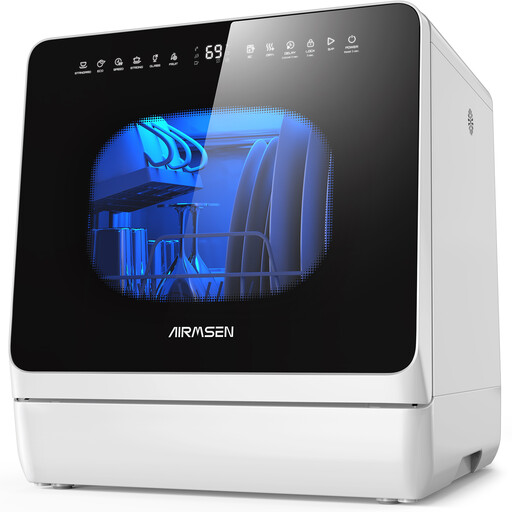 Image unavailable
AIRMSEN countertop dishwasher with 8 programmes
A compact option if you’re looking for a countertop model with a choice of programmes; check the connection and drainage requirements for your space.
The product description lists up to 4 place settings, plates up to 26 cm, eight programmes and a water softener.
View at Joybuy
 Image unavailable
AIRMSEN countertop dishwasher, 37 × 50 cm
An option if you’re looking for a countertop model with a reservoir and the stated dimensions will fit on your worktop.
The product description lists 4 place settings, a 5-litre reservoir, nine programmes and two water-supply options.
View at Joybuy
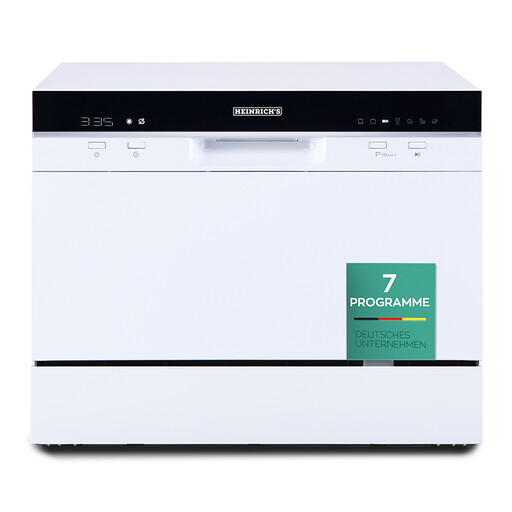 Image unavailable
Heinrich's HTG 8840 countertop dishwasher
A countertop model for anyone who wants to save up their washing up; check that the capacity and fixed connection suit your everyday needs.
The product name lists 6 place settings, seven programmes and energy class D.
View at Joybuy
 Image unavailable
Heinrich's HTG 8855 mini countertop dishwasher
A small dishwasher for anyone looking for limited capacity and the option of using a reservoir or a direct water supply.
The product name lists 3 place settings and energy class C; the product description mentions a 5-litre reservoir, a tap connection option and seven programmes. The drying function is optional.
View at Joybuy
Frequently asked questions
Should I buy a dishwasher if I only have a few plates a day?
No, not necessarily. For washing up by hand, Milieu Centraal recommends using a bowl and a small amount of hot water. If you mainly want to save yourself the work, consider whether you can load and position a small machine practically.
Does a dishwasher with a water reservoir need no connections at all?
A model that can be filled by hand doesn’t need a fixed water supply when you fill it this way. You’ll still need to arrange the power supply and drainage in line with the instructions for your chosen model.
How do I compare the consumption of two dishwashers?
Compare energy consumption per 100 eco cycles, water consumption per eco cycle and capacity on the EU energy label. A figure for eco cycles isn’t automatically the same as the consumption for your partly loaded cycles or cycles with different settings.
What are my rights in the Netherlands if my dishwasher is faulty?
According to the Dutch government, you’re entitled to a product that works properly and can contact the retailer if there’s a fault. The Netherlands has no fixed statutory guarantee period; what you can expect from a product depends, among other things, on the product and the sales information. Normal wear and tear or damage caused by incorrect use isn’t necessarily covered by free repair.
Where can I take my old dishwasher?
The Dutch government lists, among other options, the shop or online service where you buy a new, similar appliance and your local council recycling centre as places to take it.


