What should you look for when buying?
First, check the care instructions for your lunchboxes. Then compare the space available and the water connection with the amount of washing-up you usually have.
| What to consider |
What should you check? |
Who is this important for? |
| Lunchbox and programme |
Read the instructions for every part and check that the temperature and programme are suitable. The Consumers’ Association advises placing plastic items that are suitable for dishwashing on the top rack. |
I want to avoid damaging a lid or printed design, even if the container is labelled dishwasher-safe. Around 33% of consumers prioritise compatibility between the lunchbox and the programme. |
| Size and loading space |
Measure your largest container and lid, then compare them with the usable space in the rack and the space available in your kitchen. |
I have limited space and want to wash my lunchboxes with my usual dishes. Around 27% of consumers prioritise a suitable size and a practical load. |
| Water supply and drainage |
Check how water is supplied and drained for the exact model, and whether this will work in your chosen spot. |
There’s no fixed water supply where I want to put it, but I need to know whether filling and draining can be managed easily. Around 20% of consumers focus on installing a dishwasher without a fixed water supply. |
| Consumption for small loads |
Compare energy use per 100 eco cycles and water use per eco cycle on the energy label. Also consider how often you can put together a suitable load. |
I usually only wash one lunchbox and want to weigh up whether running the machine suits my needs or whether washing by hand is easier. Around 20% of consumers prioritise consumption per use. |
The Consumers’ Association points out that place settings don’t directly tell you how many lunchboxes will fit. The EU energy label shows energy consumption per 100 eco cycles and water consumption per eco cycle. These label figures don’t guarantee the consumption for every small load or a cycle with different settings.
Dishwashers for lunchboxes at Joybuy
This Joybuy selection includes compact table-top and table-top-style dishwashers. Check the loading space, water supply and drainage for each model; the product name alone won’t tell you whether your lunchboxes will fit.
 No image available
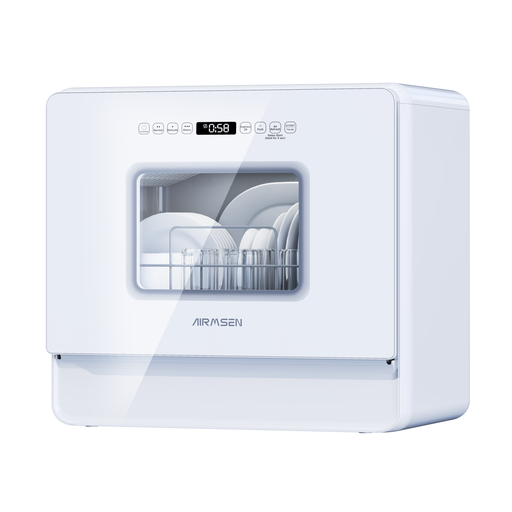
AIRMSEN A01 table-top dishwasher, 5-litre tank, two-level rack
Could suit you if you’re looking for a table-top model without a fixed water connection and want to wash lunchboxes alongside other dishes.
The product name lists a built-in 5-litre tank and a two-level rack. The product information warns against loading heat-sensitive plastics that aren’t dishwasher-safe.
View at Joybuy
 No image available
AIRMSEN portable table-top dishwasher, 5+1 wash cycles
A good option to consider if you’re looking for a compact model without a fixed water connection.
The product name lists a built-in 5-litre tank and 5+1 wash cycles. The product information warns against loading heat-sensitive plastics that aren’t dishwasher-safe.
View at Joybuy
 No image available
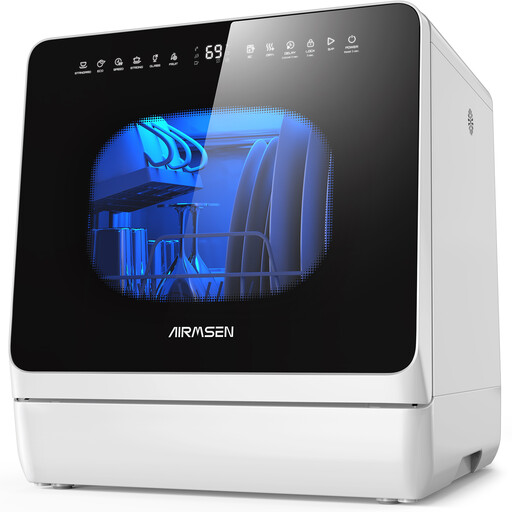
AIRMSEN table-top dishwasher, 8 wash programmes
Could suit a small kitchen where you’d like a portable table-top model.
The product name lists 8 wash programmes, an integrated water softener and a delayed start. Check the care instructions for your lunchbox before choosing a programme; the product information warns against heat-sensitive plastics that aren’t dishwasher-safe.
View at Joybuy
 No image available
AIRMSEN table-top dishwasher, 5-litre tank, 9 programmes
A good option to consider if you’re looking for a compact table-top model with a built-in tank.
The product name lists dimensions of 37 × 50 cm, a 1–24-hour timer and energy class D. The product information warns against loading heat-sensitive plastics that aren’t dishwasher-safe.
View at Joybuy
 No image available
Heinrich's HTG 8855 table-top mini dishwasher
Could suit you if you want to wash a small load. Check the dimensions and connection are right for your kitchen before buying.
The product name lists 3 place settings and 7 programmes. Check the manual to see how the water supply and drainage should be set up for your kitchen.
View at Joybuy
Frequently asked questions
Can every dishwasher-safe lunchbox go on an intensive programme?
No. The words ‘dishwasher-safe’ don’t mean every programme is suitable. Check the instructions for the container and all its separate parts. For a specific Take a Break lunchbox, Mepal recommends a maximum of 40 °C; that limit doesn’t automatically apply to other models.
How should I load and dry plastic lunchbox parts?
First, follow the lunchbox instructions. For plastic parts that are suitable for dishwashing, follow the Consumers’ Association’s advice and place them on the top rack. Angle items with rims so less water collects in them, and only store the container and lid together once they’re completely dry.
Is a small dishwasher always more convenient than washing by hand for one person?
Not always. If you have very little washing-up, washing by hand in a bowl may be a good alternative. Milieu Centraal says washing by hand is usually better for the environment if you use little hot water and turn off the hot tap. The impact of a machine cycle also depends on how full the dishwasher is and which programme you choose.
Does a built-in water tank make a dishwasher easy to install anywhere?
No. A tank supplies water, but doesn’t tell you how wastewater is drained. Check the water supply, drainage and space needed for the exact model at the spot where you plan to use it.
How do I compare dishwasher consumption?
Compare the energy use per 100 eco cycles and water use per eco cycle shown on the EU energy label. These figures provide a basis for comparing the stated eco cycle, but don’t automatically reflect the consumption of a small load or a cycle with different settings.


