
Washing a few dishes
You want to wash breakfast bowls in the dishwasher regularly and need a rack that suits your crockery. The stated number of place settings doesn’t tell you exactly how many of your bowls will fit.


A countertop or water-tank model could suit a few breakfast bowls, provided they fit properly in the rack and you can arrange the water supply and drainage. If you can wait until you have more dishes, also compare a slimline dishwasher. Milieu Centraal generally advises against compact mini dishwashers because of their relatively high electricity consumption. Compare consumption figures on the same eco-programme basis, and don’t assume that a small or short load will use less energy.
You want to wash breakfast bowls in the dishwasher regularly and need a rack that suits your crockery. The stated number of place settings doesn’t tell you exactly how many of your bowls will fit.
You’re looking for a dishwasher that you can fill with water by hand. You’ll also need to consider where to put the appliance and how to dispose of the wastewater.
You can combine breakfast bowls with dishes from later in the day and want to weigh up the size and energy consumption of a slimline machine against a countertop model.
A good fit if: you have space on your worktop and suitable connections, and the rack suits your breakfast crockery.
Consider: a smaller rack may fill up more quickly, but check that your bowls and mugs will actually fit. Milieu Centraal generally advises against compact mini dishwashers because of their relatively high electricity consumption.
A good fit if: you don’t have a fixed water supply, but can arrange a suitable spot and a way to drain the wastewater.
Consider: filling it by hand replaces the fixed water supply, not the drainage. Also check how much crockery fits in the rack.
A good fit if: you can collect breakfast dishes with other washing-up and have room for a taller, plumbed-in machine.
Consider: if you’re only washing a few bowls, it may take longer to fill the machine. A half-load function alone doesn’t tell you how much energy that load will use.
A good fit if: you usually only have a few bowls to wash and don’t want to arrange an extra appliance or connections.
Consider: it takes time to wash up. Milieu Centraal says that washing up by hand generally uses less energy only if you use little hot water and don’t leave the hot tap running.
| What to consider | What to look for when buying | Who should consider this? |
|---|---|---|
| A rack that suits your bowls | Compare the size and shape of your bowls with the rack layout, and check that the spray arm can rotate freely. | I want my own bowls to fit securely without getting in the way of the spray arm; around 36% of consumers give rack fit the highest priority. |
| Space and connections | Measure the available space and check how the exact model handles the water supply and drainage. | If there’s no fixed water supply, I want to know in advance where the appliance will go and where the wastewater can drain; around 29% of consumers put installation and connections first. |
| Electricity and water consumption | Compare kWh per 100 eco cycles and litres per eco cycle on the same programme basis; check the consumption figures for other programmes too. | I may be able to collect dishes and want to weigh up the consumption for my chosen routine; around 21% of consumers put running costs first. |
| Everyday use and maintenance | Check the programmes, drying options, rack layout and maintenance instructions for the exact model. | If I wash up regularly, I want to keep the extra steps involved in filling, unloading and maintenance to a minimum; around 14% of consumers give ease of everyday use the highest priority. |
Milieu Centraal generally advises against compact mini dishwashers because of their relatively high electricity consumption, and recommends filling a dishwasher properly.
Compare your washing-up routine with using a slimline machine or washing by hand. When comparing consumption figures, use the same eco-programme basis, and keep an eye on how much hot water you use when washing by hand.
A dishwasher with a manually filled water tank still needs a way to drain the wastewater.
Before buying, check where the drain hose can safely empty and whether that arrangement will work in your kitchen.
Place settings are a standard measure of crockery and don’t tell you exactly how many of your bowls will fit in the rack.
Measure your bowls and check the rack layout, space for mugs and position of the spray arm.
The VVW5520 is a plumbed-in countertop model with a stated capacity of 6 place settings.
Bob is a mini dishwasher with a water tank that you fill by hand.
According to ETNA, the freestanding slimline VWV147SWIT has a capacity of 9 place settings and is designed for combining loads.
According to Beko, the freestanding slimline BDFS26046XQ can accommodate 10 place settings.
The SPV2HMX02E is a fully integrated dishwasher, 45 cm wide, for a suitably sized built-in space.
This selection features countertop models with water tanks for small loads and situations where you don’t want to use a fixed water supply. Check the rack size, water supply and drainage arrangement for each model.
 No image available
A countertop model with a water tank for anyone who doesn’t want to use a fixed water supply.
The product information lists a capacity of 4 place settings, 5+1 wash cycles and a built-in 5-litre water tank.
 No image available
A countertop model for anyone who wants a water tank and a rack suited to a small load of dishes.
The product information lists a capacity of up to 4 place settings, 9 wash programmes, a 5-litre water tank and dimensions of 37 × 50 cm. Energy rating D.
 No image available
A countertop model for anyone looking for a small capacity and wanting to arrange the water supply to suit their setup.
The product name lists 3 place settings, 7 programmes, a 5-litre water tank, energy rating C and 56,3 dB. An inlet hose and a drain hose are also mentioned.
 No image available
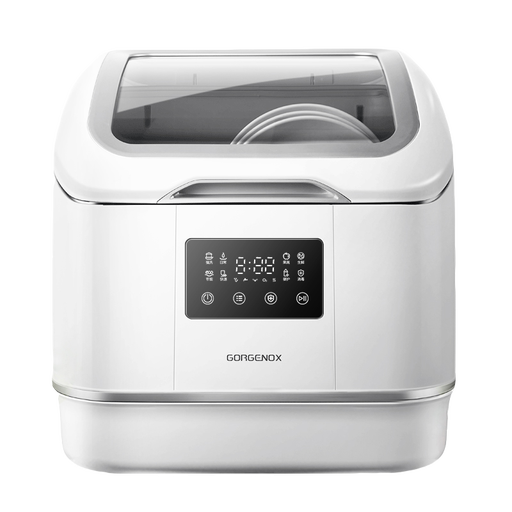
A desktop model for anyone looking for a small dishwasher with an integrated water tank.
The product name lists a capacity of 3 place settings and says that no installation is required.
 No image available
A countertop model for anyone who wants a built-in water tank and needs to wash small loads.
The product information lists 4 place settings, 6+3 programmes, a 5-litre water tank and energy rating D.
No, you can’t tell that from the number of place settings. Place settings refer to a standard set of crockery for one person for one meal. Measure your bowls and check the rack layout of the exact model.
According to Daan Tech, Bob doesn’t need a fixed water supply if you fill the tank by hand. The wastewater still needs to drain through a hose into a suitable drain or container.
The energy label includes figures such as kWh per 100 eco cycles and litres per eco cycle. These figures don’t automatically reflect the consumption of a quick programme or your small load; check the information for the exact model for those details.
Milieu Centraal recommends removing food scraps, but pre-rinsing is generally unnecessary. Food residue can clog the filter, so also follow the maintenance instructions for your model.
According to ACM ConsuWijzer, a standard online product purchase generally comes with a 14-day cooling-off period from the date of delivery. Check the seller’s information for any exceptions and returns conditions.