Who is this choice relevant to?

People living alone with few dishes each day

If you mainly wash breakfast bowls and a small amount of other crockery, you could save up your washing, consider a smaller appliance or wash up by hand. The Consumentenbond explains the difference between slimline and mini dishwashers, while Milieu Centraal offers advice on washing up by hand.

People with limited space in their kitchen

An appliance around 45 cm wide may fit where a standard-width model won’t, but a tabletop model takes up worktop space instead. The Consumentenbond points out that a freestanding slimline model needs a space with water and drainage connections.

Buyers weighing up running costs

Compare the energy and water used per eco cycle with how many loads would suit the amount of washing-up you produce each day. Milieu Centraal recommends loading the dishwasher properly and using the eco programme.

What should you look for when choosing?

Slimline dishwasher around 45 cm wide

Suitable if: you also collect plates, glasses and pans, and can usually save up your washing until you have a decent-sized load.

The trade-off: this tall model needs a suitable space with a water supply and drainage. Check the consumption for each programme, and don’t assume that a half load uses half as much.

Compact tabletop model

Suitable if: a tall slimline appliance won’t fit, but you have room on the worktop and for the required connections.

The trade-off: the Inventum VVW5520 tabletop model is 55 cm wide and holds 6 place settings. Milieu Centraal recommends loading the dishwasher properly and using the eco programme.

Washing a few bowls by hand

Suitable if: you really only have a few bowls to wash and don’t need to save up other dishes.

The trade-off: washing up takes time. According to Milieu Centraal, using a washing-up bowl is generally better for the environment than an average dishwasher if you use only a little hot water and don’t leave the tap running.

What to consider What to look for Who should pay particular attention?
Capacity and rack layout Count the dishes from a typical day and check that your own bowls will fit in the racks. If I mainly wash a few bowls, I want to know whether saving them up or choosing a smaller machine would suit the amount I have. Around 33% of consumers prioritise a small daily load.
Available space Measure the width, height and depth, including space for the door to open and for the hoses. If my kitchen has limited space, I want to know in advance which type will actually fit. Around 25% of consumers say suitable installation space is their main consideration.
Consumption and washing routine Compare kWh per 100 eco cycles and litres per eco cycle, and also consider how many loads you’ll run. If I want to keep consumption down, I look at the label figures as well as how often I’d run the machine with my washing-up. Around 25% of consumers prioritise consumption in relation to their own washing routine.
Water supply and drainage Check the water supply, drainage and installation requirements for the exact model. Before choosing a spot, I want to be sure it’s practical to connect the appliance there. Around 17% of consumers prioritise the available connections.

Common mistakes

  • Assuming that a tabletop model is automatically slim

    A tabletop model may be wider than a slimline appliance. The Inventum VVW5520 is 55 cm wide, while the slimline Inventum VVW4530AW is 45 cm wide, according to Inventum’s product information.

    Compare the external dimensions and the space needed when the door is open, rather than relying on labels such as ‘compact’ or ‘slimline’ alone.

  • Assuming consumption per eco cycle is the same as consumption for one bowl

    A label figure applies per eco cycle, while the number of loads you run depends on how much washing-up you collect. Milieu Centraal recommends loading the machine properly and choosing the eco programme.

    Compare the label figures with how often you expect to run the machine, and consider washing up by hand in a bowl if you only have a few bowls.

  • Taking a retailer’s listing at face value as a model specification

    Bosch’s Dutch product sheet lists 10 place settings for the SPS4EMI17E, while a Joybuy listing for that model gives 13 place settings.

    Check the capacity against the official product specifications for the exact model and variant.

Brands to consider

Inventum

The Dutch product information covers both a tabletop model and a slimline freestanding dishwasher.

  • The VVW4530AW is 45 cm wide, holds 10 place settings and, according to Inventum, has a half-load option.
  • The VVW5520 is 55 cm wide, holds 6 place settings and, according to its product page, does not have a half-load option.

Bosch

Bosch Netherlands describes the freestanding SPS4EMI17E as a model that is 45 cm wide.

  • The Dutch product specification sheet lists 10 place settings, energy class B and 51 kWh per 100 eco cycles.
  • The manufacturer lists adjustable baskets and automatic door opening; these features alone don’t prove that it will wash breakfast bowls better.

Beko

Beko describes the freestanding slimline BDFS26046XQ as a model with 10 place settings.

  • Beko lists energy class C, an adjustable upper rack and a cutlery drawer for this model.
  • Claims about the performance of specialist cleaning and drying functions come from the manufacturer; they are not independent findings for breakfast dishes.

Whirlpool

The Whirlpool catalogue includes freestanding and integrated dishwashers, including 45 cm models.

  • The catalogue can help you explore the available types.
  • Range information doesn’t confirm the layout or features of an individual model; check the product specifications for the exact model.

Tabletop dishwashers on Joybuy

These tabletop dishwashers are options for anyone looking for a compact solution. Check the load capacity, dimensions and connection method for each model.
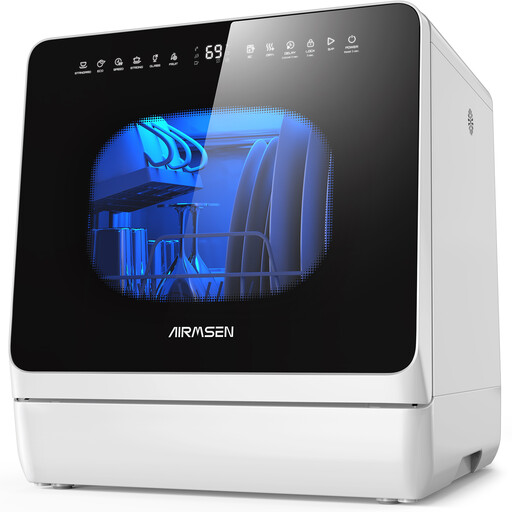
AIRMSEN portable tabletop dishwasher

AIRMSEN portable tabletop dishwasher, 8 programmes

The product information says it can be used without a fixed water connection. Check that the connection method suits the place where you plan to use it.

Holds up to 4 place settings or 31 items of crockery.

The title lists 8 wash programmes.

The instructions specify dishwasher detergent and warn against using washing-up liquid.

View on Joybuy

AIRMSEN tabletop dishwasher with water tank, 37 × 50 cm

AIRMSEN tabletop dishwasher, 37 × 50 cm, energy label D

The built-in water tank and the listed tank or tap connection give you options to compare with your kitchen space in advance.

The product information lists a capacity of up to 4 place settings and dimensions of 37 × 50 cm.

The title lists 9 wash programmes and energy label D.

The instructions specify dishwasher detergent and warn against using washing-up liquid.

View on Joybuy

Heinrich's HTG 8855 tabletop dishwasher

Heinrich's HTG 8855 tabletop dishwasher

The product information lists a built-in tank as well as a tap connection. Check which option suits your set-up.

Holds 3 place settings and has a stated water consumption of 4.2 litres per wash.

The product information lists 7 programmes, energy label C and a noise level of 56.3 dB.

View on Joybuy

Frequently asked questions

How can I tell if my breakfast bowls will fit in a dishwasher?

Measure your bowls and check the rack layout of the exact model. A stated number of place settings doesn’t guarantee that your bowls will fit the way you want them to.

Can I put a slimline freestanding dishwasher anywhere?

No. Measure the available space and allow for the door when open, the water supply and drainage. Also follow the installation instructions for your chosen model.

How can I compare consumption without estimating electricity costs?

Compare kWh per 100 eco cycles and litres per eco cycle on the EU energy label, and think about how many loads you’d run with your own amount of washing-up. The label doesn’t show consumption for an individual breakfast bowl.

Should I rinse breakfast bowls before loading them?

According to Milieu Centraal, pre-rinsing is generally unnecessary. Scrape off food residue to prevent the filter from getting clogged, and use the eco programme if it’s suitable for the dishes.

Is washing a few bowls by hand worth considering?

Yes, especially if you don’t need to save up other dishes. According to Milieu Centraal, washing up in a bowl is generally better for the environment than using an average dishwasher if you use only a little hot water and don’t leave the tap running.
