What should you look for when choosing?
Start by checking the space available and the drainage; then work out how many dishes you’ll actually collect for each load. This helps you avoid choosing a model that fits the space but proves impractical because of the connections or the amount of washing up you do each day.
| What to consider |
What to check before buying |
Who is this important for? |
| Space, water supply and drainage |
Measure the space, including room for the door to open. Check the power supply, water inlet and, above all, where the waste water can drain safely. |
I can only use a dishwasher if it fits and the waste water can drain away safely; around 33% of consumers give top priority to space and connections. |
| Room for your dishes |
Look at the rack layout and measure your bowls. A stated number of place settings doesn’t guarantee that all your crockery will fit at once. |
If I want to wash my housemates’ bowls too, I want to know what will really fit in the racks and whether we’ll collect enough dishes; around 25% of consumers prioritise capacity for their own or shared washing up. |
| Costs and consumption |
Use the EU energy label to compare electricity consumption per 100 eco cycles and water consumption per cycle. The European Commission lists these as energy label information. |
With only a few breakfast bowls to wash, I want to weigh up whether the purchase and running costs make sense compared with washing up by hand; around 25% of consumers prioritise overall costs and consumption. |
| Noise and everyday use |
Compare the stated noise levels on a like-for-like basis and read the care instructions. If you share the machine, agree who will load and unload it. |
If my kitchen is also where I study or sleep, I want to be able to fit the noise and daily upkeep into my routine; around 17% of consumers prioritise quiet, easy use. |
Joybuy products for a small kitchen
This selection includes compact countertop and tabletop dishwashers for a small kitchen. Check the water supply, drainage and space required for each version.
 No image available
AIRMSEN portable countertop dishwasher with 5 l tank
Suitable for a kitchen where you want a compact countertop model with a built-in water tank; you’ll also need to arrange a safe route for the waste water.
The product name lists a 5 l tank and 5+1 wash cycles.
Joybuy
 No image available
AIRMSEN tabletop dishwasher with 5 l tank and 9 programmes
A compact tabletop dishwasher for anyone considering filling it by hand; check that your crockery fits and where the waste water can drain.
The product name lists a built-in 5 l tank and 9 wash programmes.
Joybuy
 No image available
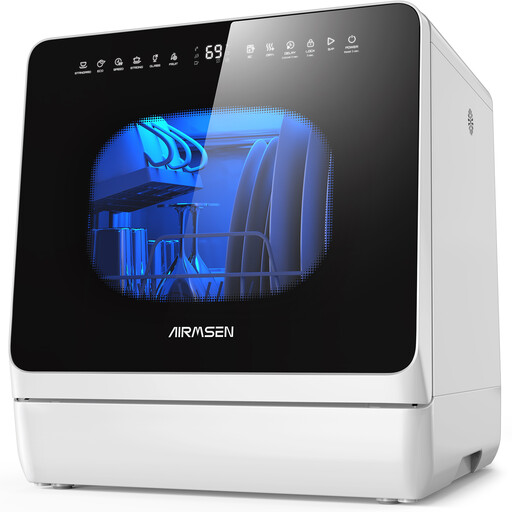
AIRMSEN countertop dishwasher with 8 programmes
Ideal if you’re looking for a tabletop model with a choice of programmes; check the water supply requirements and waste water drainage for your kitchen.
The product name lists 8 wash programmes, an integrated water softener, a delay start and a child lock.
Joybuy
 No image available
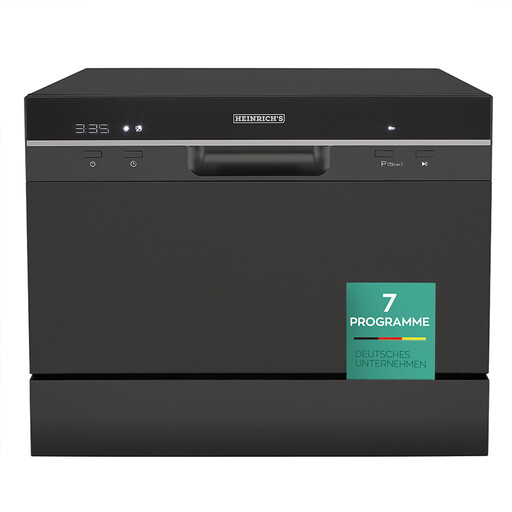
Heinrich’s HTG 8840 Schwarz tabletop dishwasher
A tabletop model for anyone who collects their washing up and can use a fixed water connection; make sure you leave room for the connections.
The product name lists 6 place settings, 7 programmes, energy class D and 47 dB.
Joybuy
 No image available
Heinrich’s HTG 8855 mini tabletop dishwasher
A small model for smaller loads if you want to check the water connection for your particular setup; suitable drainage is still essential.
The product name lists 3 place settings, 7 programmes, 56,3 dB and energy class C.
Joybuy
Frequently asked questions
Is a dishwasher more economical than washing up by hand if you only have breakfast bowls?
Not necessarily. Milieu Centraal says washing up by hand is usually better for the environment if you use only a little hot water, for example in a washing-up bowl and without leaving the hot tap running. If you use a machine, it’s best to run it full on the eco programme. Compare consumption figures on the basis stated on the energy label.
Can a dishwasher with a water tank work without a mains water supply and without drainage?
No, the used water still needs to drain away. A water tank can replace a fixed water supply, but check the manual for your chosen model, where the hose needs to go and what drainage is available.
Does the place-setting count mean my breakfast bowls will fit?
No, the number of place settings doesn’t guarantee that all your bowls will fit in the racks at once. Measure your crockery and check the rack layout and stated size limits for the exact model.
Can I alter the connections in my rented kitchen to install a dishwasher?
It depends on what needs changing. According to the Dutch government, minor alterations that can be reversed without much expense don’t require permission; renovations, such as a new kitchen, do require the landlord’s permission. Discuss any plumbing or kitchen work with your landlord beforehand.
What does a dishwasher’s energy label tell me?
The European Commission says that, since 1 March 2021, the EU label for dishwashers has used a scale from A to G and shows information including energy consumption per 100 eco cycles, water consumption per cycle, capacity, programme duration and noise. These figures are based on standardised conditions and don’t automatically predict consumption when washing just a few breakfast bowls.


