
Vandaag of morgen in huis

Kwaliteit gegarandeerd

Welkomstaanbiedingen ontgrendelen: GRATIS bezorging | Tot 80% korting | Gratis 30 dagen JoyPlus-proefperiode
Download de app
A dish rack with drainboard may seem straightforward, but small differences can determine how well it works day to day. On a compact kitchen worktop, you want to dry your dishes without puddles of water, wobbly components or a rack that turns out to be too small after just a few weeks.
Pay particular attention to these three common pitfalls:
A good choice therefore starts not with the colour or marketing copy, but with the dimensions, layout and the way water is drained away.
Measure the available space beside the sink before ordering. Do not look only at the width; consider the depth and height too. For example, a rack measuring 40 × 23,6 × 28,7 cm will have a different impact from a model measuring 42 × 32 × 30 cm.
Also take the following into account:
A space-saving dish rack often makes use of vertical space with two tiers. This is useful on a narrow worktop, but only if the upper tier remains accessible.
A 2-tier dish rack offers extra capacity by making use of vertical space. Check whether the layout suits your crockery:
“Large capacity” is only useful when the available sections suit your everyday washing-up. One compact tier may be enough for a student, while a small family may get more from two levels.
A stainless steel dish rack is worth considering if you want a metal construction and a neutral appearance. According to the product description, the product below links its rust resistance to stainless steel and polypropylene. This is information provided by the seller; the actual service life also depends on use, cleaning and exposure to moisture.
A plastic or composite model may be lighter and easier to move. In that case, pay attention to the strength of the joints and the stability on a smooth worktop.
With a dish rack with drainage tube, the tube must be positioned correctly towards the sink. A slight bend or an excessively steep angle may prevent water from draining properly. A drainboard without a tube is easier to position, but needs to be emptied and cleaned more frequently.
The following recommendations are based on verifiable details such as materials, dimensions, layout and drainage. Brand descriptions referring to durability or long-term use are not a guarantee of a specific service life.
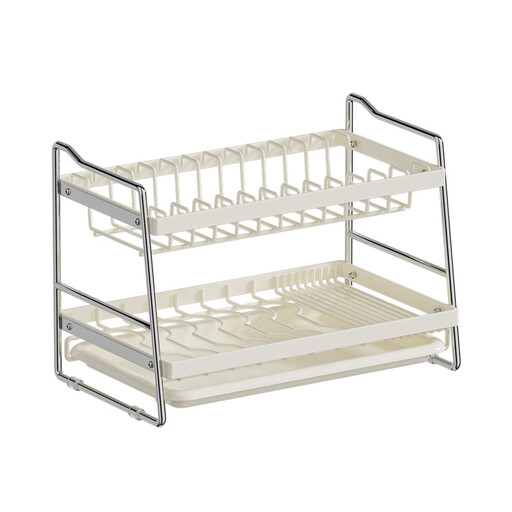
Why it suits this profile: This freestanding model has two tiers and measures approximately 40 × 23,6 × 28,7 cm. It is therefore suitable for households looking for extra drying space without installing anything beside the sink.
The dimensions and freestanding design are clearly stated. The integrated drainboards are designed to guide water towards the sink or a collection point.
Two levels, freestanding placement and suitable for plates, cups, cutlery and kitchen utensils. Assembly is required.
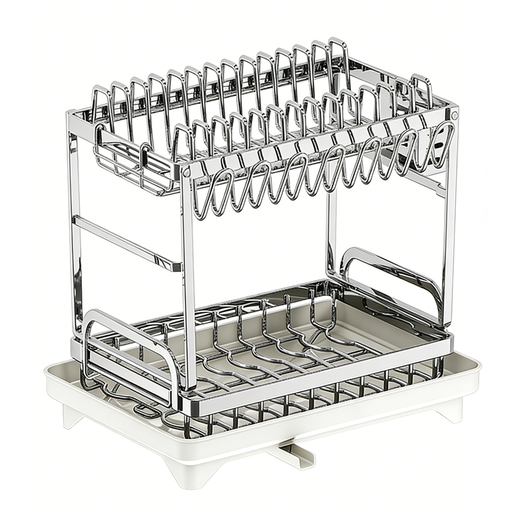
Why it suits this profile: This model combines stainless steel with PP, has two tiers and measures approximately 42 × 32 × 30 cm. It is suitable for users who prefer a larger layout and a metal construction.
The construction, material composition and dimensions are specified. The pull-out drainboard and drainage tube provide a practical solution for standing water.
Stainless steel and PP according to the product description, designated sections and a removable drainboard. Clean the tube and tray regularly.
Why it suits this profile: Anyone washing a lot of crockery every day will benefit from separate sections and direct drainage. However, the larger footprint requires a spacious dish rack for the worktop.
The drainage tube must point towards the sink and, when positioned correctly, prevents water from remaining on the worktop. Always place the rack on a level surface.
Two tiers, sections for different types of crockery and a pull-out drainboard with drainage tube. Do not use steel wool or abrasive cleaners.
Always place a dish rack on a level, stable surface. After assembly, check that all connections are secure and that the drainage tube has no sharp bends. Place heavy pans on the lower tier and distribute the weight across both levels.
Clean the drainboard, cutlery holder and drainage system regularly with mild washing-up liquid and a soft sponge. Dry the components after cleaning, especially when the rack will not be used for an extended period. This helps limit moisture build-up and residue. Also follow the assembly and maintenance instructions supplied.
We have put together a complete, up-to-date list of products that fully meet these strict selection criteria and the applicable European safety regulations.
Measure the available space beside the sink and compare it with the product dimensions. Allow a few centimetres for ventilation and to make the rack easy to move. For a 2-tier model, also check the height of cupboard doors and the space available for tall glasses.
That depends on your kitchen layout. A drainage tube can direct water straight to the sink, but it must be positioned correctly. A separate drainboard is simpler and more flexible, but needs to be emptied and cleaned more often.
Its service life depends on the materials, load, assembly and maintenance. Do not exceed the recommended load capacity, avoid leaving water standing for long periods and do not use harsh or abrasive cleaning products. This will generally help the construction remain usable for longer.
