
Vandaag of morgen in huis

Kwaliteit gegarandeerd

Welkomstaanbiedingen ontgrendelen: GRATIS bezorging | Tot 80% korting | Gratis 30 dagen JoyPlus-proefperiode
Download de app
A dish drainer may seem like a simple kitchen accessory, but the wrong choice can quickly leave you with a wet worktop, wobbly plates or not enough room for glasses and cutlery. Every centimetre counts, especially in a small kitchen. Students, families, campers and keen home cooks also have different requirements when it comes to a dish rack.
So don’t just consider the colour or price. Check the dimensions, drainage, capacity and how easy the rack is to clean.
A worktop dish drainer can look small in photos, but the handles, cutlery holder or drainage channel may need extra room. So measure not only the length and width of the rack, but also the space available next to the sink. Leave enough room around it to place plates in the rack and take them out again.
In a small kitchen, a 2-tier dish drainer may be more efficient than a wide model. A rack with several tiers uses more height, but leaves most of the worktop free.
A dish drainer with a drip tray collects water, but that doesn’t automatically mean your worktop will stay dry. A small or difficult-to-remove tray can fill up quickly. So check:
Some models specify a drain plug or drainage into the sink in the product information. Others have a separate or integrated drip tray. These are different solutions.
“Large capacity” may mean that the rack holds plenty of crockery, but it doesn’t always tell you the maximum weight it can support. For example, a rack for 12 plates may be less suitable for heavy pans. So look for specific details such as the dimensions, number of tiers, number of plates stated in the product description and maximum load capacity.
Place heavy pans on the bottom tier and distribute the weight evenly. Overloading can make the rack unstable, even if there seems to be enough room on paper.
First, measure the space next to or above the sink. When choosing a space-saving dish drainer, look out for:
A compact rectangular design is often a good fit for a small kitchen. If you cook for several people, you may prefer a taller rack or a model that sits over the sink.
A plastic dish drainer is usually lightweight and easy to move. Check that the plastic parts are smooth and allow water to drain away properly. A metal dish drainer can offer a sturdy construction, but check the finish and dry it after use if water tends to sit on it for a long time.
A model made from 304 stainless steel, as specified in the product information for one of the Maxcook models, is designed for use around the sink and has an adjustable length. This is a product specification, not a guarantee that the rack will remain stain-free in all conditions. Limescale, for example, can become visible when water dries.
A rack should stand securely on a flat surface. Check that the feet are sturdy and that the drip tray fits properly. For a rack that sits over the sink, the adjustable width must match the internal width of the sink. Don’t position the rack in a way that puts more weight on one side.
Clean the drip tray regularly with warm water and a mild cleaning product. Let the parts dry thoroughly before putting them back in place. This helps prevent stagnant water and food residue from building up.
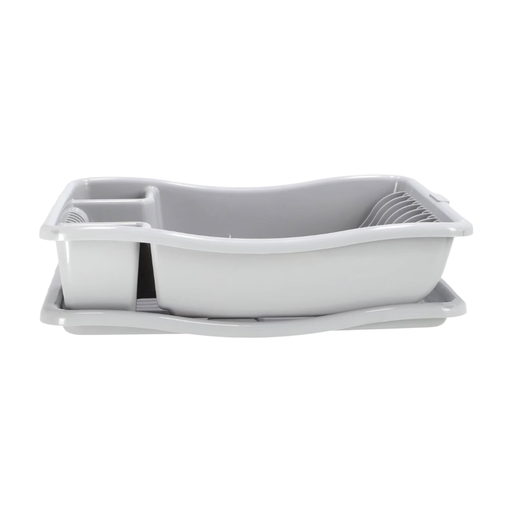
Why it suits this profile: Its manageable size and plastic construction make it practical for everyday use in a flat, student accommodation or smaller kitchen. According to the product description, it holds up to 12 plates and has two cutlery compartments.
The dimensions are clearly stated in advance, and the included drip tray stops washing-up water from running straight onto the worktop.
Plastic construction, compact footprint, two cutlery compartments and a separate drip tray, according to the product information.
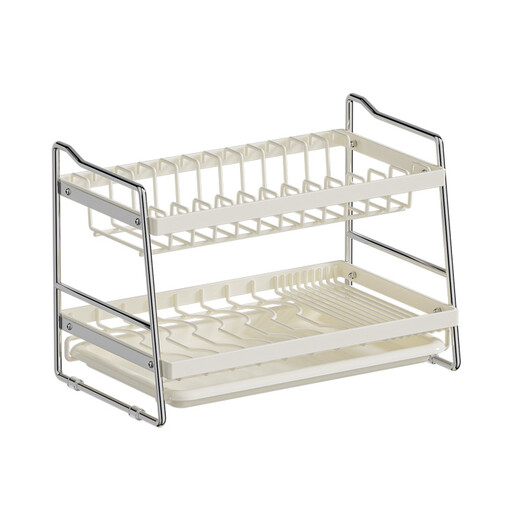
Why it suits this profile: This 2-tier dish drainer is designed for households that dry several plates, glasses and kitchen items every day. The product information gives its dimensions as approximately 40 × 23,6 × 28,7 cm and lists integrated drainage boards.
The vertical layout adds capacity without automatically requiring a much wider worktop. The drainage boards are built into the design.
Two tiers, freestanding design, composite plastic and space for different types of crockery, according to the product description.

Why it suits this profile: This model is designed to sit over or in the sink. According to the product description, its length adjusts from 29 to 44 cm and it is made from 304 stainless steel.
According to the product description, water can drain straight into the sink. Measure the width of your sink first, though, so the telescopic frame sits securely.
Adjustable length, mesh base for drainage and versatile use as a dish drainer, sink organiser or colander.
We’ve put together a complete, up-to-date list of products that meet these strict selection criteria and the applicable European safety regulations.
Empty the drip tray regularly and wash the rack with warm water and a mild cleaning product. Pay particular attention to joints, cutlery holders and drainage holes. Let all the parts dry completely before putting them back in place.
Its lifespan depends on the material, load, moisture and care. A plastic dish drainer can last a long time with normal use, provided it doesn’t crack or warp. Check a metal model regularly for damage to the coating and signs of rust. Replace the rack if it becomes unstable or has damaged parts with sharp edges.
It depends on your kitchen. A drip tray is useful when the rack sits on the worktop and you want to collect the water. A rack over the sink saves worktop space and can drain water straight into the sink, but it needs to fit properly. So measure the space available first, then choose the right design.
