
Vandaag of morgen in huis

Kwaliteit gegarandeerd

Welkomstaanbiedingen ontgrendelen: GRATIS bezorging | Tot 80% korting | Gratis 30 dagen JoyPlus-proefperiode
Download de app
A good dish drainer helps your plates, glasses and cutlery dry neatly without leaving your worktop wet for long. However, not every dish rack suits every kitchen. A model may look spacious in photos but turn out to have too little room for large plates. The drip tray may also hold water, or a tall rack may become unstable if it is loaded unevenly.
So don’t just look at the colour and price. Dimensions, drainage, material and load capacity are what really determine whether a kitchen dish drainer is practical to use.
A large overall size doesn’t automatically mean there’s room for lots of crockery. Check whether the stated capacity refers to plates, glasses or the total number of items. For example, a compact model might hold around 10 plates or 6 glasses, while a two-tier dish drainer can accommodate different types of crockery across multiple levels.
Also measure the available space next to the sink. Take taps, cupboard doors and the spot where you plan to empty the rack into account.
Without proper drainage, water collects beneath the rack. This leaves your worktop wet and means more frequent cleaning. A dish drainer with a drip tray collects the water, but the tray needs to be emptied regularly. A model with a drainage outlet can channel water straight into the sink, provided it is positioned correctly above a suitable drain.
With a dish drainer that sits in the sink, water usually runs straight into the bowl. Just check that the adjustable length fits your sink.
A metal rack can be sturdy, but its finish matters. Stainless steel resists moisture, while chrome-plated or powder-coated steel has a different surface finish. A plastic dish drainer is often lightweight and easy to wipe clean, but shouldn’t be exposed to extreme heat.
Check the care instructions too. Some parts can be wiped with a damp cloth, while others need to be cleaned with warm water and mild washing-up liquid.
First, measure the space available. Check:
For example, a rack measuring 50 × 35 × 13 cm will take up noticeably more worktop space than one measuring 39 × 33,5 × 10,5 cm. Also check that the shape suits your crockery: narrow plate holders aren’t always practical for deep bowls or large oven dishes.
Check whether water collects in a drip tray, drains away through an outlet or runs straight into the sink. A drip tray is useful if the rack can’t sit right next to the sink. If you choose an extendable dish drainer, make sure the frame rests securely on both sides of the sink.
Place any rack on a level surface and distribute the weight evenly. Overloading it can cause it to tip or become misshapen. Always follow the manufacturer’s capacity and safety instructions.
Check the full list of materials, not just the name of the main frame. For example, a rack might be made of steel with a polypropylene drip tray and a plastic cutlery holder. This is relevant to both care and moisture resistance.
A stainless steel dish drainer is a good option if you’re looking for a moisture-resistant frame. A plastic model may be more suitable if low weight and easy cleaning are your priorities. With metal models, also check that the finish remains undamaged; scratches can make the rack harder to maintain.
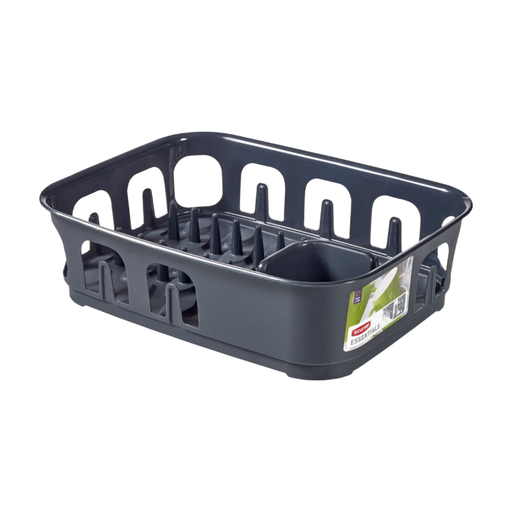
Why it suits this type of buyer: This plastic dish drainer is a good choice if you’re looking for a straightforward solution for everyday use. Its rectangular dimensions of 29 × 39 × 10 cm take up relatively little space.
Its capacity and layout are clearly specified: it holds up to 12 plates, and has an integrated cutlery holder and hooks for cups. The built-in drainage plug helps prevent water from collecting.
Plastic construction, separate cutlery holder, cup hooks and a drainage plug. Clean with warm water and mild washing-up liquid.
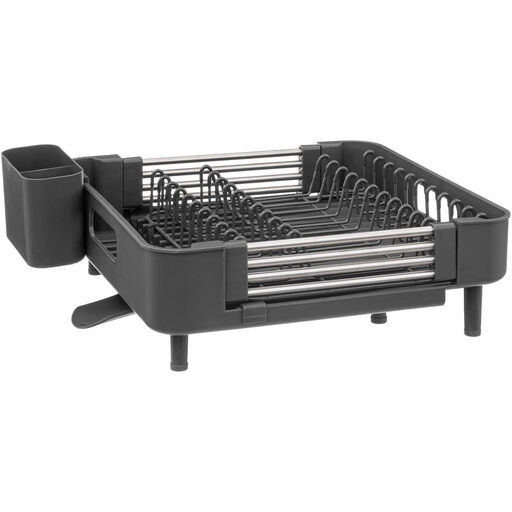
Why it suits this type of buyer: This model combines stainless steel and polypropylene. At 50 × 35 × 13 cm, it holds up to 20 items according to the product information.
The product specifications list the materials, dimensions and a separate cutlery holder. This makes it easier to compare the expected capacity with the space you have available.
Stainless steel and polypropylene, an extendable design, a separate cutlery holder, and space for plates and cups.

Why it suits this type of buyer: This extendable dish drainer is designed to sit above or in the sink. According to the product information, its length adjusts from 29 to 44 cm.
The rack drains water straight into the sink and doesn’t take up extra worktop space. Before buying, check the internal width of your sink and make sure the frame rests securely on its edges.
304 stainless steel, adjustable length of 29–44 cm, and can be used as a dish drainer or a colander for fruit and vegetables.
We’ve put together a complete, up-to-date list of products that meet these strict selection criteria and the applicable European safety regulations.
Empty the drip tray regularly and clean the joints, holders and drainage outlets. Leftover washing-up liquid and limescale can block the drain. Use a soft cloth on metal and avoid abrasive cleaners if the manufacturer advises against them.
Check from time to time that the rack is still stable and that plastic parts haven’t developed any cracks. It’s best not to put heavy pans in a rack designed for plates, glasses and cutlery. This helps avoid unnecessary strain and keeps the layout practical.
Measure the available length and depth of your worktop or sink. Allow a few extra centimetres of clearance for the tap and for emptying the drip tray. Then compare the measurements with the amount of crockery you usually wash, rather than just the number of people in your household.
It can be, especially if the rack isn’t positioned above the sink. The drip tray collects water and helps keep your worktop dry. You’ll need to empty and clean it regularly, though. If direct drainage is important, a model with a drainage plug or a dish drainer that sits in the sink may be a better choice.
Its lifespan depends on the material, how heavily it’s loaded, how much moisture it’s exposed to and how well it’s maintained. Don’t overload the rack, dry the parts if water is left standing for a long time, and follow the cleaning instructions. The statutory guarantee applies in accordance with the terms covering the product and purchase.
