
Vandaag of morgen in huis

Kwaliteit gegarandeerd

Welkomstaanbiedingen ontgrendelen: GRATIS bezorging | Tot 80% korting | Gratis 30 dagen JoyPlus-proefperiode
Download de app
A dish drainer may seem like a simple kitchen essential, but the wrong model can quickly take up too much space, leave water on your worktop or offer too little room for plates and glasses. This is particularly true in small kitchens, student accommodation, caravans and households where a lot of washing-up is done by hand every day.
So don’t just look at the colour or the number of tiers. These three common pitfalls are worth watching out for:
A drainer that’s too big for a small worktop
A 2-tier dish drainer offers more capacity, but can be awkward beside a narrow sink. Always check the length, width and height.
A drip tray that holds on to water
Without proper drainage, water can collect beneath your dishes. This may leave marks on the worktop and means more frequent cleaning. A dish drainer with a drip tray is practical, but only if the tray is easy to empty and clean.
Capacity that only looks generous on paper
The number of plates it holds doesn’t tell the whole story. Check the space for bowls, mugs, glasses and cutlery too. A narrow drainer with tall plate holders may be less suitable for large dinner plates than you’d expect.
Measure the area beside or above your sink before ordering a worktop dish drainer. Take into account:
A compact plastic dish drainer is often a good fit for a smaller kitchen. A taller metal dish drainer makes use of vertical space, but needs to stand firmly and must not get in the way of cupboard doors.
If you don’t want to give up worktop space, consider a model that sits over the sink. Check that its adjustable length suits the width of your sink. A drainer resting loosely on the edges may shift when heavily loaded.
Plastic is lightweight, easy to wipe clean and practical for students, campers and households that move the drainer regularly. Check for cracks, sharp edges and sturdy plate holders.
Metal can offer an open, sturdy design. With a metal dish drainer, the finish and maintenance are important. Standing water and leftover soap can damage the surface. Dry the drainer regularly and check its joints and coating.
For a stainless steel model, the exact specification matters. According to the product information, the MAXCOOK model below uses 304 stainless steel. This is a verifiable material specification, but it doesn’t mean the drainer will remain spotless without maintenance.
A useful dish drainer needs more than just a flat base. Look for:
A dish drainer with a cutlery basket keeps knives, forks and spoons from getting mixed in with the plates. For families, a 2-tier dish drainer can be more efficient, as long as the worktop is deep and sturdy enough.
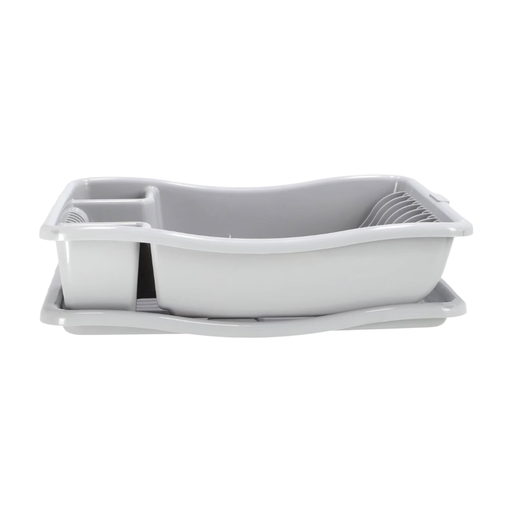
Why it suits this type of user: This plastic dish drainer has a practical footprint and is suitable for everyday use in a smaller kitchen. According to the product information, its layout can hold up to 12 plates.
The included drip tray collects the draining water. Check regularly that it’s empty to prevent water from standing in the tray.
Measures 38 x 29 x 8,5 cm, with two built-in cutlery compartments and a stackable design, according to the product description.

Why it suits this type of user: This model is designed for anyone who wants water to drain straight into the sink and to make flexible use of the available width.
As the water can drain into the sink, there’s no need for a separate drip tray on the worktop. Measure the width of your sink carefully.
Adjustable length of approximately 29 to 44 cm, a mesh base and a 304 stainless steel construction, according to the product information.
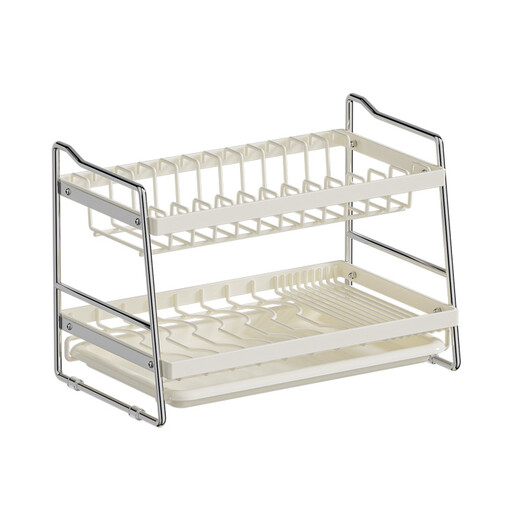
Why it suits this type of user: The two tiers are designed for households that want to dry several types of dishes at once without taking up extra worktop width.
The integrated drip trays are designed to direct water into a sink or collection area. Assembly is required; once assembled, check that the drainer stands firmly.
Two drying tiers and dimensions of approximately 40 x 23,6 x 28,7 cm. Suitable for plates, cups, cutlery and kitchen utensils, according to the product description.
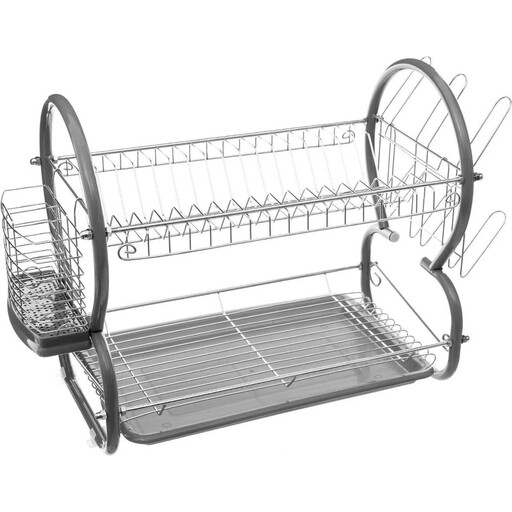
Why it suits this type of user: According to the product information, this 2-tier dish drainer has room for up to 17 plates, bowls, mugs, glasses and pieces of cutlery.
The separate cutlery basket and glass holders help keep different items from getting stacked together. The drainer does require self-assembly and should be placed on a level surface.
Measures 44 x 24 x 38 cm, with a powder-coated metal rack, a polypropylene drip tray and a stated maximum load of 1,3 kg.
We’ve put together a complete, up-to-date list of products that meet these strict selection criteria and the applicable European safety regulations.
Measure the available space and compare it with the drainer’s outer dimensions. A compact model is often enough for a small household. Families may benefit from a 2-tier design, as long as it fits beneath the kitchen cupboards. Leave enough room to remove the drip tray too.
A drip tray helps keep water off your worktop, but it needs to be emptied and cleaned regularly. Rinse the drainer and tray with warm water and a mild cleaning product. Let the parts dry thoroughly and check for limescale, cracks or damaged coating.
Its lifespan depends on the load, material and maintenance. Don’t overload the drainer, place sharp knives safely in the cutlery holder and avoid leaving water standing for long periods. Check plastic for cracks and metal for damage to the finish. Replace the drainer if it becomes unstable or parts start to come loose.
