
Vandaag of morgen in huis

Kwaliteit gegarandeerd

Welkomstaanbiedingen ontgrendelen: GRATIS bezorging | Tot 80% korting | Gratis 30 dagen JoyPlus-proefperiode
Download de app
A dish drainer might seem straightforward, but the wrong model can quickly become a source of frustration. The rack takes up too much space, water sits on the worktop, or plates topple over the moment you remove the cutlery. In a smaller British kitchen, every centimetre counts.
So don't just focus on the price or an attractive product photo. Instead, check the size, water drainage, layout and stability. Below, you'll find out which features really matter and which models suit different households.
A worktop dish drainer needs to fit between your sink, wall and kitchen cabinets. So don't just check the length and width – check the height too. A two-tier dish drainer offers more capacity, but can be awkward under wall units.
Measure your available space before you order. Also leave enough room to move the rack and empty the drip tray.
A separate drip tray catches water, but needs regular emptying. If water sits under the crockery for too long, cleaning becomes more difficult. A dish drainer with a drip tray is more practical when the tray is removable, or when water drains via a channel into the sink.
Pay attention to the position of the drain. A swivel spout or drain plug is only useful if it can actually sit above or next to the sink.
A product description might boast about a large capacity, yet in reality there's little room for deep plates, bowls and wide glasses. So look at the layout:
Measure the available space on your worktop and compare it with the external dimensions of the dish rack. For a single-person household or a student, a single-tier model may be sufficient. Families often need a larger crockery rack or a space-saving dish drainer with two levels.
A vertical layout makes use of height, while a wider model is often easier to access. Also check whether the dimensions include handles, the cutlery holder and the drain.
A metal dish drainer usually has a sturdy frame and is suitable for daily use. Do check that the steel has a protective finish, and dry it regularly. Stainless steel is practical in a damp kitchen, but the quality of the finish and joints still matters.
A plastic dish drainer is generally lightweight and easy to move. Look out for cracks, warping and the maximum temperature. According to the product information for various models, they are intended for normal drying and cleaning with mild washing-up liquid – not for hot pans or boiling liquids.
A good dish drainer sits level and has a wide base. Check that the feet fit securely and that the drip tray cannot shift. Clean the rack and drip tray regularly with warm water and a mild detergent. Allow parts to dry thoroughly before putting them back.
There is no general EU standard for every dish drainer. So always check the product specifications, warnings, manufacturer details and any warranty information. A statutory guarantee does not mean a model is suitable for every kitchen.
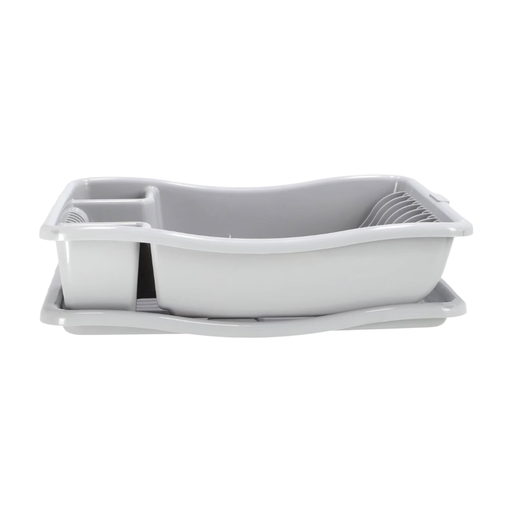
Why this suits the profile: This compact plastic model is ideal for first-timers, students and smaller households looking for a straightforward dish rack with no extra assembly required.
The dimensions are clearly stated and the included drip tray catches run-off water. Just check that 38 × 29 cm fits on your worktop.
Space for up to 12 plates, two cutlery compartments and a plastic drip tray, according to the product information.

Why this suits the profile: The combination of stainless steel, a removable PP drip tray and a layout for plates, bowls, glasses and cutlery makes it ideal for everyday use.
The drip tray is removable for cleaning and the water drain is designed to channel away excess water. Check the drain position next to your sink.
Stainless steel frame, PP drip tray, no assembly required and dimensions of approximately 42 × 29 × 12.7 cm.
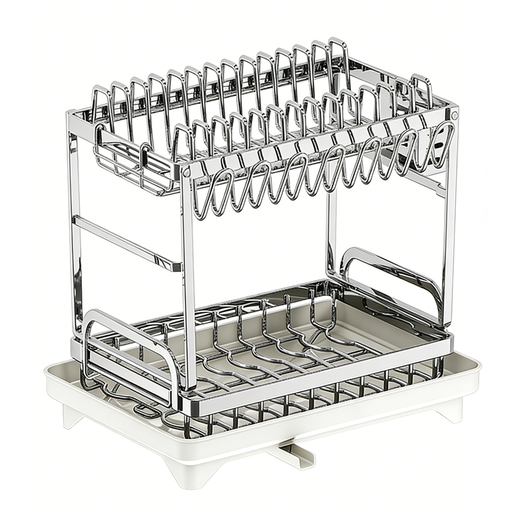
Why this suits the profile: The two levels are designed for households that wash a lot of crockery at once and want to make the most of vertical space.
The divided compartments reduce stacking of crockery. The pull-out drip tray and lower drain help keep water off the worktop.
Two tiers, stainless steel and PP, dimensions of approximately 42 × 32 × 30 cm and a built-in drain pipe.
We've put together a full, up-to-date list of products that fully meet these strict selection criteria and current European safety regulations.
First, measure the available space on your worktop. Add a few centimetres to the width for handles, and also check the height under your wall cabinets. For one or two people, a compact single-tier model is often sufficient. A family may be better off with a wider or two-tier dish drainer.
Yes, especially when the rack isn't positioned directly over the sink. A drip tray prevents water from sitting on the worktop. Where possible, choose a removable tray or a model with a drain that leads to the sink. Empty and clean the tray regularly.
The lifespan depends on the material, load and maintenance. Don't put heavy pans in a rack designed for crockery, avoid using abrasive cleaners on plastic or stainless steel, and dry metal parts if water tends to sit on them. Check the rack regularly for rust, cracks and loose joints.
