
Vandaag of morgen in huis

Kwaliteit gegarandeerd

Welkomstaanbiedingen ontgrendelen: GRATIS bezorging | Tot 80% korting | Gratis 30 dagen JoyPlus-proefperiode
Download de app
Finding the right lighting can be a challenge. You want bright light for functional tasks, but also a soft, warm ambiance for relaxing evenings. A dimmable LED ceiling light offers the flexibility to adjust the light intensity for any time of day. This makes them a practical choice for almost any room in the house, from the living room to the bathroom.
In this article, we'll help you get started. We'll discuss what to look for when making your choice and highlight several popular models with different features. This will enable you to make an informed decision that suits your needs and interior design.
Before you make a choice, it's wise to consider a few key features. These will determine how and where you can use the light.
The way you dim the light is an important consideration. Many models come as a ceiling light with a remote control. This allows you to easily adjust the brightness without getting up from the sofa. For those who want more control and automation, a smart ceiling light is an interesting option. You connect these lights to your Wi-Fi network and control them via an app on your smartphone. They can often be linked to voice assistants like Google Assistant or Amazon Alexa.
In addition to dimmability, many LED ceiling lights offer the ability to adjust the colour temperature. This is expressed in Kelvin (K).
A light with adjustable colour temperature gives you the freedom to optimise the lighting for any situation.
Not every light is suitable for every room. For places where moisture and dust are a factor, such as the bathroom, garage, or a covered balcony, the IP rating is crucial. This value indicates the degree of protection. For example, an IP54-rated bathroom ceiling light is a good choice. The first digit (5) stands for dust resistance, and the second digit (4) means the light is splash-proof. For a bathroom, a minimum IP rating of IP44 is recommended.
Below is a selection of models that stand out for their specific features.

This round, white ceiling light from Aigostar is designed for functionality. With a colour temperature of 6500K, it delivers bright daylight, which is ideal for workspaces.
Why it stands out: The IP54 rating makes this light resistant to moisture, dust, and insects. This makes it a reliable choice for spaces where standard lights are not sufficient.
Pros:
Who is it for?: For the practical buyer looking for a robust, bright, and low-maintenance lighting solution for functional spaces. Note: This model is not dimmable and has a fixed colour temperature.
View the Aigostar Ceiling Light
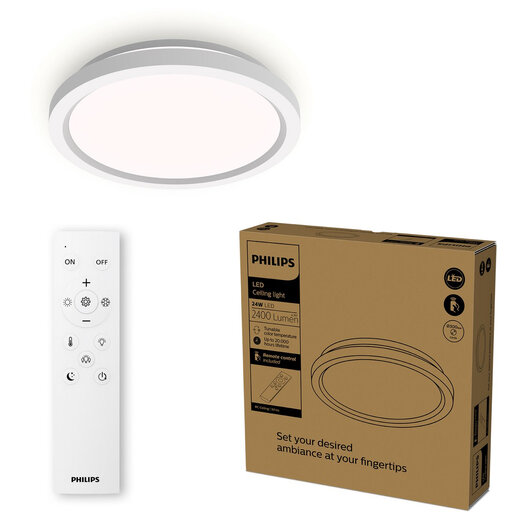
This Philips ceiling light combines ease of use with versatility. With the included remote control, you can effortlessly adjust both the brightness and the colour temperature.
Why it stands out: The ability to switch between warm white light (2700K) and cool white light (6500K) makes this light a true all-rounder for living spaces.
Pros:
Who is it for?: For anyone looking for a flexible lighting solution for the living room, bedroom, or home office, who values the convenience of a remote control.
View the Philips Ceiling Light

The Xiaomi Smart Ceiling Light D30 is a modern, smart ceiling light that focuses on light quality and connectivity. It can be controlled via the Xiaomi Home app or the included remote control.
Why it stands out: This light uses full-spectrum LEDs with a very high colour rendering index (CRI Ra97). According to the manufacturer, this ensures that colours in the room look true-to-life and vibrant, similar to natural sunlight.
Pros:
Who is it for?: For the tech-savvy user who wants to integrate their lighting into a smart home system and values superior light quality with natural colour reproduction.
The right LED ceiling lighting depends heavily on your personal preference and the specific room. The models mentioned above are just a sample of the possibilities. Are you curious about other styles, sizes, or features?
Browse our full range and discover more options that suit your situation.
Discover all LED ceiling lights
Can I dim any LED ceiling light? No, an LED light must be specifically designated as "dimmable." Both the light itself and its built-in driver must be suitable for this. Always check the product specifications to be sure.
What's the difference between dimming and adjusting colour temperature? Dimming changes the light intensity (the amount of light). Adjusting the colour temperature changes the colour of the white light, from a warm, yellowish hue (low Kelvin value) to a cool, bluish hue (high Kelvin value).
Do I need a special wall switch for a dimmable LED light? That depends on the light. Many modern dimmable LED ceiling lights, like the Philips and Xiaomi models mentioned here, are controlled with a remote or an app. In that case, a special wall switch is not necessary. If you want to dim a light using an existing or new wall switch, you will need an LED-compatible dimmer.
