
Vandaag of morgen in huis

Kwaliteit gegarandeerd

Welkomstaanbiedingen ontgrendelen: GRATIS bezorging | Tot 80% korting | Gratis 30 dagen JoyPlus-proefperiode
Download de app
If a fastener is tightened too loosely, it can develop play. Tightening it too much can damage threads, bolts or components. A digital torque wrench helps you apply the specified torque in Nm more accurately, but only if the measuring range, drive size and controls suit the job at hand.
Bicycles and motorbikes often require low torque settings. Cars, machinery and industrial applications usually require higher torque. A model that appears to offer plenty of features on paper is therefore not automatically suitable for every user.
A torque wrench with a high maximum setting may seem versatile, but the lower limit is just as important. For small bicycle bolts or motorbike components, a 17–340 Nm wrench may be unsuitable. Check that your required torque falls within the usable measuring range.
A 1/4-inch, 3/8-inch or 1/2-inch torque wrench refers to the connection for sockets or interchangeable heads. It is not the same as the size of the bolt. A 1/4-inch model is generally practical for smaller fasteners, while 1/2 inch is better suited to larger sockets and higher torque settings.
Check which sockets you already have beforehand. Otherwise, a torque wrench set may appear complete, only for you to discover that you still need to buy adapters or additional sockets.
An electronic torque wrench with a display may use a beep, vibration and LED indicator when a preset value is reached. According to MoveCrab’s product description, these signals are designed to warn the user in good time. However, they do not remove the need to work calmly and keep the wrench straight on the fastener.
Stop pulling as soon as the preset torque is reached. Do not exceed the maximum range and do not use the wrench as an impact tool or breaker bar.
The Nm unit is the most practical reference in the UK. Some models also display ft.lb, in.lb or kgf.cm. This is useful when a manual uses a different unit, but always check that the conversion has been set correctly.
For the selected digital models, an accuracy of ±2% according to the product description is stated. This is a quoted product specification, not a guarantee that every measurement will produce exactly the same result in all conditions. Store the wrench according to the instructions and have the tool checked again if accuracy is important for safety or production processes.
A mechanical torque wrench works with a scale and an adjustable spring. It does not require a battery, but the scale can be more difficult to read. An electronic model displays the value directly on screen and may offer additional functions, such as peak-value storage.
Choose the size based on the work you need to do:
A ratchet torque wrench makes working in confined spaces easier. A model with interchangeable heads can offer additional flexibility. Pay attention to the heads supplied, the locking mechanism and compatibility with your sockets.
A display is most useful when the figures are easy to see from your working position. Preset functions can save time if you frequently use the same settings. Track mode displays the torque while tightening; Peak mode records the highest value reached during the operation.
Also consider these practical points:
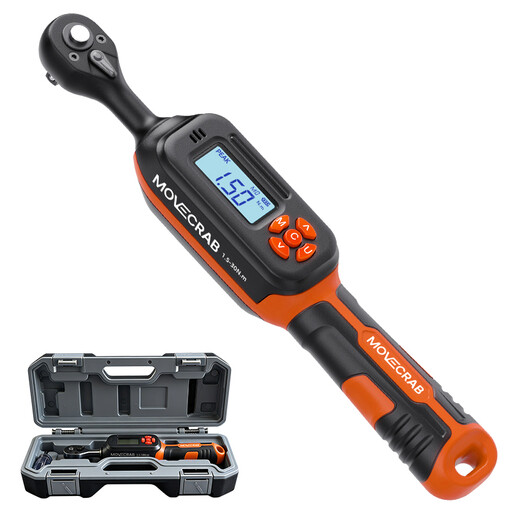
Why it suits this profile: The low range is well suited to smaller fasteners on bicycles, motorbikes and for precision work at home. The display shows Nm, ft.lb, in.lb and kgf.cm.
The limited range makes it clear what this wrench is designed for. You are not buying a large model for small bicycle bolts.
According to the product description: stated accuracy of ±2%, 10 preset values, Track and Peak modes, and three warning signals.
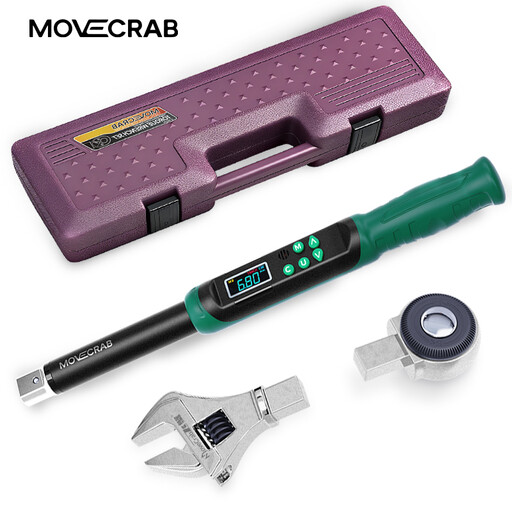
Why it suits this profile: The 3/8-inch version combines a ratchet head with an adjustable open-ended head. This makes it suitable for users working on cars, motorbikes and machinery.
You are less reliant on separate adapters because two types of head are supplied. However, check that the head is securely locked in place before use.
According to the product description: stated accuracy of ±2%, six preset values, storage for up to 500 measurements and four units.
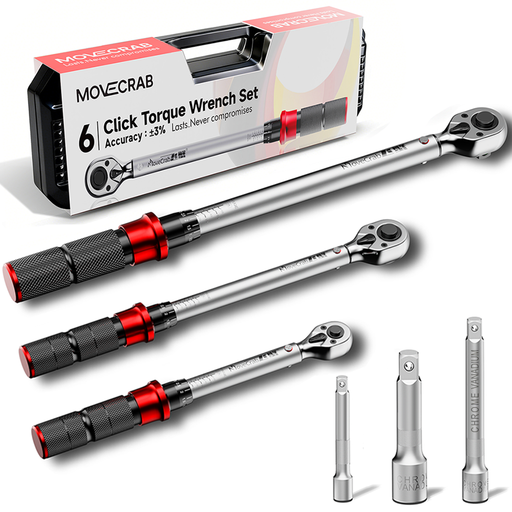
Why it suits this profile: This torque wrench set is aimed at users who need several ranges for bicycle, motorbike, car and industrial maintenance.
The set divides the range across three wrenches, so you do not have to use a single wrench outside its suitable working range.
According to the product description: three wrenches with a stated deviation of ±3%, ranges of 5-25, 20-110 and 40-220 Nm, plus three extension bars.
Choose an electronic torque wrench if a display, multiple units, preset values or an alarm function are important to you. This is practical if you regularly switch between different torque settings.
A mechanical version has a simpler design and does not require a battery. A model with a clear scale may be perfectly adequate for occasional maintenance, provided you can read the setting easily and store the wrench correctly.
For intensive use, it is sensible to look beyond the term professional torque wrench. Check the stated accuracy, range, drive size, accessories supplied and information about inspection or calibration.
We have put together a complete, up-to-date list of products that fully meet these strict selection criteria and the applicable European safety regulations.
First, check the torque settings in your bicycle’s maintenance manual. For smaller fasteners, a 1/4-inch torque wrench with a low Nm range is often more suitable than a 1/2-inch model. Also check that the sockets and bits supplied or available are compatible.
Its lifespan depends on how it is used, stored and maintained. Avoid overloading, moisture, high temperatures and drops. Store the wrench in a dry place and follow the instructions for batteries and calibration. For work requiring a fixed level of accuracy, arrange periodic checks in line with the requirements of your workshop or organisation.
In addition to the purchase price, an electronic model may require batteries. In return, features such as a display, preset values and Peak mode can simplify setting and checking. So do not compare the price alone; also consider the measuring range, drive size and the cost of any inspection or calibration.
