
Vandaag of morgen in huis

Kwaliteit gegarandeerd

Welkomstaanbiedingen ontgrendelen: GRATIS bezorging | Tot 80% korting | Gratis 30 dagen JoyPlus-proefperiode
Download de app
From: Joybuy Product Recommendation Officer
Over-tightening a bolt can damage an expensive part. Too loose, and it can create hazardous situations. For anyone serious about working on a car, motorcycle, or bicycle, precision isn't a luxury—it's a necessity. A mechanical torque wrench gets the job done, but reading the scale and feeling for the 'click' can be inaccurate, especially in a noisy workshop.
A digital torque wrench offers the perfect solution. With a clear display and distinct alerts, you know exactly when the correct torque has been reached. This article will help you make the right choice by highlighting the most important features and reviewing several popular models for 2026.
Before you make a decision, it's important to consider a few key specifications. This ensures you purchase a tool that is perfectly suited for your tasks.
The drive size determines which sockets you can use with the wrench. The size you need depends directly on the type of work you do.
Every bolt has a specific torque specification, expressed in Newton-meters (Nm). An electronic torque wrench for a bicycle has a much lower range (e.g., 1.5-30 Nm) than a professional torque wrench for car wheels (e.g., 17-340 Nm). Check your vehicle's specifications and choose a wrench with a matching range. A high-precision torque wrench typically has an accuracy of ±2% to ±3%. This ensures you consistently work within safe margins.
In a busy garage or in low light, it's easy to miss the 'click' of a traditional wrench. A torque wrench with a display solves this problem. The best models indicate that the set torque has been reached in multiple ways:
This combination ensures you never miss the signal, no matter the conditions.
Based on the criteria above, we've selected a few models that stand out for their specifications and features.
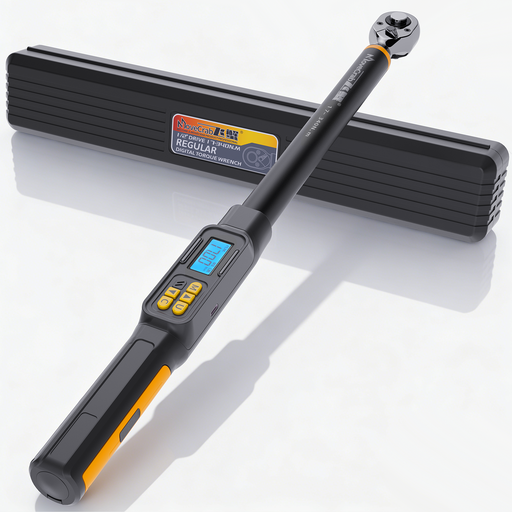
Why It Stands Out This model is designed for heavy-duty work. Its wide torque range of 17 to 340 Nm makes it suitable for the most common jobs on cars and larger motorcycles. According to the manufacturer, Movecrab, the triple-alert system with sound, light, and vibration ensures you never miss the target torque.
Advantages
Who Is This For? For the serious DIYer and the professional auto mechanic who needs a reliable and powerful 1/2" digital torque wrench for maintenance and repairs.
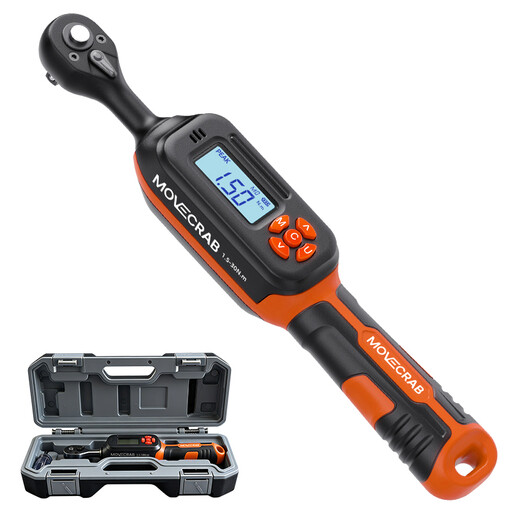
Why It Stands Out Precision is the key word for this model. With a range of 1.5 to 30 Nm, this 1/4" digital torque wrench is perfect for delicate components where over-torquing leads to immediate damage. Its compact form factor makes it ideal for working in tight spaces.
Advantages
Who Is This For? Bicycle mechanics, motorcycle technicians working on smaller engines, and hobbyists dealing with fragile (e.g., carbon) components.
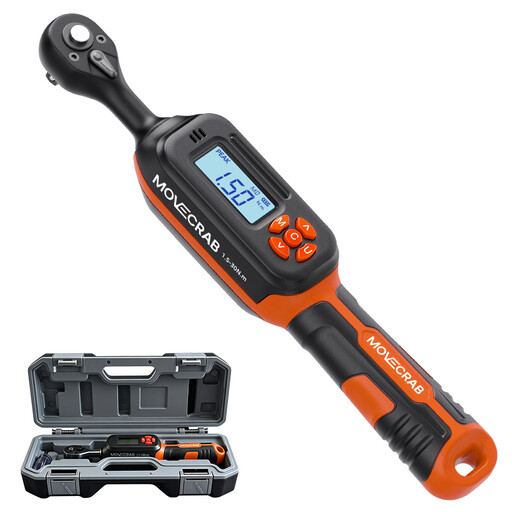
Why It Stands Out This 3/8" digital torque wrench is the perfect middle ground. Its torque range of 4.2 to 85 Nm covers a wide array of applications, from motorcycle repairs to common jobs under a car's hood. It combines the precision of the 1/4" model with some of the power of the 1/2" version.
Advantages
Who Is This For? The all-around mechanic or DIYer looking for a single, flexible electronic torque wrench for both motorcycle and automotive work.
The right tool is half the battle, but good lighting is just as crucial. This is especially true for precision jobs where you need to clearly read the numbers on your torque wrench with a display. A bright, shadow-free workspace prevents mistakes and makes the job more pleasant. Consider upgrading the lighting in your workshop as well.
Check out our selection of LED light panels
A mechanical torque wrench indicates the set torque has been reached with a 'click,' which relies on feel and hearing. A digital torque wrench uses an electronic sensor and shows the value on a display. Reaching the target torque is indicated with light, sound, and/or vibration, which is generally more accurate and unambiguous.
The calibration interval depends on usage and the manufacturer's recommendations. For professional use, annual calibration is often advised. For the serious hobbyist who uses the wrench less frequently, this can be less often. Always handle the tool with care and avoid dropping it to maintain its accuracy.
Most digital torque wrenches are primarily designed for accurately tightening bolts. While many models have a bi-directional ratchet and can therefore loosen bolts, the torque measurement is often only calibrated for clockwise (tightening) operation. To break loose stubborn bolts, it's best to use a standard ratchet or a breaker bar to avoid overloading the torque wrench's sensitive sensors.
