
Vandaag of morgen in huis

Kwaliteit gegarandeerd

Welkomstaanbiedingen ontgrendelen: GRATIS bezorging | Tot 80% korting | Gratis 30 dagen JoyPlus-proefperiode
Download de app
A digital torque wrench helps you tighten fasteners to a specified torque. This matters for things such as wheel bolts, brake components, handlebars, engine parts and bike maintenance. But a display alone doesn’t tell you whether a model is right for the job.
The most common buying mistakes usually come down to three pitfalls:
Check the source of any accuracy claims. For example, when a manufacturer states an accuracy of ±2%, this is a specification in the brand’s product description, not a general guarantee for every working situation. Use the wrench within its stated range and follow the instructions.
The measuring range determines what you can use an electronic torque wrench for. Don’t just look at the maximum torque; check the lower limit too.
Always check the torque specified by the vehicle or component manufacturer. A range that looks wide on paper won’t automatically suit every fastener.
The most common sizes are:
A ratchet torque wrench makes it easy to change the direction of rotation. Some models come with interchangeable heads or adapters. Check that the included accessories fit your sockets and fasteners.
A torque wrench with a display can show the target setting in units such as Nm, ft.lb, in.lb or kgf.cm. This is useful when instructions use a different unit. However, switching between units can lead to an incorrect setting, so check the value before you start.
A torque wrench with a vibration alert is useful when you can’t keep looking at the screen. Some models combine vibration with audible and visual alerts. According to MoveCrab’s product descriptions, several models have track, peak and preset modes. Track mode shows the current reading, while peak mode records the highest reading measured.
Memory functions are particularly useful for repeat jobs. According to their product descriptions, the models mentioned store up to 500 or 1,000 readings. This lets you look back at previous readings, but it doesn’t mean the wrench will stay accurate indefinitely without maintenance or checks.
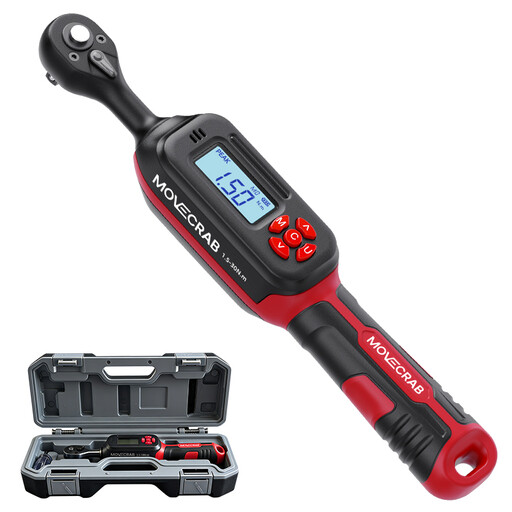
Why it suits this user: Its 4.2-85 Nm range and reversible ratchet make it a practical choice for home maintenance on bikes, motorbikes and cars.
The product description gives the specific measuring range and four units of measurement, making it easier to avoid choosing a model that isn’t suited to your needs.
According to the product description: ±2% accuracy, vibration, audible and visual alerts, plus storage for up to 500 readings.
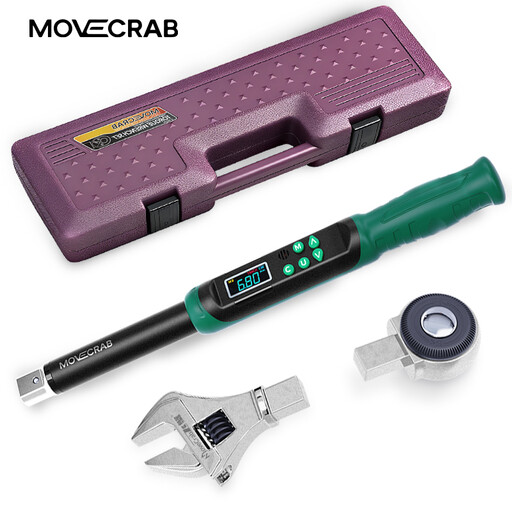
Why it suits this user: The ratchet and open-ended heads make this model a good option if you work with different nuts, bolts and pipes.
You’re not limited to a single head: the product description lists two interchangeable heads and a range of 6.8-135 Nm.
According to MoveCrab: ±2% accuracy, peak, track and preset modes, and storage for up to 500 readings.
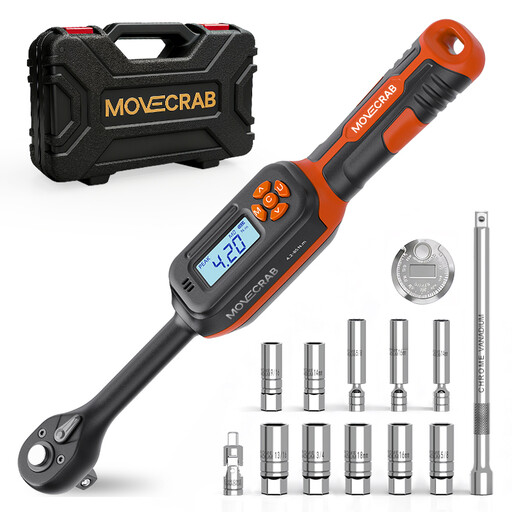
Why it suits this user: This set is designed for car, motorbike and machinery maintenance. Alongside the wrench, it includes several sockets and spark plug accessories.
The set specifies the drive size, the 4.2-85 Nm range and the included accessories, so you can check in advance whether it’s right for your work.
According to the product description: ±2% accuracy, 10 preset modes, peak mode and a set of Cr-V steel sockets.
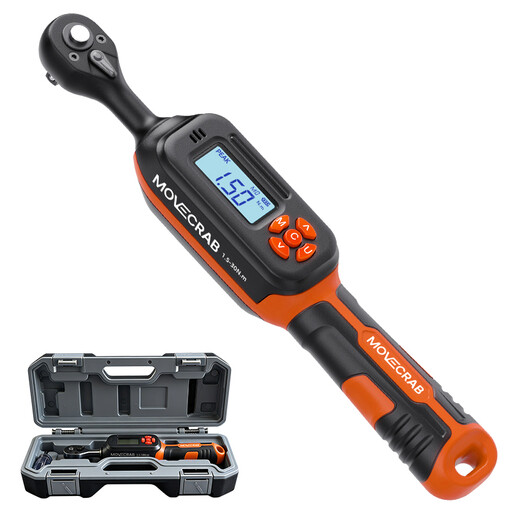
Why it suits this user: Its low starting point is useful for cyclists and anyone who needs to set the torque precisely on small, delicate fasteners.
According to the product name, the range starts at 0.6 Nm. So this isn’t a heavy-duty model that only starts measuring at higher torque settings.
According to the product description: 1/4 inch drive, ±2% accuracy, and vibration, audible and LED alerts.
We’ve put together a complete, up-to-date list of products that meet these strict selection criteria and the applicable European safety regulations.
First, set the correct unit and target value. Then fit the right socket and apply even pressure. Stop as soon as the alarm sounds, vibrates or lights up. Continuing to turn after the signal can result in excessive torque.
Also keep these points in mind:
It can be, as long as the measuring range starts low enough and the drive size fits your sockets. For delicate bike components, a 1/4 inch model with a range starting at around 0.6 Nm is often a better choice than a 1/2 inch model that only starts measuring at higher values.
It depends on how it’s used and stored, the loads it’s subjected to and the manufacturer’s calibration information. Overloading, moisture and drops can affect its measuring performance. Store the tool according to the instructions and have its accuracy checked if you use it for jobs where precise torque matters.
They’re not essential, but they can make the wrench easier to use. Vibration, audible and visual alerts are especially useful in a noisy workshop or a poorly lit area. These features are helpful extras; choosing the right unit and measuring range, and working carefully, remain the most important factors.
