
Vandaag of morgen in huis

Kwaliteit gegarandeerd

Welkomstaanbiedingen ontgrendelen: GRATIS bezorging | Tot 80% korting | Gratis 30 dagen JoyPlus-proefperiode
Download de app
A digital torque wrench is useful when you need to tighten bolts and nuts to the specified torque. This applies to cars, motorbikes, bicycles, machinery and installations. However, many models look similar in online listings. A low price, large display or claim such as “professional” says little on its own about whether a tool is suitable for your job.
As a Joybuy Product Recommendation Officer, I filter the most important product specifications and considerations. This helps you compare an electronic torque wrench based on practical features rather than marketing language.
A 5-220 Nm torque wrench may appear suitable for a wide range of tasks, but that does not mean every torque setting within this range is equally appropriate. Small bicycle components often require a low minimum setting. For wheel bolts or larger machine connections, sufficient capacity at the top end is more important.
So check:
Never use a wrench above its specified maximum. Some digital models warn that exceeding 120% of the maximum value may cause damage or loss of accuracy.
A torque wrench with a display shows the value digitally, but you will not always be looking at the screen while working. This is particularly inconvenient in a dark engine bay or a noisy workshop.
A torque wrench with a vibration alarm, audible alarm and LED indicator provides several signals when the set value is reached. According to the product descriptions for the relevant MoveCrab models, these alarms are designed to clearly indicate when you should stop. Treat this as a usability feature, not a guarantee that every installation will automatically be completed correctly.
A torque wrench is designed for controlled tightening. Do not use it as an impact tool or to loosen extremely tight bolts unless the manufacturer explicitly allows this. A long breaker bar, such as the DURATECH 1/2-inch model, is a different type of tool intended for loosening heavily seized connections.
After use, a mechanical torque wrench should generally be wound back to its lowest setting. With digital models, follow the storage and maintenance instructions in the manual.
The drive size determines which sockets and accessories you can use.
An adapter can change the connection, but it does not automatically change the permitted torque or accuracy. Also check whether the head has a fixed ratchet, reversible ratchet or interchangeable head.
The stated accuracy is an important technical specification. The product details for several MoveCrab digital models state ±2%. The six-piece mechanical set states ±3% deviation. These figures are the supplier’s product specifications and should be considered alongside the manual, operating conditions and any calibration information.
An accurate torque wrench is only useful if you:
According to the product information, digital models generally support several units, such as Nm, ft-lb, in-lb and kgf-cm. Always check that the correct unit is selected before you begin.
A torque wrench with a ratchet is easier to use in confined spaces because you do not need to reposition the handle after every small movement. A two-way ratchet can also switch between clockwise and anti-clockwise operation. Do check whether the stated accuracy applies specifically to your intended direction of rotation.
Digital models in this selection list features such as:
These functions are particularly useful if you regularly carry out the same assembly tasks.
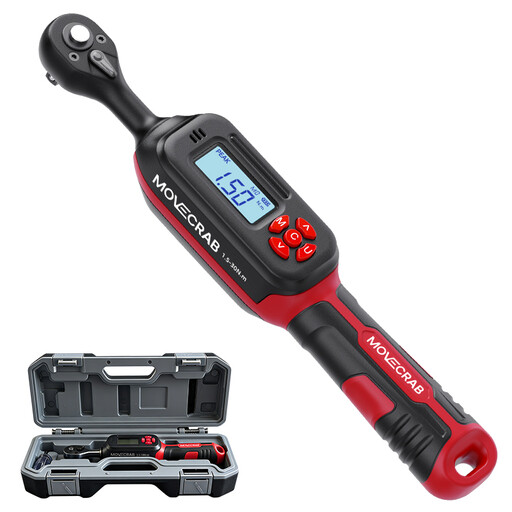
Why it suits this profile: The range from 4.2 to 85 Nm is suitable for many bicycle, motorbike and light car repairs. The digital readout makes setting the torque straightforward for users who have little experience with mechanical scales.
The clear range helps prevent you from choosing an overly powerful wrench for small connections. The product description lists vibration, audible and LED alarms.
3/8-inch ratchet, Track and Peak modes, 10 presets and storage for up to 500 values according to the product details.
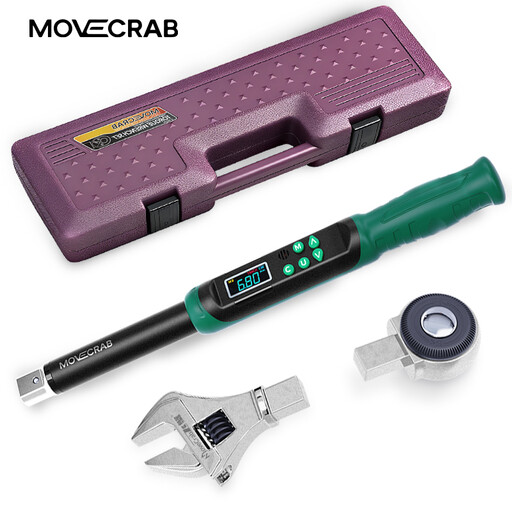
Why it suits this profile: This 3/8-inch electronic torque wrench combines a ratchet head with an adjustable open-ended head. This is practical for maintaining cars and machinery, as well as for connections where a standard socket will not fit.
The interchangeable heads reduce the need to buy a separate tool for every connection. The product details state a range of 6.8 to 135 Nm and a specified accuracy of ±2%.
4 measurement units, Peak, Track and Preset modes, 6 saved preferred values, plus a ratchet and open-ended head.
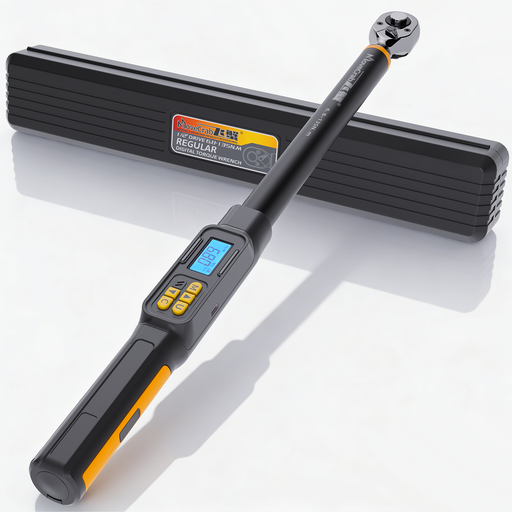
Why it suits this profile: The 1/2-inch connection is designed for higher torque settings when working on cars, motorbikes and during maintenance tasks. The triple alert is useful when you cannot keep your eyes on the display.
The larger drive size and range of 6.8 to 135 Nm make this model less limited than a small bicycle wrench. However, check that the range suits your required torque specifications.
According to the product description: ±2%, two-way ratchet, LED, audible and vibration alarms, 10 preferred values and 500 stored measurements.
We have compiled a complete, up-to-date list of products that fully meet these strict selection criteria and the applicable European safety regulations.
For small bicycle jobs, a 1/4-inch model may be sufficient. For a car torque wrench or motorbike torque wrench, 3/8 or 1/2 inch is often more practical, depending on the specified values. A mechanical torque wrench set may be worth considering if you do not want to use batteries and need several ranges.
Not automatically. Accuracy depends on the product specification, how the wrench is used and its condition. The product details mentioned above state ±2% for several digital models and ±3% for one mechanical set. Always compare these values within the same range and follow the maintenance and calibration instructions.
Its service life depends on the load, storage and maintenance. Avoid exceeding the maximum range, do not use the wrench as an impact tool and keep the electronics dry. Remove or check the batteries according to the manual if you are not going to use the tool for an extended period.
In addition to the purchase price, the main considerations are batteries, any calibration and suitable sockets. A model with memory and several measurement units can save time when carrying out recurring tasks. For occasional jobs, a simpler model without extensive storage functions may be the more sensible choice.
