
Vandaag of morgen in huis

Kwaliteit gegarandeerd

Welkomstaanbiedingen ontgrendelen: GRATIS bezorging | Tot 80% korting | Gratis 30 dagen JoyPlus-proefperiode
Download de app
A digital torque wrench helps you tighten bolts and nuts to a set torque. This matters for jobs such as bicycle maintenance, motorbike repairs, wheel fitting and workshop tasks. However, not every model is suitable for every job. A low purchase price may offer little value if the measurement range is unsuitable, the drive size doesn’t fit or the warning signal is barely audible in a noisy garage.
These are some common pitfalls:
First, check the minimum and maximum torque in N·m. Bicycle components often require low torque settings, while wheel bolts or motorbike parts need a higher range. A wrench with a range of 4.2 to 85 N·m suits many light-duty car, motorbike and bicycle jobs, but not every heavy-duty fastening task.
A claim such as torque wrench accuracy of ±2% sounds clear, but read the product information carefully. According to Movecrab’s product description, the stated ±2% accuracy on the relevant models applies to the specified direction of rotation. Treat this as a product specification, not a general guarantee for every situation. Calibration, storage and correct use can all affect measurement performance.
The square drive determines which sockets fit directly:
Also check whether the wrench measures in both directions. A ratchet mechanism can be useful when loosening fasteners, but the accuracy specification doesn’t necessarily apply automatically in both directions.
A torque wrench with an LED display shows the current reading digitally and may offer different units, such as N·m, ft·lb, in·lb and kgf·cm. This helps prevent conversion errors when a manual uses a different unit.
A torque wrench with a vibration alert and audible signal can be useful in a workshop where compressors and power tools drown out other sounds. A visual alert provides an extra check. According to Movecrab’s product descriptions, the digital models mentioned combine vibration, sound and an LED warning. Before buying, check the battery requirements, display size and button layout.
A torque wrench for cars and motorbikes usually needs a wider range than one intended solely for bicycle use. For a professional torque wrench, storage, repeatability and maintenance are also important. A memory function can be handy when you use several set values in succession, but it isn’t essential for every DIY user.
Also follow these guidelines:
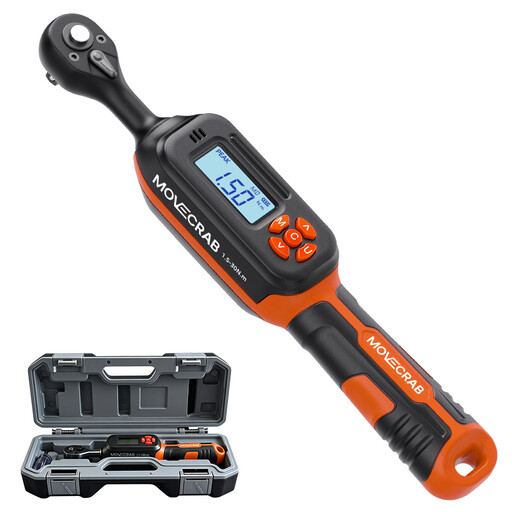
Why it suits this user: The 4.2-85 N·m range covers many general maintenance jobs on bicycles, motorbikes and cars. The digital controls and multiple measurement units make it easy to use if you’re switching from a mechanical to an electronic torque wrench.
The drive size and measurement range are clearly stated. According to the product description, vibration, sound and an LED are combined, so you don’t have to rely on just one warning.
3/8-inch drive, stated accuracy of ±2% and storage for up to 500 readings, according to the product information.
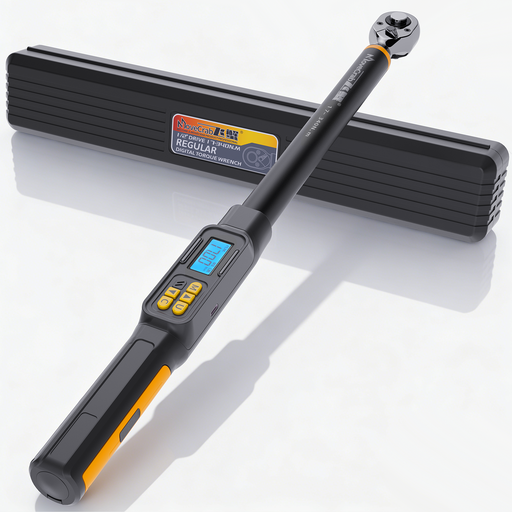
Why it suits this user: This model is designed for users who value a digital readout, preset values and a compact drive. The product description gives a range of 17-340 N·m; before buying, check that this stated range suits your sockets and the jobs you have in mind.
You can compare the stated measurement values, drive size and alert types in advance, rather than relying on the word “professional” alone.
LED display, N·m/ft·lb/in·lb/kgf·cm according to the product description, and 10 memory slots for preset values.
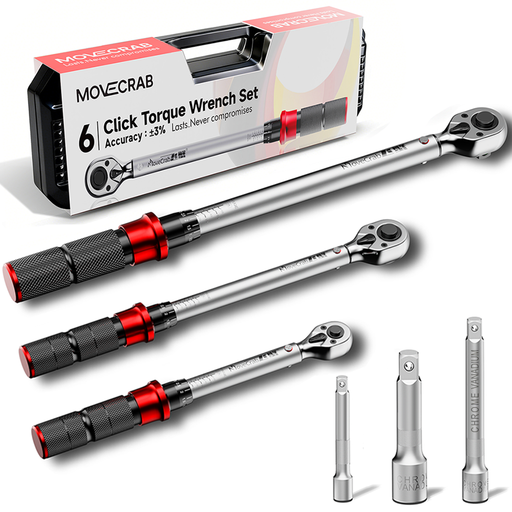
Why it suits this user: If you regularly need different ranges, three wrenches and three extension bars give you more flexibility. This is a mechanical alternative to an electronic torque wrench for car, motorbike and industrial jobs.
The set spreads the range across several wrenches. According to the product description, the stated deviation is ±3%; compare this with the tolerance required by your vehicle or component manual.
A range of 5-220 N·m, 1/4-, 3/8- and 1/2-inch extension bars, and three different wrench ranges, according to the product information.
We’ve put together a complete, up-to-date list of products that meet these strict selection criteria and the applicable European safety regulations.
Yes, as long as the model has a sufficiently low range. For delicate bicycle components, a 1/4-inch digital torque wrench with a range starting at around 0.6 N·m may be more practical than a 3/8-inch model with a higher minimum. Always check the specified torque for the component.
Its lifespan depends on the load, storage, battery use and maintenance. Store the wrench somewhere dry, avoid dropping it and don’t exceed its maximum setting. If you use it intensively in a workshop, it’s sensible to check its accuracy regularly. A display or alarm doesn’t remove the need for calibration.
As well as the purchase price, you’ll need to consider batteries, any calibration and compatible sockets. A model with memory and several alert types can save time, but these features are only worthwhile if you actually use them. So compare the complete set-up with a mechanical ratchet torque wrench or a complete set.
