
Baker with limited storage space
Wants to keep track of baking time without having to make room in a cupboard or on the worktop. Product information from HEMA, Brabantia and TFA Dostmann describes timers with different fixing options.


If you’re baking a cake and short on storage space, a compact digital timer with a suitable fixing or stand is a sensible place to start. Then choose based on how it’s operated, how easy the display is to read and its timing range. The alarm tells you when to check, but it can’t tell you whether the cake is cooked.
Wants to keep track of baking time without having to make room in a cupboard or on the worktop. Product information from HEMA, Brabantia and TFA Dostmann describes timers with different fixing options.
Wants to know when it’s time to check the cake while getting on with other things. TFA Dostmann describes a timer with a display; the Voedingscentrum advises checking whether the dish is ready at the end of the stated cooking time.
Wants to keep track of the cake and other dishes separately. OXO describes the Triple Timer as having three timers with separate alarms.
First, decide where you can place and read the timer. Then compare its timing range and controls with your recipe and how you plan to use it.
| What to consider | What should you check? | Who is this important for? |
|---|---|---|
| Limited space | Check the dimensions and how it attaches, and decide in advance where you’ll be able to see the display. | If I don’t want to leave a timer on the worktop, I’ll look for a suitable place to hang or attach it. Saving space is the main reason for buying for around 36% of consumers. |
| Keeping track of the time | Check whether you can see the display from where you’re working and whether you’ll notice the alarm. | If I don’t want to lose track of the cake while doing other things, I want to be able to read the time remaining and notice the alarm. Readability and the alarm are the main priorities for around 29% of consumers. |
| Setting one baking time | Compare the controls and check that the maximum time setting covers your recipe. | For one cake, I want to be able to set the baking time easily. Controls for setting a single time are the most important deciding factor for around 21% of consumers. |
| Several dishes | Check how many timers can run at once and whether you can tell their alarms apart. | If several dishes could be ready at the same time, I want to track when each one is due separately. Having several separate timers is the main priority for around 14% of consumers. |
A magnet only saves space if you can attach the timer somewhere suitable and see the display clearly there.
Decide where you’ll put it before you buy. If attaching it isn’t practical, compare models with a stand, clip or hanging option.
A kitchen timer tells you when the set time has elapsed; it doesn’t tell you whether the cake is ready.
Use the alarm as a reminder to check, and follow your recipe’s instructions. The Voedingscentrum advises checking whether the dish is ready at the end of the cooking time.
The battery supplied and the maximum time you can set vary by model.
Check what’s included in the packaging and compare the maximum time setting with the baking time in your recipe.
You’ll need to supply one AAA battery for the HEMA model reviewed.
A digital magnetic kitchen timer for anyone looking for a simple timer that can be attached somewhere suitable.
The Tasty+ combines a magnet with controls operated by turning the outer ring.
The 38.2021.01 is a digital timer worth considering if you’re looking for different placement options.
The Triple Timer is designed to let you keep track of several dishes separately.
The Heyo is a digital rotary timer worth considering if you want a compact model with adjustable volume.
This product selection is designed to help you keep track of a cake’s baking time with a digital timer when storage space is limited.
 No image available
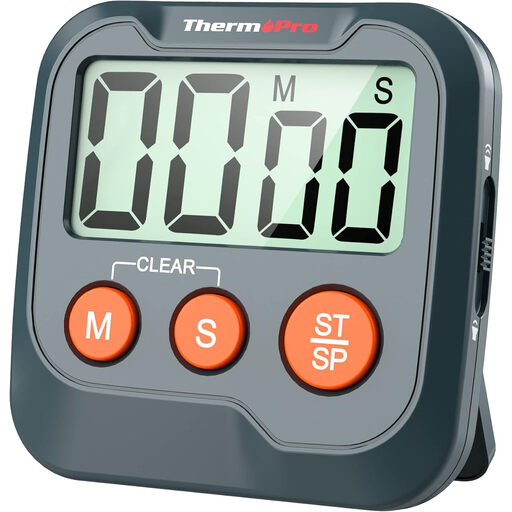
Suitable for keeping track of one baking time if your recipe’s timing falls within the range of 99 minutes and 59 seconds.
Includes a stopwatch function and adjustable volume.
Follow the steps and timings in your recipe. The Voedingscentrum advises setting the oven time according to the recipe and checking whether the dish is ready at the end.
Not necessarily: the alarm tells you that the set time has elapsed. The Voedingscentrum advises checking whether the dish is cooked at the end.
It depends on the model. One AAA battery is not included with the HEMA kitchen timer reviewed; Brabantia lists a CR2032 battery included with the Tasty+ model reviewed, while TFA Dostmann lists an AAA battery included with model 38.2021.01.
According to the Dutch government, when you buy at a distance you’ll often have a 14-day cooling-off period. There’s no fixed statutory warranty period in the Netherlands; a manufacturer’s warranty is in addition to your statutory rights.
The Dutch government classifies devices that use electricity or batteries as electrical appliances. Used batteries must not go in the bin; take them to a collection point.