
Vandaag of morgen in huis

Kwaliteit gegarandeerd

Welkomstaanbiedingen ontgrendelen: GRATIS bezorging | Tot 80% korting | Gratis 30 dagen JoyPlus-proefperiode
Download de app
A digital thermometer belongs in any well-equipped bathroom or medicine cabinet. Even so, choosing the right model quickly can be difficult. A fever thermometer, forehead thermometer and ear thermometer do not work in the same way. Terms such as “1-second measurement” or “clinical accuracy” also do not automatically mean that every result will be the same in all circumstances.
The right choice depends on who will use the thermometer, where you want to take the temperature and how much attention you are prepared to pay to the measurement instructions.
An infrared thermometer can display a reading within a second. That is useful with a sleeping baby or restless child, but speed alone says little about the quality of the measurement. The distance from the forehead, ambient temperature, perspiration and movement can all affect the result.
A non-contact thermometer must therefore be used at the prescribed distance. For some models, this may be 1 to 5 cm; for others, 4 to 6 cm. Always check the instructions.
A pen-style model with a flexible tip can be used orally, rectally or under the arm. A forehead thermometer measures from the outside and is hygienic and fast. An ear thermometer requires correct positioning in the ear, but can be practical for young children and adults.
So do not focus solely on the display or appearance. Pay particular attention to the measurement site, the accessories required and whether it is suitable for babies, children and adults.
Some thermometers display colour codes or age settings. This can make a reading easier to interpret, but a colour display is no substitute for medical assessment. According to Braun’s own information, the Age Precision features are used to interpret temperature readings by age group. Treat this as an aid to reading the result, not as a diagnosis.
Choose a method that suits your everyday needs:
Only use a thermometer for the purpose for which it was designed. A kitchen or meat thermometer, such as the WMF Profi Plus, is intended for food and not for measuring body temperature.
A display with a resolution of 0.1 °C shows small changes. This does not mean that every measurement is automatically accurate to 0.1 °C. The permitted deviation varies depending on the model, measurement area and conditions.
For example, the Treesmile T11 specifies a measurement range of 32.0 °C to 42.9 °C, with different margins of error within specific temperature ranges. This type of information is more useful than a general claim of “high accuracy”.
The following details are practical for families:
Clean the device according to the instructions. Do not immerse a digital thermometer in water and avoid scratching the sensor. When the device is used by several people, a consistent cleaning routine is important.
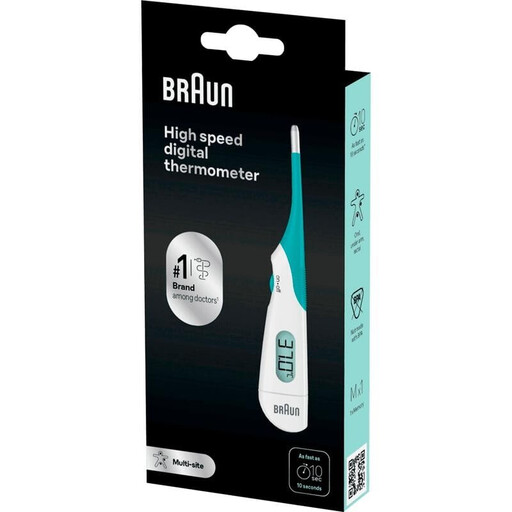
Why it suits this profile: This pen-style model is straightforward to use and suitable for oral, rectal and underarm measurements. According to the product description, the measurement time is approximately 8 seconds, although results may vary depending on the individual and the measurement method.
The measurement method is clearly described, while the flexible tip makes the device suitable for different measurement sites.
LCD display, memory for the last reading, flexible tip, battery and protective cover included.
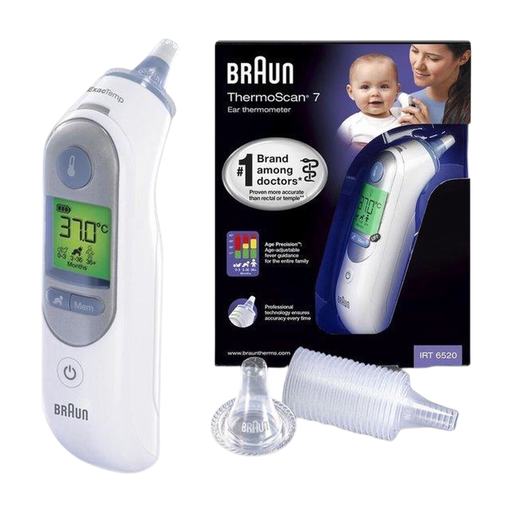
Why it suits this profile: An ear thermometer with age settings, a pre-warmed probe and an ExacTemp indicator is ideal for families who place a high value on positioning and a consistent measuring method.
The indicator helps ensure stable positioning. A new hygienic cover is used for each measurement, in accordance with the product instructions.
Age settings, colour-coded display, 21 hygiene covers, two AA batteries and storage case.
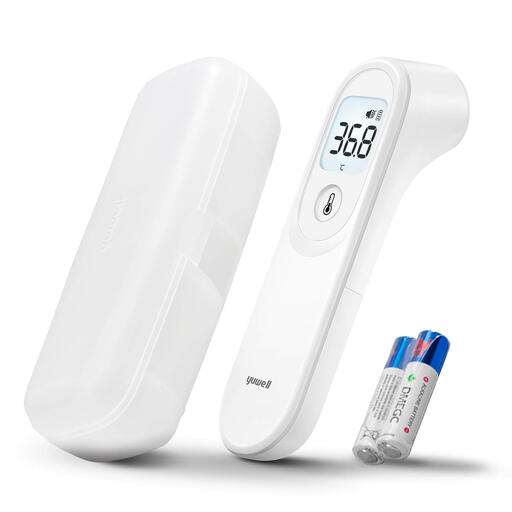
Why it suits this profile: This non-contact model is designed for quick measurements for adults and children. The product description mentions distance detection, a large display and a silent mode.
The distance sensor helps you maintain the prescribed position. Clean the forehead and avoid taking a measurement immediately after exercise or exposure to heat.
Non-contact measurements, a result in approximately one second according to the description, mute mode, carry case and two AAA batteries.
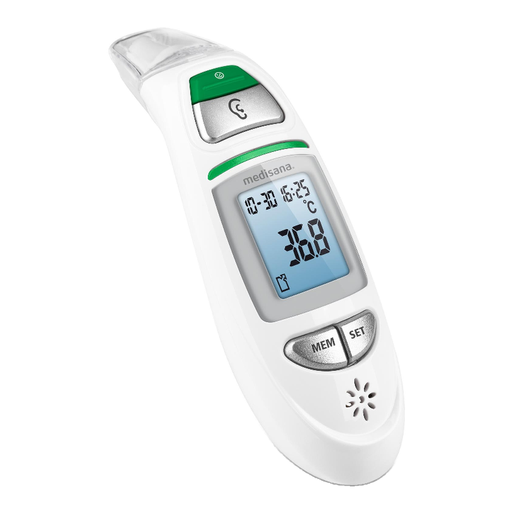
Why it suits this profile: The TM 750 is a compact forehead thermometer for non-contact measurements for babies, children and adults, with a memory function for previous readings.
The measurement site is clearly limited to the forehead. This reduces the risk of accidentally using the device as an internal thermometer.
Non-contact infrared measurement, memory function, digital display with one decimal place and suitable for home use.
We have put together a complete, up-to-date list of products that fully meet these strict selection criteria and the applicable European safety regulations.
Always follow the instructions for your chosen model. With a forehead thermometer, it is important to have a clean, dry forehead. Wait a while after exercising, showering, eating or drinking before taking a measurement. Keep the device and head still, and if in doubt, take several measurements in the same place.
When taking repeated measurements, note the time, measurement method and reading. This helps prevent readings taken under the arm from being compared directly with readings taken in the ear or on the forehead.
A digital thermometer is intended as an aid for measuring temperature at home. If you are concerned about a baby, child or adult, if unusual readings persist or if there are other symptoms, it is advisable to contact your GP.
The lifespan depends on battery use, cleaning and storage. Store the device in a dry place, protect the sensor from scratches and remove the batteries if you will not be using it for an extended period. Replace disposable covers according to the instructions.
A forehead thermometer can be practical for a baby, particularly because it allows measurements to be taken without contact. However, check the age restrictions, measuring distance and instructions for the specific model. With newborns, or if you have concerns about their health, you should not rely solely on a device reading.
In addition to the purchase price, batteries, hygiene covers and any replaceable accessories may add to the cost. A pen-style model generally uses a small button battery. An ear thermometer may require disposable covers, while some forehead models work without contact covers. It is therefore worth considering the total cost of use, not just the price at the time of purchase.
