
Vandaag of morgen in huis

Kwaliteit gegarandeerd

Welkomstaanbiedingen ontgrendelen: GRATIS bezorging | Tot 80% korting | Gratis 30 dagen JoyPlus-proefperiode
Download de app
A digital thermometer is a household essential for many families, particularly those with babies, children, older people or anyone whose health can change from day to day. However, the differences between models are often greater than the packaging suggests. A fast temperature reading does not automatically mean the device is right for your needs.
When comparing models, pay particular attention to the measuring method, the conditions of use and ongoing maintenance costs. This will help you avoid buying a thermometer that proves awkward to use with a sleeping baby, is difficult to clean or only works accurately in very specific circumstances.
An infrared thermometer may display a result in around one second, according to the product description. That is convenient, but the reading also depends on the distance, positioning, ambient temperature and a clean measuring surface. A digital pen thermometer may take slightly longer, but can be suitable for measurements taken under the arm, in the mouth or rectally, depending on the instructions for use.
So do not just look for “fast” — check where and how you need to take the measurement.
A colour display, beep or thermometer with a fever alert can help you read a value quickly. However, such a signal is not a diagnosis. Manufacturers may use their own algorithms or age settings. According to Braun’s own research, Age Precision is used to display temperature readings with age-specific colour codes. This does not mean that a colour alone is sufficient to make a medical decision.
Some ear thermometers use disposable probe covers. This can be useful when the device is shared between several family members, but it also creates ongoing costs. A contactless thermometer usually avoids this drawback, although the sensor must still be cleaned according to the instructions.
Also check whether batteries, protective covers, a storage case and an instruction manual in Dutch are included.
A forehead thermometer and a contactless thermometer use infrared technology to measure the surface temperature of the forehead. This is useful for sleeping children and whenever you want to avoid direct skin contact. According to the product information, the Medisana TM 750 is designed for contactless forehead measurements and has a memory function.
An ear thermometer measures inside the ear and requires correct positioning. According to the product specifications, the Braun ThermoScan 7 has a pre-warmed tip, a wide measuring probe and ExacTemp positioning guidance. With babies and young children, it is particularly important to follow the instructions carefully.
A pen model makes direct contact with the body. According to the product description, the Treesmile T11 has a resolution of 0.1 °C, a measuring range of 32.0 °C to 42.9 °C and a replaceable LR41 button cell.
An infrared thermometer may display inaccurate readings if the forehead is sweaty, covered or has just been washed. A cold room, direct sunlight or a rapid change from outdoors to indoors can also affect the result.
For the Braun BNT050WE, the instructions state that the thermometer and user should have been exposed to the same ambient temperature for at least 30 minutes. The manual also recommends holding the device 1 to 5 centimetres from the centre of the forehead. Follow the specified distance and preparation instructions for each model.
A memory function is useful when you want to compare readings taken at different times. Check how many values are stored: the Braun ThermoScan 7 records nine readings, while some infrared models can store up to 35 or 60 values, according to their product information.
For use at night, a backlit display, silent mode and clear confirmation of a reading are practical features. A colour code can make readings quicker to interpret, but always check the exact temperature and age setting.
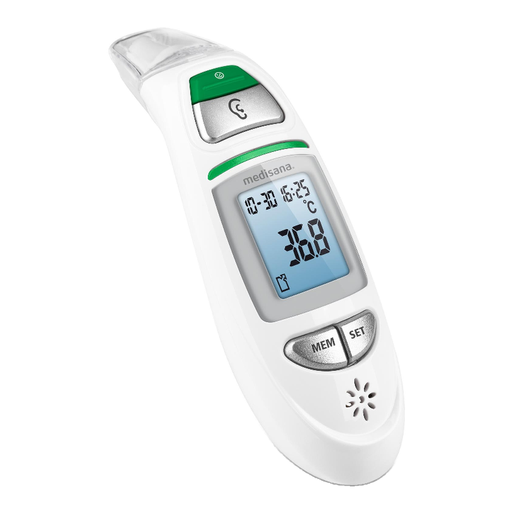
Why it suits this profile: Contactless forehead measurement and simple operation are ideal for families looking for a digital thermometer for everyday use at home.
The product information clearly states that this model is intended for forehead measurements, not internal measurements. This makes its usage limitations clear from the outset.
Contactless infrared measurement, a memory function, digital display and a design suitable for babies, children and adults.
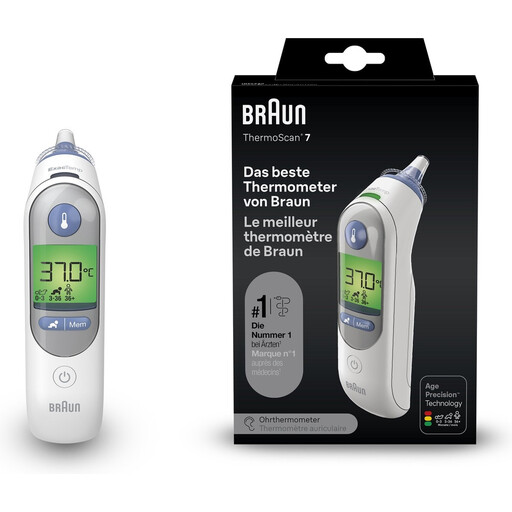
Why it suits this profile: This model is designed for families looking for an ear thermometer with age settings, positioning guidance and multiple memory slots.
The instructions specify using a new hygiene cover for every measurement. This makes the hygiene requirement clear, although you will need to factor in the cost of refills.
Age settings, colour-coded display, ExacTemp positioning guidance, nine memory slots and a pre-warmed measuring tip.
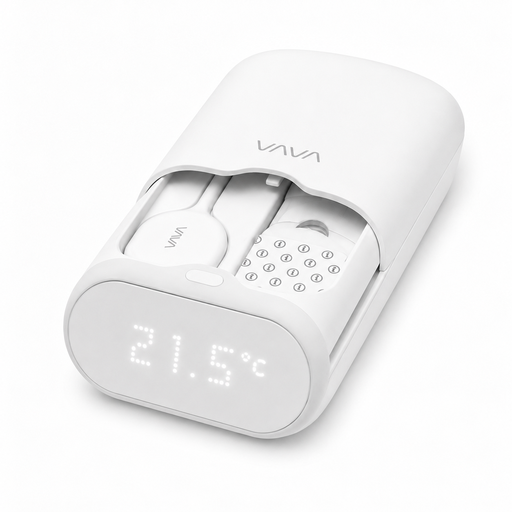
Why it suits this profile: Parents who want to monitor their baby’s temperature over a longer period get a separate sensor and display without the need for an app.
The product information states a range of up to 15 metres, along with light and sound alerts. Read the instructions and check the skin regularly when using the patch.
Continuous monitoring according to the product description, up to 24 hours of sensor use and a separate display without an app.
A baby thermometer, children’s thermometer or adult thermometer does not necessarily need to be a different device. More important factors include the permitted measuring site, sizing, operation and the manufacturer’s instructions.
We have put together a complete, up-to-date list of products that fully meet these strict selection criteria and the applicable European safety regulations.
The lifespan depends on battery use, cleaning, storage and the vulnerability of the sensor. Store the device in a dry place, avoid dropping it and remove the batteries if the model will not be used for an extended period. Also check the warranty terms. In the EU, the Medisana models mentioned are covered by a minimum statutory warranty of two years; additional rights may apply under national law.
In addition to the purchase price, batteries, hygiene covers and replacement patches can affect the overall cost. A contactless forehead thermometer generally does not use disposable covers, while an ear thermometer with lens filters may require more consumables. For a baby temperature monitor, sensors and adhesive patches are also relevant.
A contactless infrared thermometer can be practical because you do not need to touch the child. However, always measure at the specified distance and under the recommended conditions. An alarm or colour code is only an aid; do not assess the situation solely on the basis of a single reading.
