
Beginner learning to play waltzes
You want to develop your melody and left-hand accompaniment while learning to control touch, time and pedal. Casio describes an adjustable metronome on the CDP-S110, while Roland lists Twin Piano on the FP-10.


For playing a waltz with both hands, it’s worth comparing digital pianos with a keyboard suited to your playing goals, useful pedal functions and a metronome with an adjustable time signature. Measure the space for the stand, music rest and seat too. A portable model can keep the floor clear, but using headphones doesn’t mean the keys or pedals will be silent mechanically.
You want to develop your melody and left-hand accompaniment while learning to control touch, time and pedal. Casio describes an adjustable metronome on the CDP-S110, while Roland lists Twin Piano on the FP-10.
Your piano needs to fit into a room that serves another purpose too. Compare the instrument’s dimensions and allow extra space for the stand, music rest, stool and room to move. Yamaha and Korg publish dimensions for the P-145 and B2 respectively.
You want to practise with headphones when you don’t want sound coming from the speakers. Check the connection on the exact version you’re considering, and bear in mind that headphones won’t eliminate mechanical noise from the keys or pedals.
First, compare the keyboard and pedal with your learning goals, then measure the entire playing area. Also check whether the metronome can be set to a three-beat bar.
| What to consider | What to look for | Who should pay particular attention? |
|---|---|---|
| Touch response and pedal | Try the touch response if possible. Check which pedal is included and what functions an optional pedal adds. | If I want to develop my two-handed piano technique, I pay attention to the keyboard and pedal. Around 28% of consumers prioritise touch response and pedal for playing technique. |
| Space in the spare room | Measure the playing area and compare the dimensions of the version, including the music rest and any stand. | If the room also needs to remain a spare room, I want to position the piano without overlooking the seating area and room to move around. Around 22% of consumers prioritise the space available. |
| Practising with headphones | Check the connection type on the exact version, and try the set-up if noise is an important consideration for other people in your home. | If I don’t want to disturb others with sound from the speakers, I check the headphone connection. Around 22% of consumers make private practice their main priority when choosing. |
| Practising in waltz time | Check whether you can set three beats per bar and how to adjust the tempo and accent. | If I want to practise the waltz rhythm, I want to be able to set the time signature myself. Around 17% of consumers prioritise time-signature and learning features. |
| Complete playing set-up | Compare what’s included with the exact version against the stand, stool, headphones and pedal functions you need. | If I don’t want to source every component separately, I compare what comes with the piano against the set-up I need. Around 11% of consumers prioritise having all the equipment they need. |
The amount of space the piano takes up changes when you use a music rest or stand. The instrument’s dimensions don’t tell you how much room you need for the stool and player.
Measure the entire playing area, including accessories and room to move.
You may need a different stand or have to rearrange the room.
Manufacturers distinguish between a basic pedal included with the piano and optional features such as half-pedalling.
Compare what’s included with the exact version against the pedal technique you want to learn, and check that any upgrades are compatible.
A more advanced pedal and, sometimes, a suitable stand may need to be bought separately.
A headphone connection lets you listen without using the built-in speakers, but it says nothing about mechanical key or pedal noise in your room.
Try the instrument if mechanical noise could be a deciding factor for other people in your home.
The P-145 is worth comparing if you’re looking for a portable piano with 88 keys and a GHC keyboard.
The FP-10 is worth comparing if the keyboard and practising alongside a teacher are important to you.
The CDP-S110 is worth comparing if you’re looking for a slim, portable piano with a metronome.
The ES120 is worth comparing if you want to weigh up its learning and pedal functions against a permanent home set-up.
The B2 is worth comparing if you’re looking for a piano with 88 weighted keys and an adjustable metronome.
These Joybuy options are keyboards and digital pianos with 61 keys. Compare the number of keys and listed features with the requirements of your waltz lessons and the space you have available.
 Image unavailable
The product name mentions a weighted keyboard and headphone connection. Check whether 61 keys suit your learning goals.
 Image unavailable
The product name mentions a metronome and music rest. Check whether the number of keys and the connection suit your practice set-up.
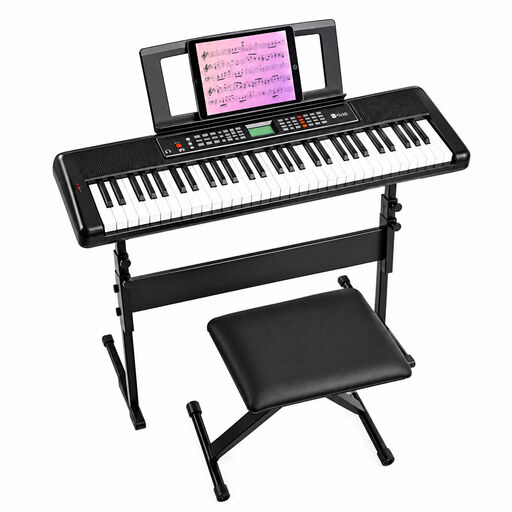 Image unavailable
The product name mentions a stand, stool and music rest. Compare the listed components with what you need for your playing area.
Yes, if you can set the metronome on the version you’ve chosen to three beats per bar. The Casio CDP-S110 manual describes adjustable time signatures; check the manual for any other model.
Check the dimensions with the accessories you plan to use and follow the instructions for a suitable stand. Leave room for your seat and pedal too; the instrument’s dimensions aren’t the same as the space you need in the room.
No, the pedal set varies by model and version. Casio lists an SP-3 pedal as included with the CDP-S110; for half-pedalling on the FP-10, Roland lists an optional DP-10 pedal. Check what’s included with the version you’re considering and whether it’s compatible.
According to ACM ConsuWijzer, in addition to any seller’s or manufacturer’s warranty, you have a legal guarantee: when used normally, the product must do what you could reasonably expect. Online product purchases generally come with a statutory cooling-off period of up to 14 days after delivery, subject to exceptions that you should check before buying.
The Dutch Government states that electrical appliances sold on the EU market must meet the applicable safety requirements and carry a CE marking. For the specific offer, check the version, included power supply and product information.