
Beginner waltz student
You want to practise the melody and accompaniment with both hands, so look for responsive keys, a metronome and suitable pedal options. Yamaha, Roland and Korg describe features that may be useful.


When choosing a digital piano for waltz lessons, focus on the feel of the keys, practice features and the set-up your studio can accommodate. A portable model may suit you if you share the space or need to put the instrument away; for a permanent set-up, check which stand and pedals are included with the version you’re considering. Before buying, also check that the specific version carries the CE marking.
You want to practise the melody and accompaniment with both hands, so look for responsive keys, a metronome and suitable pedal options. Yamaha, Roland and Korg describe features that may be useful.
You want to practise on your own without the speakers disturbing others. Check that the headphone socket on the specific version is compatible with your headphones; Roland and Korg both list headphone listening options.
You may need to move or put the instrument away, so compare its dimensions and weight, as well as the parts you’ll need to play. Yamaha lists the P-145 as weighing 11,1 kg; Korg says the stand and pedal unit for the B2+ are available separately.
A good fit if: you share the studio or need to move the instrument regularly. Compare the space available with the dimensions and weight of the specific version.
Bear in mind: a standalone instrument doesn’t automatically come with everything you need to play; Yamaha lists the three-pedal unit for the P-145 as optional.
A good fit if: the piano can stay in the studio and your lessons call for more extensive pedal control. Korg distinguishes the B2+ from the B2+SP, which the manufacturer says comes with a stand and three pedals.
Bear in mind: check the version and what’s included in the bundle; the stand and pedal unit aren’t included in the same way with every variant.
| What to consider | What should you check? | Who is this important for? |
|---|---|---|
| Keys and control of each part | If possible, try the keyboard and compare the number of keys, the key action and the adjustable touch response. | If you want to control the melody and accompaniment separately in a waltz, the feel of the keys is likely to come first. Around 29% of consumers in this choice breakdown name it as their top purchasing priority. |
| Keeping time and using the pedals | Check whether the metronome lets you set the time signature you need and which pedals are included with the specific version. | If your main aim is to practise a steady pulse and use the pedals in line with your lesson material, these features are key. Around 29% of consumers give practising time and pedal technique their top priority. |
| Listening in a shared studio | Check the type of headphone socket and whether others in the studio also need to listen through the speakers. | If you want to practise on your own while others use the space, headphone listening is an important consideration. Around 21% of consumers prioritise practising without interruptions. |
| Positioning and set-up | Measure the space, including room for the music rest and seating; compare the dimensions and weight, as well as what’s included in the bundle you’ve chosen. | If you need to put the piano away or move it, check that the instrument and all the parts you need will fit in the space available. Around 21% of consumers give a practical set-up that fits their space top priority. |
A compatible socket doesn’t automatically mean an extended pedal unit is included. Yamaha lists the LP-5A unit for the P-145 as optional; Korg says the PU-2 pedal unit for the B2+ is sold separately.
Before buying, check what’s included with the specific version and confirm compatibility, including with the pedals you need for your lessons.
You may need to buy a compatible pedal unit separately.
An instrument that’s easy to move still needs to fit where you’ll play. Depending on the version, the stand may also be a separate accessory.
Measure the available space and check in advance whether you’ll need a stand, music rest or any other parts.
Easypianos & Guitars published a digital piano ranking dated 2025. Its original position doesn’t, by itself, tell you whether a version is currently available or meets the applicable product requirements.
Use a ranking as a starting point at most, and check the latest product details and CE marking for the specific version.
Yamaha describes the P-145 as a portable entry-level model for piano students.
Roland describes the FP-10 as a portable digital piano for piano-focused practice, with built-in speakers or headphone listening.
The B2 and B2+ are worth comparing if you’re considering a portable instrument alongside a more fully equipped studio set-up.
The CDP-S110 is worth comparing if you’re looking for practice features and an included damper pedal.
This selection includes digital pianos and keyboards with 61 keys. Check that this range suits your waltz lessons and make sure the specific version carries the required CE marking.
 No image available
An option if you’re looking for an instrument with 61 keys and your lesson material doesn’t require a full 88-key keyboard.
61 keys; black.
Not suitable if you need a full 88-key keyboard.
 No image available
An option if you’re looking for an instrument with 61 keys and your lesson material doesn’t require a full 88-key keyboard.
61 keys; black.
Not suitable if you need a full 88-key keyboard.
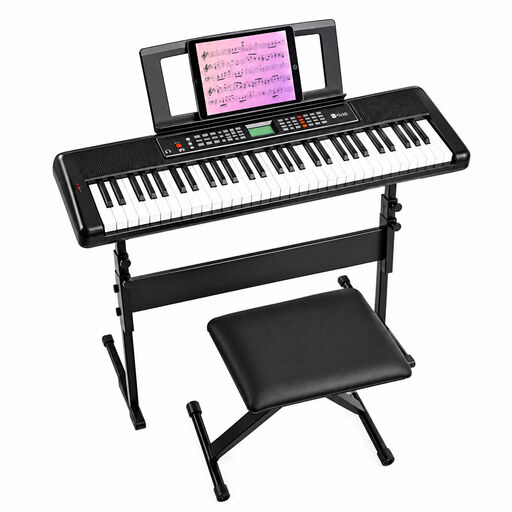 No image available
An option if you’re looking for an instrument with 61 keys and your lesson material doesn’t require a full 88-key keyboard.
61 keys; the product name lists a stand, bench and music rest.
Not suitable if you need a full 88-key keyboard.
A metronome with an adjustable time signature can help you practise with a suitable pulse; Korg lists tempo and time signature controls for the B2. Follow the guidance for accents and pedal use in your waltz music or from your teacher.
No, it varies by version. Yamaha lists the three-pedal unit for the P-145 as optional; Korg says the stand and pedal unit for the B2+ are sold separately. Check what’s included with the specific version before ordering.
According to the Netherlands Food and Consumer Product Safety Authority, CE marking is mandatory for electrical products. Check the marking on the specific version; the general requirement doesn’t confirm that a particular product meets it.
According to the Dutch Government, you’re entitled to a product that works properly if the item you bought is faulty. You may be entitled to a free repair, replacement or refund; there is no fixed statutory warranty period in the Netherlands. The appropriate solution depends on the circumstances of the fault.