
Jazz student with a piano-focused approach
You practise voicings, dynamics and perhaps an independent bass line with both hands. So pay attention to the keyboard’s range and type; Yamaha, Roland and Korg all describe models with 88 keys.


For piano-style chords, dynamics and a separate bass part, a digital piano with 88 weighted keys is the obvious choice. If you want to play melodies and chords with rhythms or automatic accompaniment, a more compact keyboard may suit you, provided your arrangement fits its range. Oostendorp Muziek explains the differences in range and size. Whichever option you choose, check the headphone socket, the space available and how much noise the keys make when played or touched. Headphones don’t replace an agreement with your housemates.
You practise voicings, dynamics and perhaps an independent bass line with both hands. So pay attention to the keyboard’s range and type; Yamaha, Roland and Korg all describe models with 88 keys.
You enjoy learning melodies and chords with a built-in rhythm or automatic accompaniment, as long as your arrangement fits the range of the more compact keyboard. Yamaha describes Styles as automatic accompaniment, while Casio lists rhythm patterns for the CT-S400.
You want to be able to set up or put away your instrument in a shared room, while respecting agreements about practice times and noise. Measure the space available and discuss practical arrangements with your housemates.
Your choice mainly comes down to the sound while practising, the range and touch you need, whether you want accompaniment, and where you’ll put the instrument.
| What to consider | What should you check? | Who is this important for? |
|---|---|---|
| Practising at home with housemates | Check for a headphone socket and agree on practice times. Bear in mind that key or contact noise may still be audible. | If I want to practise while others are at home, I want to hear the electronic sound through suitable headphones. Around 36% of consumers put quietness first. |
| Range and piano-style touch | Compare the lowest and highest notes in your arrangement with the number of keys. Also check whether the keyboard is weighted or touch-sensitive. | If I play chords and a low bass part at the same time, I want to know whether my arrangement fits the keyboard and whether its touch suits my piano practice goals. Around 29% of consumers prioritise range and touch. |
| Rhythm and accompaniment | Check which styles or rhythms the model offers and whether you can set the accompaniment to your preferred tempo. | If I want to practise melodies and chords with a built-in rhythm, I’m looking for features that suit the way I practise. Around 21% of consumers put accompaniment first. |
| Setting up and storage | Measure the space available and check whether you have a suitable, stable surface or stand. | If I need to set up or put away the instrument in a shared room, I want to know whether there’ll still be enough space to play. Around 14% of consumers prioritise storage and placement. |
Touch-sensitive and weighted describe different features. The Yamaha PSR-E383 is described as touch-sensitive; Korg specifies an NH-weighted keyboard for the B2.
Choose according to the touch you want to practise and check the keyboard specifications for the exact model.
If piano-style touch later becomes your main requirement, you may eventually need a different instrument.
A headphone socket determines where the electronic sound is played, but it doesn’t automatically eliminate audible key or contact noise, and it doesn’t replace household agreements.
Check the socket, try out the setup if possible, and agree on practice times with your housemates.
The model and included accessories vary. Korg says the B2 comes with a damper pedal, but its stand and PU-2 pedal unit are sold separately. Automatic Styles are documented for the Yamaha PSR-E383.
Compare the features and box contents of the exact model before choosing.
You may need to buy a suitable stand or PU-2 pedal unit separately for the B2.
The models reviewed represent two options: the PSR-E383, with 61 touch-sensitive keys and Styles, and the P-145, with an 88-key keyboard.
The Casiotone CT-S400 reviewed here is a compact keyboard with rhythm patterns and automatic accompaniment.
The FP-10 is Roland’s digital piano reviewed here, with 88 keys and headphone use.
The B2 reviewed here is an 88-key digital piano with an NH-weighted keyboard, metronome and PHONES socket.
These product picks focus on keyboards with 61 keys. Check that the range suits your arrangement and that the stated features and accessories work for your practice space.
 Image unavailable
A good fit for an arrangement that stays within 61 keys and gives you the chance to try out different rhythms.
The product name lists 300 tones, 300 rhythms, an LCD screen, USB-MIDI, speakers, a headphone socket and a music rest.
 Image unavailable
Consider this model if you’re looking for a 61-key setup with a metronome and recording function.
The product name lists a MIDI controller, recording function, speakers, metronome and music rest.
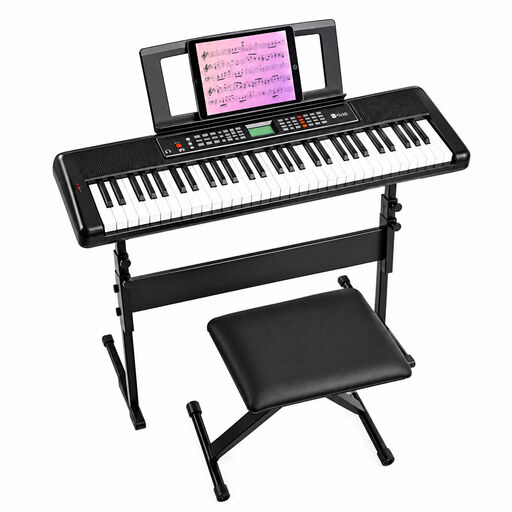 Image unavailable
This set could be a good fit if you’re looking for a 61-key keyboard that comes with a stand and stool.
The product name lists 300 tones, 300 rhythms, a three-level learning mode, LCD and USB-MIDI.
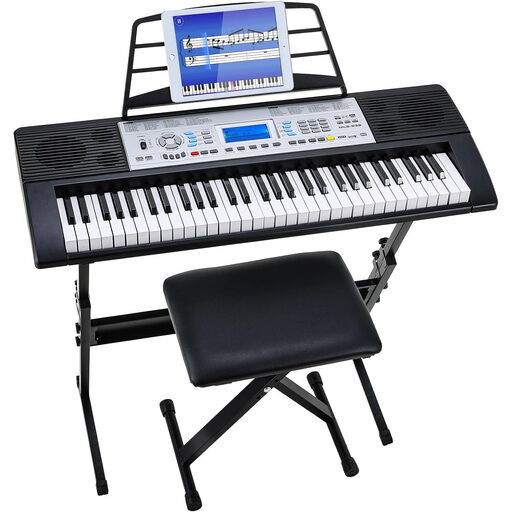 Image unavailable
This model is an option if you’re looking for a 61-key keyboard with a dedicated practice setup.
The product name lists 500 tones, a three-level learning mode, two speakers and an LCD screen.
It depends on your arrangement. Compare the lowest bass note and highest melody note you want to play at the same time with the instrument’s range. Yamaha lists 61 keys for the PSR-E383; the P-145 and B2 reviewed here have 88 keys. The number of keys alone doesn’t guarantee that every playing style will fit.
For the exact model, check the connections, plug size, box contents, and whether a pedal and stand are compatible. Korg specifies a PHONES socket and an included damper pedal for the B2; the stand and PU-2 pedal unit are sold separately.
For a consumer purchase in the Netherlands, the product must meet what you can reasonably expect. The Dutch government says you should contact the seller if there’s a problem. A manufacturer’s warranty is an extra benefit and doesn’t replace your legal rights.
For eligible distance purchases from a business, you’ll often have a 14-day cooling-off period, subject to the exceptions outlined by the Dutch government. Check the terms and who the seller is before buying; this doesn’t automatically apply to a purchase from a private seller.
No. Having headphones doesn’t in itself determine when it’s appropriate to practise. The Dutch government says there are no general nationwide legal noise limits for noise between neighbours, although local rules may apply. If necessary, ask your local council which rules apply and agree with your housemates about practice times and audible noise.