
Quiet home practiser
You share your home and want to practise while other people are in. A headphone socket can help you listen without using the built-in speakers; it’s also worth discussing whether the keys themselves can be heard.


Choose a digital piano with a suitable headphone socket and a keyboard that lets you practise the tune and any accompaniment. If you also want to learn piano technique, consider a model with 88 weighted keys. Measure the full playing area too, and check which pedals and stands come with the version you’re considering. Headphones won’t necessarily stop housemates from hearing anything, so agree practice times with them if needed.
You share your home and want to practise while other people are in. A headphone socket can help you listen without using the built-in speakers; it’s also worth discussing whether the keys themselves can be heard.
You want to do more than play a tune: you’d also like to practise your touch and playing with both hands. Compare the keyboard type and the range of the specific version.
You want to set up a piano in a shared room or put it away after use. Compare its dimensions with the space available for playing and storage.
First decide how you want to practise: using headphones only, or with other people too. Then measure the space for the instrument, as well as the room you’ll need to sit and set it up.
| What to consider | What should you look for? | Who is it important for? |
|---|---|---|
| Practising with as little disturbance as possible | Check the type of headphone socket and agree suitable times to practise. | If I mainly want to practise while housemates are at home, I’ll consider the listening set-up; around 36% of consumers put minimising disruption first. |
| Piano touch and playing range | Compare the number of keys and the keyboard action; try the feel of the keys if possible. | If I want to learn piano technique as well as play a tune, I’ll look at the keyboard and its range; around 29% of consumers prioritise this learning need. |
| Setting up and storage | Measure the space for the instrument and seat, as well as the room needed to store it. | If the piano needs to fit in a shared room, I’ll want to know how much space the complete set-up takes; around 21% of consumers put available space first. |
| Everything you need to practise | Check which pedals and stands are included with each version, and whether optional accessories are compatible. | If I want to know what I’ll need before buying, I’ll check what’s in the package; around 14% of consumers make getting everything they need their top priority. |
Headphones change how you hear the instrument, but they don’t rule out housemates hearing the keys being played.
Check the socket and agree suitable practice times with your housemates. The Dutch Government advises people to try agreeing arrangements together first when noise is affecting neighbours.
A shallow case can still take up a lot of width. Casio lists the CDP-S110BK as 232 mm deep and 1,322 mm wide; you’ll also need to allow room to sit and play.
Measure the space for the instrument, player and any music stand, and check where you can store the piano after use.
The pedals and stands supplied, or available as optional extras, vary by model and version. For example, Casio lists an SP-3 with the CDP-S110BK, while Roland describes the DP-10 pedal for the FP-10 as optional.
Check the contents and compatibility of the exact version before ordering.
Depending on the version you choose, you may need to buy a compatible pedal or another accessory separately.
According to Roland, the FP-10 is a portable entry-level option with 88 PHA-4 Standard keys and headphone playback.
According to Yamaha, the P-145 combines 88 GHC keys with a portable design, making it an option if you also want to practise piano touch.
The CDP-S110BK is an option if you’re looking for a portable piano with a weighted 88-key keyboard.
The ES120 may be worth considering if two headphone sockets or practising together are important to you.
The B2+ Black is a model to compare if you’re looking for a digital piano to practise on at home.
The products below are 61-key keyboards for practising a tune. They’re an alternative to a full 88-key keyboard for more extensive piano study.
 No image available
The headphone socket is useful if you want to practise using headphones. This model has 61 weighted keys, a headphone socket and USB-MIDI. Its 61-key range is more limited than that of an 88-key keyboard.
 No image available
This model may suit you if you’re looking for a keyboard with a recording function and are happy with a 61-key range. The product name lists MIDI, a recording function, speakers, a metronome and a music stand.
 No image available
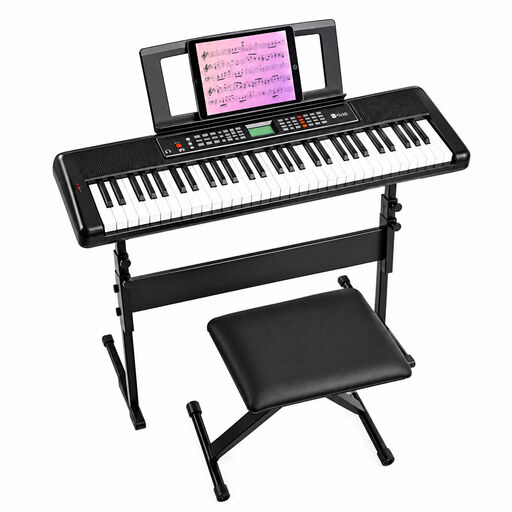
This set may suit you if you’d also like a bench and stand for practising; check the package contents for the version you choose. The product name lists 61 keys, a three-level learning mode, 300 tones, 300 rhythms, a music rest and USB-MIDI.
No, don’t assume that the entire set-up will be inaudible. Choose a model with a suitable socket and, if the sound is disturbing others, agree suitable times to practise. The Dutch Government advises people to try agreeing arrangements together first when noise is affecting neighbours.
Measure the space for the keyboard and leave room for a music stand, seat and pedal too. Yamaha lists the P-145 as 1,326 mm wide; compare this measurement with the space needed for the complete set-up.
It depends on the model and the offer. Casio lists an SP-3 with the CDP-S110BK; Roland describes the DP-10 pedal for the FP-10 as optional. Check the contents and compatibility of the specific package.
When buying remotely from a business, you’ll often have a 14-day cooling-off period; check the applicable terms and conditions. The Dutch Government states that there is no fixed statutory warranty period: you’re entitled to a product that works properly, and if there’s a fault, the seller is your point of contact for a solution.