
Considerate housemate
You practise while other people are at home and want to listen without using the speakers. Several of the models discussed have a headphone option, but it’s still important to agree how to manage noise.


Start with how you’ll practise: choose a model with a suitable headphone socket and decide whether you need a fully weighted 88-key keyboard for the film theme and future piano lessons. Then check the space you have, the pedal and the practice features on the exact version. Headphones mute the speakers, but they don’t guarantee that housemates won’t hear the keys.
You practise while other people are at home and want to listen without using the speakers. Several of the models discussed have a headphone option, but it’s still important to agree how to manage noise.
You want to practise more than just the melody, including touch and accompaniment. Compare the keyboard and range of the exact version with what you want to learn.
You need to be able to set up or store the piano in a shared room. Measure the instrument itself, but also allow for a stand, stool and space for the pedal.
For a film theme in a shared home, your choice mainly depends on how you practise, how wide a keyboard range you need and whether the complete set-up will fit in the room.
| What to consider | What should you check? | Who is this important for? |
|---|---|---|
| Practising with headphones | Check the model’s socket and whether your headphone plug will fit. Also consider how audible the keys are in your home. | If I practise while housemates are at home, I don’t want to have to use the speakers, but I still need to consider how audible the keys are. Around 36% of consumers put quiet practice first. |
| Keyboard range and touch | Compare the range of your arrangement with the number of keys, and check which type of key action the version has. | If I want to practise accompaniment and piano technique as well as the melody, I look at the range and touch. Around 29% of consumers prioritise this. |
| Space and storage | Measure the available space and allow for the stand, stool, pedal and cables. | In a shared room, I want to know whether the whole playing set-up will fit and whether I can store the instrument away. Around 21% of consumers choose mainly based on space and storage. |
| Practice features and pedal | Check whether the practice feature you want is included, and whether the pedal is supplied with the exact version or available separately. | If I want to practise to a steady beat or need sustain, I check the features and what’s included in the bundle. Around 14% of consumers prioritise practice aids and pedal use. |
Headphones let you hear the electronic sound, but they don’t eliminate the noise of the keys or key action.
Agree practice times with your housemates and check how loud the keys are where you plan to play. The Government of the Netherlands recommends agreeing together on how to manage noise nuisance.
The dimensions of the piano alone don’t tell you how much space you’ll need to play comfortably. Yamaha lists the P-145 as 1.326 mm wide.
Measure the available width and depth, and leave room for your legs, stool and pedal.
Depending on your set-up, you may need a suitable stand or seat.
Accessories vary by model and bundle; an optional three-pedal unit won’t necessarily be included with every version.
Before ordering, check what’s included in the specific Dutch listing and whether any upgrades are compatible.
You may need to buy a pedal unit or stand separately.
The P-145 is a portable option if you’re looking for 88 weighted keys and the ability to practise with headphones.
According to Roland, the FP-10 combines an 88-key keyboard with sound through speakers or headphones.
The CDP-S110 is designed for a portable piano set-up with basic features.
The ES120 may suit a set-up where two headphone sockets are important.
The B2+ is worth comparing if you’re looking for an 88-key keyboard.
The Joybuy options below are digital pianos and keyboard sets with 61 keys. Check whether that range suits the film theme and your future piano lessons.
 No image available
Could be suitable if 61 keys are enough; the product name lists a weighted keyboard, metronome, recording function and USB-MIDI.
With 61 keys, this model doesn’t offer the full 88-key range that may be useful for developing your piano technique.
 No image available
An option if a 61-key keyboard suits your arrangement; the product name lists a music rest, metronome and recording function.
Its range is smaller than that of an 88-key keyboard, which may be a consideration for future piano lessons.
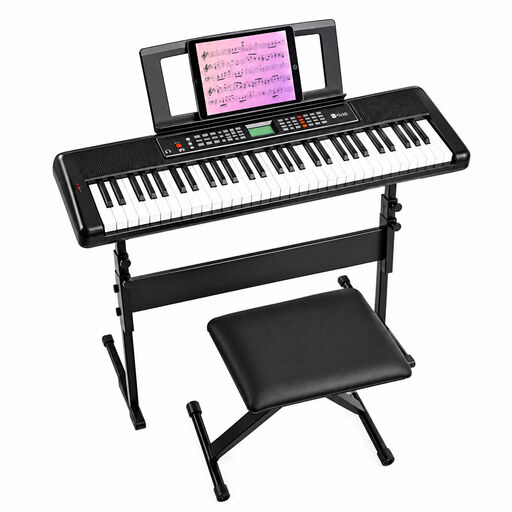 No image available
Could be suitable if you’re looking for a set with a seat and stand; the product name also lists a three-level learning mode.
With 61 keys, the range is more limited than that of an 88-key keyboard; check that your arrangement fits within it.
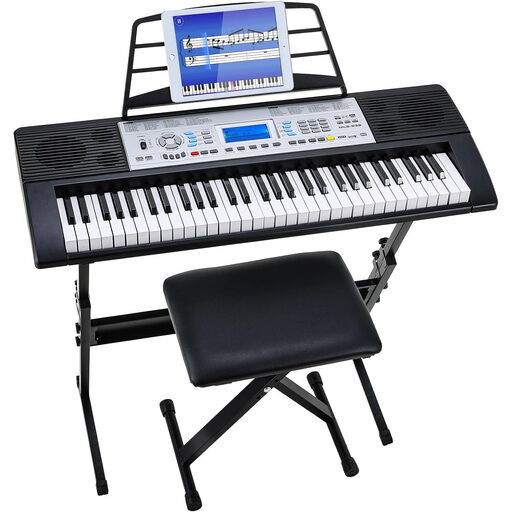 No image available
An option if you’re looking for a set-up with a stand and stool; the product name lists a three-level learning mode and 500 tones.
The instrument has 61 keys, so it doesn’t offer the full range of an 88-key keyboard.
Not necessarily: headphones let you hear the electronic sound, but the noise of the keys or key action may still be audible. The Government of the Netherlands recommends agreeing together on how to manage noise nuisance; its guidance doesn’t set a fixed practice time that applies to every home.
Check the socket on the exact piano model and the plug on your headphones. Kawai lists connections for both a stereo mini-jack and a standard stereo jack on the ES120.
It depends on the model and bundle. Casio lists an SP-3 pedal included with the CDP-S110; Yamaha lists the LP-5A three-pedal unit for the P-145 as an option. Check what’s included in the specific offer before ordering.
Contact the seller. According to ACM ConsuWijzer, in addition to any manufacturer’s warranty, you have a statutory guarantee if the product doesn’t meet what you could reasonably expect; the period isn’t automatically two years for every product.
For a standard online consumer purchase, you’ll generally have up to 14 days after delivery to change your mind. ACM ConsuWijzer explains the conditions and exceptions for unpacking, trying out and returning an item; check what applies to your order.