
Quiet home player
You practise while other people at home are around and want to hear the piano through headphones. Bear in mind that the keys and pedal may still make noise in the room.


First, choose a piano with a headphone socket that suits your headphones and a setup that fits your room. Then check whether the keyboard and pedal work well for your chords and left-hand patterns. A compact model may be all you need for practising on your own, while rhythms or two headphone sockets matter most if you plan to use those features. Headphones won’t eliminate the sound of the keys or pedal.
You practise while other people at home are around and want to hear the piano through headphones. Bear in mind that the keys and pedal may still make noise in the room.
You practise accompaniment figures and chords, so you want to assess the feel and range of the keyboard, as well as the pedal setup on the specific piano.
You share your living space and need a setup that fits the room you have, or an instrument you can move after practising.
Start with where you’ll put the piano and how you want to practise. Then check the keyboard, connection and pedal on the exact model you’re considering.
| Buying concern | What should you check? | Who is this important for? |
|---|---|---|
| Practising with minimal disruption | Check the headphone socket and the plug or adapter you’ll need. Also consider how much noise the keys and pedal make where you plan to put the piano. | If other people are at home, I want to practise with headphones without assuming the keys and pedal will be inaudible. Around 29% of consumers weighing up this purchase give minimising disruption their top priority. |
| Control when playing chords | Try bass notes, chords and repeated notes. Check which pedal is included with the model or is compatible with it. | When playing accompaniment patterns, I want to know whether the key action and pedal feel comfortable for my left hand and chords. Around 29% of consumers put piano-playing control first. |
| A setup that fits | Measure the space needed for the stand, seating and pedal. Casio lists a cabinet depth of 232 mm for the CDP-S110BK; this isn’t the space needed for the complete playing setup. | If I need to put the piano in a shared room or store it away, I want to know in advance how much space the complete setup will take. Around 21% of consumers name limited space for setting up as their main buying concern. |
| Rhythm and pedal features | Decide whether you want to use a built-in rhythm. Kawai lists drum rhythms for the ES120; Casio lists separately available three-pedal options for the CDP-S360. | If I want to practise my patterns with a built-in rhythm or need more pedal options, I check these features for each model. Around 21% of consumers give rhythm and pedal features their top priority. |
Headphones let you hear the piano without using its speakers, but they don’t tell you whether the keys and pedal will be audible in your room.
Try the setup where you plan to put it, and agree on practice times if other people at home can still hear the instrument.
What’s in the box varies by model. Yamaha lists the LP-5A as optional for the P-145BT, while Casio lists an SP-3 pedal as included with the CDP-S110BK.
Before deciding, check what’s included and which accessories are compatible with the exact model.
One of the Joybuy models below has 61 keys; according to their manufacturers, the Yamaha P-145BT and Roland FP-10 among the models reviewed have 88 keys. The range you need depends on the music you play.
Compare the range and try the key action. Choose a shorter keyboard only if it suits your patterns and the space you have available.
Yamaha describes the P-145BT as a portable piano with an 88-key GHC keyboard.
Roland describes the portable FP-10 as having an 88-key PHA-4 keyboard and headphone support.
The compact CDP-S110BK may be worth considering if cabinet depth matters; the CDP-S360 is a separate model to look at if you want three pedal options.
Kawai describes the ES120 as a portable piano with Split, built-in drum rhythms and two headphone sockets.
These Joybuy products focus on 61-key models with rhythm or practice features. Check each model to make sure its range, key action and setup suit the accompaniment patterns you play.
 No image available
The listed metronome may be useful for practising to a steady beat.
61 keys; the title also lists a recording function and MIDI controller. A 61-key keyboard doesn’t offer the full range of an 88-key model.
Before buying, check whether this version has a headphone socket if you want to practise without using the speakers.
 No image available
The listed rhythms may be useful if you want to practise with rhythmic accompaniment.
The product name lists weighted keys, 300 sounds, 300 rhythms, an LCD screen, USB-MIDI, speakers and a headphone socket.
The keyboard has 61 keys, not the full range of 88 keys.
 No image available
The listed rhythms and learning mode may suit practising with a range of built-in learning features.
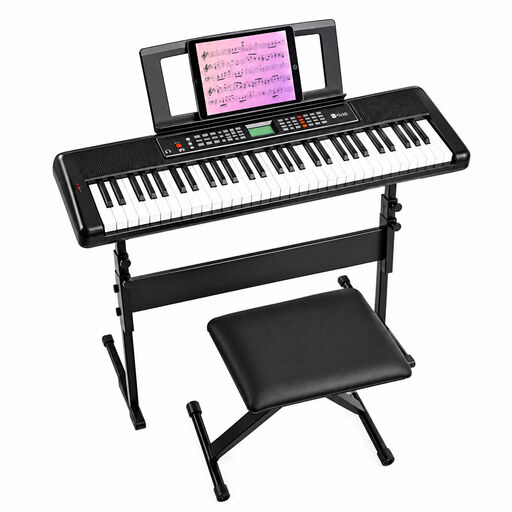
The product name lists 300 tones, 300 rhythms, an LCD screen, USB-MIDI and a music stand. The set name also mentions a stand and bench.
The keyboard has 61 keys, not the full range of 88 keys. Check which items are included with the exact version.
No, don’t assume they do. You’ll hear the piano through your headphones without using the speakers, but you’ll need to check how much noise the keys and pedal make in your own setup. The Rijksoverheid advises neighbours to try to agree things between themselves first when noise becomes a problem, for example about music and timings.
Measure the space before buying, allowing room for the stand, a seat and the pedal. Check what’s included with the exact version: Yamaha lists the LP-5A as optional for the P-145BT, while Casio lists an SP-3 pedal as included with the CDP-S110BK.
Only if you want to play along with a built-in rhythm. Kawai lists drum rhythms for the ES120; for practising on your own, it’s also important that the keyboard and controls suit the way you play.
When you buy a product online, you generally have a statutory 14-day cooling-off period from delivery, with some exceptions. ACM ConsuWijzer advises checking the terms for trying out and returning the specific order.
There isn’t one practice time that’s allowed in every rented home. The Rijksoverheid says tenants must not cause a nuisance and advises agreeing times for playing music. So discuss practice times with the people you live with and your neighbours.