
Player in a shared home
Wants to practise a film theme while other people are at home, and is considering the headphone socket, personal listening volume and the possibility of audible key presses.


Choose a digital piano with a headphone socket that’s compatible with your headphones and lets you set a comfortable, low listening volume. Then compare the touch and pedal with the passages you want to practise. If you’re considering a compact model, check that there’s enough room for the complete setup. Manufacturer specifications confirm connections and features, but they can’t tell you how audible the keys will be in your home.
Wants to practise a film theme while other people are at home, and is considering the headphone socket, personal listening volume and the possibility of audible key presses.
Wants to practise melody, dynamics and possibly pedalling, so looks at the keyboard and essential features rather than just extra sounds.
Needs to fit or store the piano and playing setup in a limited space, so considers the dimensions, music rest and separate components.
| What to consider | What should you check? | Who is this most important for? |
|---|---|---|
| Private practice | Check whether the piano has a PHONES socket that’s compatible with your headphones and whether you can set a comfortable, low listening volume. | When I practise while other people are at home, I want to keep the piano sound down for them without having to listen at a high volume myself. Around 36% of consumers prioritise private practice. |
| Touch and dynamics | Try the touch for yourself. Yamaha lists an 88-key GHC keyboard for the P-145, while Roland lists an 88-key PHA-4 Standard keyboard for the FP-10. These are manufacturer specifications, not independent assessments of how the keyboards feel to play. | If I want to learn to play soft and powerful passages, I want a keyboard that suits my touch. Around 29% of consumers give learning to play and dynamics the highest priority. |
| Space and setup | Measure your practice space and allow for the music rest and room for the player. Casio lists a depth of 232 mm for the CDP-S110BK; Korg gives the B2+ dimensions as 1312 × 336 × 117 mm, without the music rest. | If my practice space is limited, I want to know whether the complete playing setup will fit, not just the piano itself. Around 21% of consumers give the available space the greatest consideration. |
| Pedal and practice aids | Check which pedal is included and whether the app or sheet music feature works with your device. Casio lists an SP-3 sustain pedal as included and PDF viewing via Music Space; the PU-2 pedal unit is optional for the Korg B2+. | If my arrangement calls for pedalling or I practise with sheet music, I want to know in advance which aids are suitable. Around 14% of consumers put pedals or practice aids at the top of their list. |
The socket tells you something about the piano sound you hear through your headphones, but not how much noise the keys or pedal will make in your space.
If possible, try the setup in a quiet room. Keep the headphone volume at a comfortable level; the World Health Organization points out that both volume and listening time matter.
Your preferred setup will determine whether you also need a stand, bench or more advanced pedal. Korg lists a damper pedal as included with the B2+, while the STB1 stand and PU-2 pedal unit are sold separately.
Compare what’s included with the exact model and measure the space needed for the instrument, music rest and player.
You may need to buy a stand, bench or more advanced pedal separately, depending on the setup you want to use.
A Bluetooth listing doesn’t necessarily confirm that an instrument can both send and receive MIDI data and audio. Roland also says that Bluetooth availability for the FP-10 may vary by country of purchase.
Check which connection your app or practice method needs for the exact model.
Yamaha describes the P-145 as a portable piano with an 88-key GHC keyboard. It’s worth comparing if you’re looking for a full-size keyboard for a limited space.
For the FP-10, Roland lists an 88-key PHA-4 Standard keyboard and says you can play through its built-in speakers or headphones.
Casio lists a cabinet depth of 232 mm, a PHONES/OUTPUT socket and Music Space support for the CDP-S110BK.
According to the manufacturer, the Korg B2+ has 88 weighted NH keys, a PHONES socket, AUDIO IN and USB-C. Korg lists its weight as 11,4 kg without the music rest.
Kawai describes the ES120 as a portable piano with a Responsive Hammer Compact keyboard and Bluetooth MIDI and Audio.
The Joybuy products below are keyboards with 61 keys. Check whether each model has a headphone socket and whether the number of keys suits the passages you want to learn.
 No image available
The product description mentions a headphone socket for private practice.
61 keys; touch-sensitive, weighted keyboard; metronome and recording function.
 No image available
The product description mentions a headphone socket for private practice.
61 keys; metronome, music rest and recording function.
 No image available
The product description mentions a headphone socket and a learning function for practice.
61 keys; the title lists a stand and stool. The learning function has three levels.
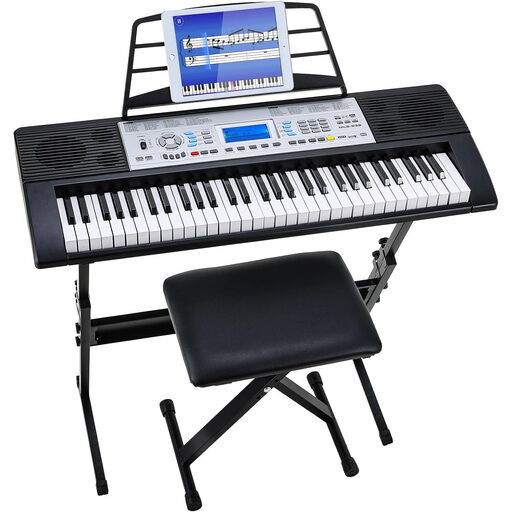 No image available
The product description mentions a learning function for practice. If you want to practise privately, check whether this model has a headphone socket.
61 keys; three-level learning function and built-in speakers.
Headphones limit the piano sound that other people hear, but they won’t automatically make every physical key press inaudible throughout your home. Also consider your own listening volume and how long you listen for. The World Health Organization offers listening advice, not a Dutch noise standard for piano playing.
No, not unless your arrangement calls for one. First, check which passages you want to play with a pedal and what’s included: Casio lists an SP-3 sustain pedal for the CDP-S110BK, while Korg includes a damper pedal with the B2+ and sells the PU-2 pedal unit separately.
According to ACM ConsuWijzer, the statutory guarantee applies alongside any seller’s or manufacturer’s warranty. If a product breaks during normal use sooner than you could reasonably expect, the seller must provide an appropriate solution free of charge. There isn’t one fixed statutory guarantee period that applies to every piano.
The Dutch government doesn’t give general permission to play at any time. It advises people to make arrangements with their neighbours about noise, for example by agreeing when music can be played. If the disturbance continues, the Dutch government lists the landlord, residents’ association or local council as possible next steps.