
Beginner piano student
Wants to learn the festive tune and then move on to piano technique. The keyboard and feel are important considerations.


For piano technique and a wider range of notes, a portable digital piano with a weighted 88-key keyboard is a good fit for your learning goals. Also consider how you want to listen in the studio, and check whether the stand, pedal and correct power supply are included with the version on offer.
Wants to learn the festive tune and then move on to piano technique. The keyboard and feel are important considerations.
Sometimes wants to practise with headphones and play aloud with others at other times. So, consider the listening options and connections.
Sets up the instrument in different locations and wants to know in advance whether it will fit, and which power supply, stand and pedals are needed.
First decide whether you mainly want to practise piano technique, play quietly in a shared studio or move the instrument regularly. Then check which features and accessories suit your set-up.
| What matters | What should you check? | Who is this for? |
|---|---|---|
| Keyboard and feel | Check the number of keys and the type of keyboard on the exact version; try the key action if you can. | If I want to practise piano technique as well as the tune, I focus on the key action and range. Around 36% of consumers say the keyboard and feel are their main buying concern. |
| Quiet practice or playing together | Check for a headphone socket, built-in speakers and, if applicable, an output for studio equipment. | When I share a studio, I want to be able to practise privately and play aloud when others join in. Around 28% of consumers prioritise these listening options. |
| Space and set-up | Compare the dimensions with the space available and check which stand and pedals are included or available as optional extras. | If I move the instrument or set it up each time, I want to know whether it will fit and what else I need. Around 18% of consumers put space and portability first. |
| Practice aids | Check whether it has a metronome, audio input or another feature that suits the way you practise. | When learning a piece, I want to practise the tempo and perhaps play along with audio. Around 18% of consumers choose practice aids as their main buying priority. |
Yamaha lists the P-145 as 1.326 mm wide; Korg gives the B2’s width as 1.312 mm. Measure the space before choosing a piano or stand.
Measure the available width and depth, and allow for the space you’ll need while playing.
Yamaha lists the LP-5A three-pedal unit for the P-145 as optional. Korg lists the stand and three-pedal unit for the B2 as accessories, while a damper pedal is included.
Compare the contents of the exact offer with the parts you need for your set-up.
Korg lists a connection for combined PHONES/LINE OUT use on the B2. So, check which connections are available on the exact piano and your studio equipment.
Compare the piano’s output with the studio equipment’s inputs before choosing connection cables.
According to Yamaha, the P-145 is a portable digital piano with an 88-key GHC keyboard.
According to Roland, the FP-10 has an 88-key PHA-4 Standard keyboard, built-in speakers, headphone use and a metronome.
The CDP-S110 could suit a compact set-up or practising with an external device.
According to Korg’s Dutch specifications, the B2 is a digital piano with an 88-key NH keyboard.
The Joybuy products below have 61 keys. They could suit you if you want to practise the tune on a shorter keyboard, but they don’t offer the full range of an 88-key keyboard. Also check that the exact version has the CE marking and find out which accessories are included.
 Image unavailable
An option for practising a tune if you don’t need an 88-key keyboard; the product name describes the keys as weighted.
The product name lists 300 tones, 300 rhythms, an LCD screen, USB-MIDI, speakers, a headphone socket and a music rest. With 61 keys, this model doesn’t offer the full range needed for a piano-focused learning path.
Before buying, check that the version on offer has the required CE marking.
 Image unavailable
This version could suit you if you want to use a metronome and music rest while practising; check whether 61 keys are enough for your learning goals.
The product name lists a metronome, MIDI controller function, recording function, speakers, a headphone socket and a music rest. The keyboard doesn’t offer the full range of an 88-key piano.
Before buying, check that the version on offer has the required CE marking.
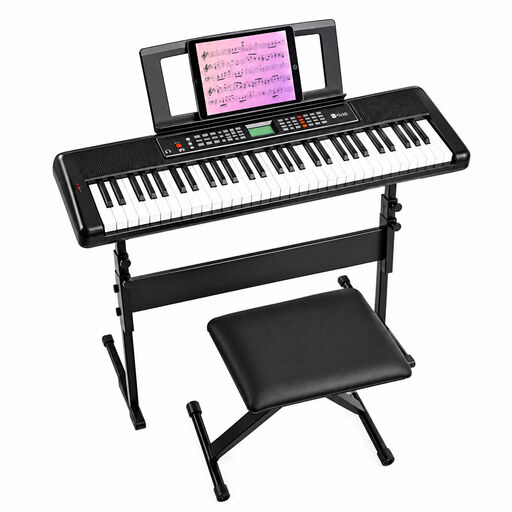 Image unavailable
A set for creating a dedicated practice space if you want to use the included stand and bench; the keyboard is shorter than an 88-key one.
The product name lists a stand, bench, music rest, 300 tones, 300 rhythms, a three-level learning function, an LCD screen and USB-MIDI.
Before buying, check that the version on offer has the required CE marking.
A headphone socket may be enough for private listening. If others need to hear you, also check for speakers or a suitable output for studio equipment; according to Korg, the B2 has a combined PHONES/LINE OUT connection.
Choose a piano with a metronome if you want to practise keeping time; Roland lists this feature for the FP-10, and Casio for the CDP-S110. Casio also lists an AUDIO IN connection for playing along with audio from an external device.
Measure the space available and check which stand and pedal are included in the exact offer. Use the adapter specified for the Casio CDP-S110, and check that the connections are compatible with your studio equipment.
According to the Dutch government, electronic devices placed on the market in the EU must have the required CE marking. Check this for the actual version on offer; a model name alone doesn’t prove that this requirement has been met.
The Dutch government says you’re entitled to a product that works properly, and that the seller must provide a solution if a product is faulty. There’s no fixed statutory guarantee period for every product; what you can expect depends, among other things, on the product and whether it’s new or second-hand.