Who is this suitable for?

Practising while your housemates are at home

You want to hear yourself through headphones, but should also consider how much noise the keys or pedal make. The Dutch Government advises people to agree on arrangements together if noise could be a problem, such as setting times for playing music.

Learning to play your own accompaniment patterns

You want to practise chords, bass notes and rhythm yourself. A metronome, key action that suits you and, potentially, a recording function may all be useful.

Playing along with built-in rhythms

You want to practise along with drums or an automatic backing part. Bear in mind that a drum rhythm is not necessarily a part that follows the chords you play.

What should you look for when choosing?

What to consider What should you check? Who should give this more weight?
Noise in a shared home Check the headphone socket and speaker behaviour. Also try out the mechanical noise from the keys, pedal and stand. If I practise while my housemates are at home, I want to hear the piano through headphones and keep disruption to a minimum. Around 36% of consumers making this choice prioritise quiet above all else.
Key action and timing Play your own pattern on the keyboard and try the metronome, split function and, if available, recording. If you want to learn chord changes and bass patterns yourself, try out the key action and timing first. Around 29% of consumers making this choice focus on their own playing technique.
Rhythms or chord accompaniment Ask for a demonstration of what happens when you change chords. Also test the tempo and volume balance. If I want to play along with a built-in part, I want to know whether it only provides a drum rhythm or follows my chords. This accompaniment feature is the top priority for around 21% of consumers.
Space and complete set-up Measure the space you have, including room for the stand and seat. Check which stand and pedals are included with the version you choose. If my practice space is limited, I want to know how much room the complete set-up takes up, not just the piano itself. Around 14% of consumers prioritise available space and a suitable set-up above all else.

Common mistakes

  • Assuming ‘rhythms’ means automatic chord accompaniment

    A drum rhythm and a part that responds to your chord changes are different features, so they do not necessarily support the same kind of practice.

    Check the manual for the exact model and ask for a demonstration of what happens when you change chords.

  • Thinking headphones make the whole set-up silent

    Headphones let you listen to the piano sound privately. You’ll need to assess the mechanical noise from the keys, pedal and stand separately.

    Try the set-up where you plan to use it and agree practice times with your housemates. The Dutch Government advises people to agree on arrangements together if noise could disturb their neighbours.

  • Comparing only the piano’s dimensions

    The piano itself is not the whole playing space. A suitable stand or a more advanced pedal unit may also be a separate accessory.

    Measure the space you have, including room for a seat and stand, and check what’s included with the exact version and whether the accessories are compatible.

Brands to consider

Roland

The FP-30X is suited to practising on your own with a metronome, while the FP-E50 adds automatic accompaniment.

  • According to Roland, the FP-30X manual lists split, recording and headphone connections. The FP-E50 offers automatic accompaniment and headphone use.
  • The FP-E50 manual lists the stand and advanced pedal unit as separate accessories. Check what’s included with the version you choose.

Casio

The Privia PX-S3100 is worth considering if a shallow casing and built-in accompaniment rhythms are important to you.

  • Casio specifies a depth of 232 mm, 200 built-in rhythms and two headphone sockets for the PX-S3100.
  • These specifications don’t tell you whether the keyboard and rhythms suit your playing style, so try them out for yourself.

Kawai

The ES120 is a portable piano for anyone who wants to play themselves with drum rhythms in the background.

  • Kawai lists 100 drum rhythms, a split function and two headphone sockets for the ES120.
  • Drum rhythms are not necessarily the same as automatic accompaniment that follows your chords. A suitable stand and three-pedal unit are optional extras.

Yamaha

The P-225 is a compact, portable piano for practising your own patterns and key action.

  • According to Yamaha’s specifications for the Netherlands, Belgium and Luxembourg, the P-225 has 88 GHC keys, a metronome, a split function and a width of 1.326 mm.
  • The stated width and depth of 272 mm don’t account for the full space needed for the stand, bench and player.

Joybuy products

These products are designed for practising with built-in rhythms or accompaniment. Check the parts and practice features available on each model.

MLS-931 digital piano with 61 keys

MLS-931 digital piano, 61 keys

The listed rhythms and headphone socket may be useful if you want to practise at home with a rhythmic backing.

61 keys; 300 rhythms; headphone socket; piano-style keys; recording and playback functions.

View at Joybuy
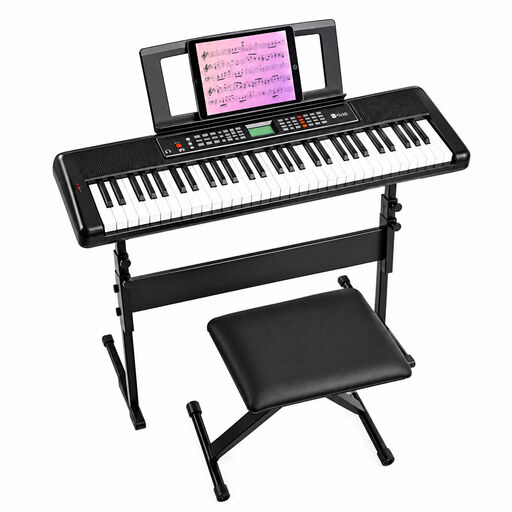
Digital keyboard piano set with 61 keys, stand and bench

Digital keyboard piano set, 61 keys

The listed automatic bass chords and metronome may suit practising with accompaniment and a steady beat.

61 keys; touch-sensitive keys; 300 rhythms; automatic bass chords; metronome; headphone socket. The product name mentions a stand and bench.

View at Joybuy

Frequently asked questions

Are headphones enough to practise without disturbing anyone?

No, don’t expect complete silence: headphones let you listen to the piano sound privately, but you’ll need to assess the mechanical noise from the keys, pedal and set-up separately. The Dutch Government advises people to agree on arrangements together if noise could disturb their neighbours, for example by setting times for playing music.

Can I practise chord-following accompaniment with drum rhythms too?

You can’t tell from the word ‘rhythms’ alone. Kawai lists drum rhythms for the ES120, while Roland documents automatic accompaniment for the FP-E50 and Casio for the PX-S3100. Ask for a demonstration on the exact model to see how the accompaniment responds to your chord changes.

What do I need to get started at home besides the instrument?

Check what’s included with the version you choose, and allow for a stable stand, a suitable seat, headphones and, if needed, a pedal. According to the manual for Roland’s FP-E50, the pedal switch is included, but the stand and advanced pedal unit are separate accessories.

What are my rights when buying online in the Netherlands?

According to the Dutch Government, many distance purchases come with a 14-day cooling-off period, although there are exceptions. If a product doesn’t meet what you could reasonably expect, you’re covered by the statutory guarantee; if there’s a problem, the seller must provide a solution. Before buying, check the terms for the specific seller and version.
