
Beginner ballad player
You want to practise melodies, chords and playing softly and loudly. So compare how a weighted, touch-sensitive keyboard feels to play.


Start with a keyboard that feels comfortable for playing melodies, chords and dynamic changes. Then check the headphone connection and make sure there’s room for your complete playing setup. A portable piano is practical if your spare room has other uses, while a permanent setup with suitable pedals may be a good choice if you can leave the piano in place. Check which accessories are included with each version.
You want to practise melodies, chords and playing softly and loudly. So compare how a weighted, touch-sensitive keyboard feels to play.
You share your home and want to practise with headphones often. Check the connection on the exact model, and bear in mind that the keys may still make a noise.
You may need to leave the piano set up between practice sessions, or put it away. Remember to allow space for a stand, stool and sheet music too.
First compare the touch and number of keys, then check whether you can use the piano with headphones and whether the complete setup will fit in your room.
| What to consider | What should you look for? | Who is this most important for? |
|---|---|---|
| Touch and range | Check the number of keys and the touch response of the exact model. Yamaha lists 88 weighted GHC keys for the P-145BT; Roland lists 88 keys for the FP-10. | If I want to practise melodies and chords with both hands, I want a keyboard that suits my playing style. Around 40% of consumers prioritise range and touch. |
| Headphones | Check whether the model has a headphone socket and whether your plug will fit. Casio lists a PHONES/OUTPUT socket for the CDP-S110BK; Roland mentions headphone use for the FP-10. | When other people are at home, I want to practise without sound coming from the piano speakers. Around 30% of consumers prioritise headphone use. |
| Space and portability | Measure the piano with its stand and seating area, not just the body. Casio lists a depth of 232 mm for the body of the CDP-S110BK. | If the spare room also needs to be available for guests, I want to know how much space the complete setup will take up. Around 20% of consumers prioritise space and portability. |
| Playing along and pedal | Decide whether you need audio, MIDI or both, and check which pedal is included with the version you’re considering. Yamaha lists Bluetooth audio for the P-145BT; Casio lists an SP-3 pedal included with the CDP-S110BK. | If I want to practise along with a recording and use sustain, I want to choose the right connection and pedal function. Around 10% of consumers prioritise playing along and using a pedal. |
Headphones prevent sound coming from the piano speakers, but the keys may still be audible in a shared home.
Check the connection and, if possible, try the piano in a room with a similar setup to yours.
The listed depth of 232 mm for the Casio CDP-S110BK applies to the body. You’ll also need space to sit and move around while playing.
Measure the planned complete setup, including the stand and seating area.
A feature for playing audio doesn’t confirm that the instrument also supports MIDI. Pedals and stands included in the package can also vary by version.
Decide how you want to practise, then compare the connections and contents of the specific version.
The Dutch product information positions the P-145BT as a compact, portable entry-level piano with a weighted keyboard.
The Dutch product information for the CDP-S110BK is worth considering if a slim, portable piano is important to you.
Roland describes the FP-10 as a portable piano for practising at home.
The Dutch ES120 product information describes a portable piano that can later be set up as a permanent fixture.
The Dutch product information describes the B2+ range as a standalone piano, with a B2+SP version that comes with a stand and pedal unit.
The Joybuy options below have 61 keys. Compare the range with an 88-key keyboard, and measure the complete setup, including any stand and seating area.
 No image available
This could suit you if you’re looking for a smaller keyboard range; consider whether 61 keys are enough for the music you want to practise.
The product name lists 61 keys, not the full range of an 88-key keyboard.
 No image available
This could suit you if you’re looking for a keyboard with a more limited range; check that it covers the parts you want to play.
The product name lists 61 keys, not the full range of an 88-key keyboard.
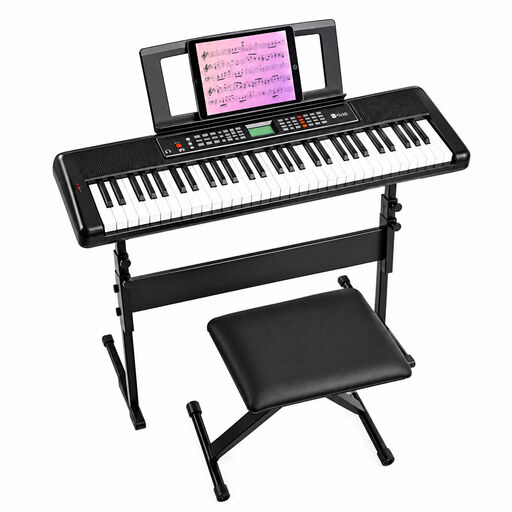 No image available
This could suit you if you’re looking for a set with a stand and stool; bear in mind how much room the complete setup will take up.
The product name lists 61 keys, a stand, a stool and a music rest. Check that the keyboard range suits your practice goals.
Not necessarily. With suitable models, headphones prevent sound coming from the piano speakers, but they don’t necessarily silence the mechanical noise of the keys. Roland mentions headphone use for the FP-10; assess the key noise in your own room.
Not necessarily. First decide whether you want to play recordings or exchange data with a lesson app. Yamaha lists Bluetooth audio for the P-145BT; Kawai lists Bluetooth audio and Bluetooth MIDI separately for the ES120. Check which connection your learning method requires.
It varies by model and version. Casio lists an SP-3 pedal included with the CDP-S110BK, Yamaha lists an optional LP-5A pedal console for the P-145BT, and Korg offers a B2+SP version with a stand and pedal unit. Check the package contents, compatibility and space requirements for the version you’re considering.