
Singer learning a song
Wants to practise the melody and vocal cues, with a pianist or a backing track. Music Theatre International describes RehearScore as recorded rehearsal accompaniment that lets you practise without a pianist.


For a musical theatre song in a rehearsal studio, choose a digital piano to suit your role. If you’ll be accompanying yourself, focus on the keyboard and touch response; if you mainly want to practise vocal cues, you can also use a separate recording. Check how well the sound carries in the room and whether the instrument fits the available space. Built-in piano sounds don’t mean that accompaniment for your musical theatre song is included.
Wants to practise the melody and vocal cues, with a pianist or a backing track. Music Theatre International describes RehearScore as recorded rehearsal accompaniment that lets you practise without a pianist.
Wants to practise piano parts and dynamics, so pays attention to touch response and how well the instrument can be heard in the room. Yamaha and Roland each describe their own 88-key keyboard on the P-145BT and FP-30X respectively.
Takes an instrument between rooms and weighs up its size and set-up against the playing feel they want. Casio gives the PX-S1100BK a depth of 232 mm; Kawai describes the ES120 as a portable instrument suitable for studio use, among other settings.
First decide whether you’ll be playing yourself or mainly using existing accompaniment. Then compare the keyboard, listening options and practical set-up for your rehearsal space.
| What to consider | What to look for when buying | Who is this important for? |
|---|---|---|
| Accompaniment and vocal cues | Check that you can use the recording you want and how you’ll play it in the studio. | If I mainly want to practise vocal cues, I’ll first check whether accompaniment for my song is available and how I can play it. Around 37% of consumers put accompaniment and vocal cues first. |
| Touch response when accompanying yourself | Compare the key action and number of keys on the exact model; try the keyboard if possible. | When I play a piano part myself, I want a keyboard that suits my technique and has enough keys. Around 27% of consumers prioritise touch response when accompanying themselves. |
| Practising quietly | Check the number and type of headphone outputs, and how to play the sound in the room without headphones. | If I want to practise on my own without disturbing others, I’ll check which headphone connections are available. Quiet practice is the top priority for around 18% of consumers. |
| Moving and setting up | Compare the dimensions and weight, the stand you’ll need and the accessories included. | When I move between rehearsal rooms, I want to know in advance whether the piano will fit in the space and be practical to move. For around 18% of consumers, moving and setting up is the top priority. |
The number of keys varies from one instrument to another. Yamaha and Roland list 88 keys for the P-145BT and FP-30X respectively; Joybuy Netherlands lists 61 keys for the MLS-931. A smaller range may be limiting for piano parts that require more keys.
Check the number of keys and the key action on the exact version before comparing models.
If the range or touch response doesn’t suit the part, you may need a different instrument later.
Accessories can vary by model and version. Yamaha states that the three-pedal console for the P-145BT is optional.
Check what’s included with the specific version and whether the accessories are compatible with the instrument.
If a part is missing, you may need to buy it separately.
Yamaha says that the P-145BT can play audio from a phone or tablet through its speakers. This doesn’t mean that your musical theatre song or its backing track is included with the piano.
Check separately whether the accompaniment you want is available and how you’ll play it during rehearsal.
The P-145BT is a portable piano worth comparing if you’re looking for an 88-key keyboard and Bluetooth audio.
The FP-30X is worth considering if you want to compare the keyboard and different listening options.
The PX-S1100BK may be worth considering if space for your piano is limited.
Kawai describes the ES120 as a portable instrument suitable for studio use, among other settings.
This selection includes 61-key keyboards and a digital piano for independent practice. Check that the number of keys suits the piano part you want to play.
 No image available
For independent practice, with a music stand and built-in speakers.
The product name lists 61 keys, a MIDI controller, a recording function and a metronome.
 No image available
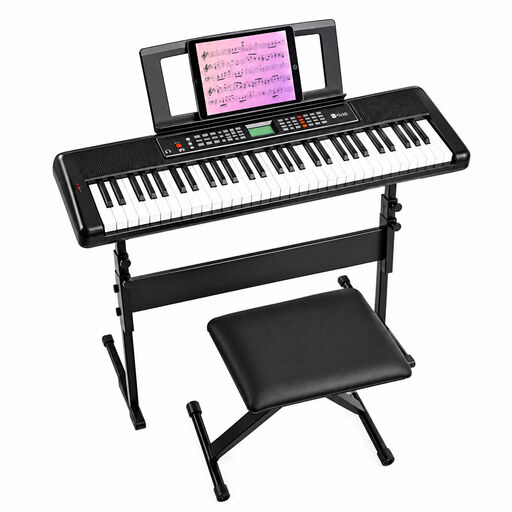
For independent practice; the product name mentions a stand, stool and music stand.
The product name lists 61 keys, 300 sounds, 300 rhythms, a three-step learning mode, an LCD screen and USB-MIDI.
 No image available
For anyone who wants to use a music stand and speakers while practising; the keyboard has 61 keys.
The product name lists a weighted keyboard, 300 sounds, 300 rhythms, USB-MIDI and a headphone connection.
Not necessarily. If someone is playing the part, the keyboard and how well it can be heard are important. You can also use separate recorded accompaniment to practise without a pianist. Music Theatre International describes RehearScore as a source of rehearsal accompaniment; check that the accompaniment you want is available and how to play it.
Check that the piano and stand fit in the space, then decide whether you want to listen through the built-in speakers, headphones or external equipment. Roland lists two headphone outputs and outputs for external powered speakers on the FP-30X; these features are specific to this model.
Not always. The Dutch government states that a 14-day cooling-off period applies in many cases to distance purchases, and lists some exceptions. Check the terms and conditions that apply to your purchase.
You don’t need an extra warranty to have your statutory rights. According to the Dutch government, if there’s a problem with a product, the seller must provide a solution. Check the terms of any additional warranty to see what extra cover it offers.
Check the documentation and the suitability of the exact product and its power supply. Ondernemersplein, the Dutch government’s business portal, outlines the applicable safety requirements for electrical and electronic equipment and states that CE marking is mandatory for certain product groups. This alone doesn’t confirm that an individual product on offer complies.