
Beginner piano student
Would you like to learn a tune now and later practise with a full keyboard and a piano-style touch? Compare the key range and touch of the specific version you’re considering.


If you’d like to learn piano technique after mastering a tune, compare portable models with 88 weighted keys. If you need to practise alongside others, a suitable headphone socket is an important consideration. A fixed setup can be convenient if the piano will stay in one place, but it does take up space. Measure the area for the piano, music rest and seating, and check which pedals and accessories are included with the version you’re considering. Headphones reduce sound from the speakers, but they won’t necessarily prevent noise disturbance or remove the need to agree practice times.
Would you like to learn a tune now and later practise with a full keyboard and a piano-style touch? Compare the key range and touch of the specific version you’re considering.
If you share your loft or live close to neighbours, check whether you can connect headphones. This won’t automatically prevent other people from hearing sounds such as the keys.
Check whether the piano, music rest, stand and seating will all fit in the available space. The instrument’s dimensions alone don’t tell you how much room the complete setup needs.
Start with your learning goals and the space available. Then consider how you want to practise and which accessories you’ll need for a complete setup.
| What to consider | What to look for when buying | Who should give this extra thought? |
|---|---|---|
| Touch and room to progress | Compare the key range and touch of the specific models; try them out yourself if possible. | If you want to take piano lessons after learning your first tune, look for keys and a touch that will support your progress. Around 31% of consumers say that being able to progress to piano playing is their main concern when buying. |
| Practising without speaker sound | Check whether the model has a headphone output and what type of connection it requires. | If you share your loft with others, you may want to practise without sound coming from the speakers. Around 31% of consumers give this option their highest priority. |
| Space and positioning | Measure the width and depth, allowing for the music rest, stand and seating. | If floor space is limited, you’ll want to know whether the piano, music rest and seating will all fit. Around 23% of consumers put the available space for a setup first. |
| Included accessories | Check what comes with the specific version; distinguish between an included damper pedal and a separate pedal unit or stand. | If you want to create a complete practice space, check in advance which accessories you’ll still need. Around 15% of consumers say included accessories are their main concern when buying. |
The stated body dimensions don’t necessarily include the music rest, stand or space to sit comfortably. For example, Korg notes that the music rest isn’t included in the stated dimensions of the B2+.
Measure the available width and depth, and map out the complete setup, including seating, before you order.
A damper pedal isn’t the same as a three-pedal unit. The STB1 stand and PU-2 pedal unit for the Korg B2+ are sold separately.
Compare what comes with the specific version against what you need for your lessons and setup.
Headphones reduce sound from the speakers, but they don’t mean the keys will be completely inaudible or that you won’t need to agree practice times.
Consider your living situation and, if necessary, agree arrangements with housemates or neighbours. The Dutch Government advises neighbours to discuss noise and agree arrangements together.
The P-145 is a portable model worth considering if you’re looking for a compact setup with 88 keys.
The FP-30X is a portable model to compare if the PHA-4 Standard keyboard and headphone practice are important to you.
The CDP-S110 is worth considering if the depth of your available space is a key constraint.
Compare the portable B2+ with the B2SP bundle if you’re deciding between a standalone instrument and a setup with a stand.
The ES120 is a portable model to compare if you’re considering an optional fixed setup.
The Joybuy products below are 61-key keyboards for practising a tune. They’re not the same as 88-key models, which are better suited to anyone looking to develop their piano technique.
 No image available
An option for practising a tune if you’re looking for a keyboard with a headphone socket. Its 61 keys don’t offer the 88-key range needed to develop your piano technique further.
Weighted keyboard, 300 tones, 300 rhythms, LCD, USB-MIDI, speakers, headphone socket and music rest.
 No image available
Suitable for practising a tune if you’re looking for features such as a metronome and recording function. With 61 keys, this model doesn’t offer the 88-key range needed to develop your piano technique further.
MIDI controller, recording function, speakers, metronome and music rest.
 No image available
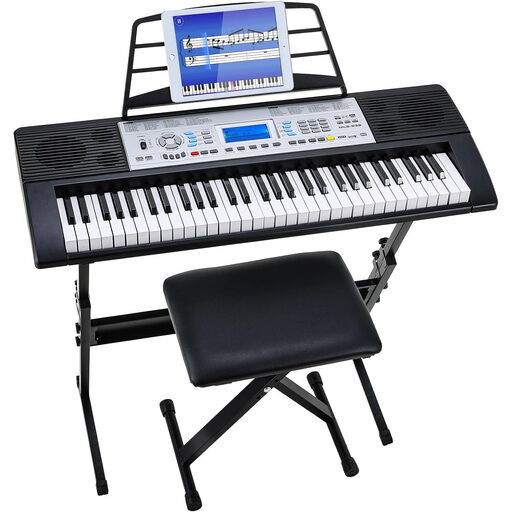
A set for creating a place to sit and practise a tune. Bear in mind that 61 keys don’t offer the 88-key range needed to develop your piano technique further.
Stand, bench and music rest; 300 tones, 300 rhythms, three-step learning mode, LCD and USB-MIDI.
 No image available
An option if you’d like a stand and stool for your practice space. Its 61 keys don’t offer the 88-key range needed to develop your piano technique further.
500 tones, three-step learning mode, dual speakers and LCD.
No. Headphones don’t give you a general right to practise at any time. The Dutch Government advises neighbours to discuss music noise and agree arrangements together; you should also follow any arrangements that apply in your own home.
According to Korg, the B2+ includes a damper pedal, music rest and adapter; the STB1 stand and PU-2 pedal unit are sold separately. Check what’s included with the specific version you’re ordering.
Follow the manual for the specific model. For the P-145BT, Yamaha’s instructions include using the specified voltage and adapter, and unplugging the instrument before cleaning it. Don’t assume these model-specific instructions apply to another piano without checking.
If you bought as a consumer in the Netherlands, you’re entitled to a product that works properly, and the seller must provide a solution if it’s faulty, according to the Dutch Government. The Netherlands doesn’t have a fixed, general statutory warranty period; what you can expect also depends on the product.
For a standard online purchase from a business, the Dutch Government says you’ll generally have a 14-day cooling-off period. Check the terms that apply to your specific order.