
Pianist preparing a recital piece
You want to practise a piano part with the right key range and touch, and perhaps use a pedal too. Yamaha and Roland describe models with 88 keys; check which keyboard suits your part.


For a piano part with a wide range, a piano-style touch or pedal technique, an 88-key digital piano is the obvious choice. If your part fits within 61 keys and calls for other sounds or accompaniment, a touch-sensitive keyboard may be more suitable. Check the highest and lowest notes in your own part, then compare the pedal, connections and complete set-up. A smaller keyboard won’t automatically offer the same range or feel as a piano keyboard.
You want to practise a piano part with the right key range and touch, and perhaps use a pedal too. Yamaha and Roland describe models with 88 keys; check which keyboard suits your part.
You’re practising a part that would work with a shorter, touch-sensitive keyboard and other sounds or accompaniment. Yamaha lists these features for the PSR-E383; first check that all the notes in your piece fall within its range.
You want to move your set-up or listen privately. Check the dimensions and headphone connections of the exact model, as well as which components are included with the version you’re considering.
Choose this option: if your piano part calls for a wide key range, a piano-style touch or pedal technique. Yamaha lists an 88-key GHC keyboard for the P-145.
Bear in mind: the complete set-up may take up more space and be less compact than a shorter keyboard. Also check which pedal and stand components are included with the version you’re considering.
Choose this option: if your part fits within 61 keys and you want to use the available sounds or accompaniment. Yamaha lists 61 touch-sensitive keys and accompaniment styles for the PSR-E383.
Bear in mind: 61 keys don’t cover the full range of a piano keyboard. Compare the lowest and highest notes in your part with the range of the exact model.
The figures below show which factors may influence your choice when practising in a rehearsal studio. Start with the requirements of your own part.
| Consideration | What to look for when buying | Who is this important for? |
|---|---|---|
| Touch and key range | Compare the lowest and highest notes in the entire part with the keyboard, and consider the type of touch too. Yamaha and Roland describe models with 88 keys, while Yamaha lists 61 touch-sensitive keys for the PSR-E383. | If I want to practise passages and dynamics on a suitable keyboard, the range of my part comes first. Around 39% of consumers prioritise touch and key range. |
| Pedal technique | Check which pedal function your part requires, which pedal is compatible and whether it’s included with the version you’re considering. For half-pedalling on the FP-10, Roland names the optional DP-10 pedal; Korg lists the PU-2 as an optional extra for the B2+. | If my piece calls for pedal technique, I want to practise it with the right combination of instrument and pedal. Around 23% of consumers prioritise pedal technique. |
| Portability, space and sounds | Measure your playing area, including the stand and space for your seat. If you need specific sounds or accompaniment, check the features available on the exact keyboard model. Yamaha lists the P-145 as 1,326 mm wide and weighing 11.1 kg. | If I need to move the instrument or use particular sounds for my part, I want to know whether it will fit my set-up. Around 23% of consumers prioritise portability, space or the sounds they need. |
| Private listening | Check the headphone socket on the exact model and whether your headphones will fit, using an adapter if needed. Korg lists a PHONES socket on the B2+ that also serves as a line-out. | If I want to listen privately in a shared space, I want to know in advance whether I can connect my headphones. Around 15% of consumers make private listening their main buying consideration. |
A 61-key keyboard doesn’t offer the same range as an 88-key one. Different sounds won’t change that.
Compare the full part with the keyboard’s range, then choose the touch you want to practise the piece with.
For the B2+, Korg distinguishes between the included damper pedal and the optional PU-2 for half-pedalling. For the FP-10, Roland lists the optional DP-10 pedal for this function.
Check the pedal markings in your part, the exact pedal name and what’s included with the version on offer.
Your playing area also needs room for the stand and seat. Some versions are sold with set-up components separately.
Measure the full playing area and check which components are included with the instrument before you buy.
The P-145 is a portable digital piano with 88 keys, while the PSR-E383 is a 61-key touch-sensitive keyboard with accompaniment features.
The FP-10 is a portable digital piano with 88 keys and the option to listen through headphones.
The B2+ is a portable digital piano with 88 keys and a headphone/line-out socket.
The Privia PX-S1100 is an 88-key digital piano for anyone who needs to consider the depth of their set-up.
These Joybuy products are 61-key keyboards for parts that fit within a 61-key range. Check the features listed for each product and make sure the keyboard meets the requirements of your piece.
 No image available
Suitable for a part that fits within 61 keys and could make use of extra sounds or rhythms.
The product description lists 300 sounds, 300 rhythms, recording and playback functions, and a headphone socket.
 No image available
An option if your part fits within 61 keys and you want to use sounds or rhythms while practising.
The product description lists 500 sounds, 300 rhythms, a metronome, a recording function, speakers, a headphone socket and a music stand.
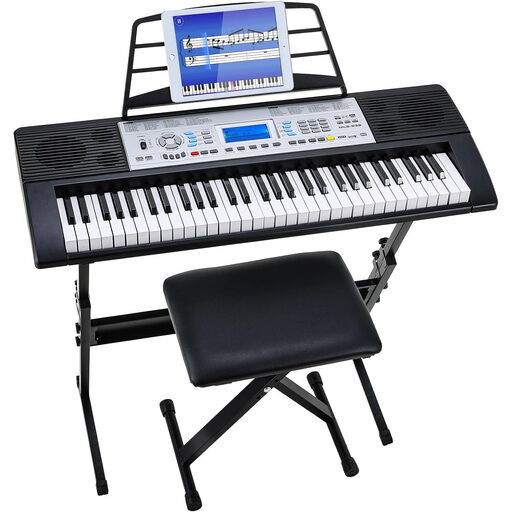 No image available
Suitable for a part within 61 keys and a practice space where you’d like a fixed set-up with a stand and stool.
The product description lists 500 sounds and rhythms, an LCD screen, two speakers and a three-level learning function. The set description includes a stand and an adjustable stool.
Check the lowest and highest notes in the entire part. The Yamaha PSR-E383 has 61 keys and the Yamaha P-145 has 88; without seeing your specific part, it’s not possible to tell which range is right.
That depends on the combination of instrument and pedal. Korg lists an included damper pedal with the B2+ and names the optional PU-2 for half-pedalling. For the FP-10, Roland lists the optional DP-10 pedal for this function.
Check that there’s enough space and a power supply, that your headphones fit the socket on the exact model, and that your pedal and stand are part of your set-up. For the B2+, Korg lists which components are included and which accessories are available separately.
If a product is faulty despite normal use, the seller must resolve the issue under the Dutch statutory guarantee. There’s no fixed statutory guarantee period in the Netherlands. For a standard online purchase of goods, you’ll generally also have up to 14 days from delivery to change your mind; ACM ConsuWijzer explains the exceptions.
A CE mark is required only if the applicable harmonised EU rules require it for that product. The European Commission and Your Europe explain the rules for electrical and electronic equipment, including those on electromagnetic compatibility. Whether those rules apply to a particular version must be determined for each product.