
Pianists learning jazz chords
You practise melodies and chord voicings with both hands, and mainly want to assess whether the feel of the keys and the range suit the music you’re practising.


Start with the keyboard and the range you need to practise melodies and chord voicings with both hands. Then compare headphone use and the space required for your complete playing setup. A portable piano with the features you’ll actually use may be enough for independent practice, while rhythms, recording functions or extra connections may matter if they suit your practice plan. Check which accessories are included with each version, too.
You practise melodies and chord voicings with both hands, and mainly want to assess whether the feel of the keys and the range suit the music you’re practising.
You share your home with others or want to practise at different times. In that case, headphone use and the possibility of audible noise are important points to consider.
You want to put a piano in a spare room or move it after use, so you’ll need to consider its dimensions and the space required for your complete playing setup.
The right choice depends on what matters most to you when practising: the keyboard, quiet playing, the space available or extra practice features.
| What to consider | What should you check? | Who is this most relevant to? |
|---|---|---|
| Key feel and range | Compare the range with your sheet music and, if possible, try the keys for yourself. Yamaha lists an 88-key GHC keyboard for the P-145; Roland lists an 88-note PHA-4 Standard keyboard for the FP-10. | If I practise melodies and chord voicings with both hands, I want the keyboard to suit my music. Around 29% of consumers give piano playing and key feel their highest priority. |
| Practising with headphones | Check the headphone socket and the right plug for the exact version. Bear in mind that using headphones doesn’t eliminate the sound of the keys or pedal. | If I want to practise at home without using the speakers, I look for a suitable headphone socket. Around 23% of consumers prioritise practising quietly at home. |
| Setting up in a spare room | Measure the space for the piano, stand, pedal and seat. Casio lists a cabinet depth of 232 mm for the PX-S1100BK; this doesn’t include the space needed for the complete playing setup. | If the spare room is used for other things too, I want to know whether the whole setup will fit and where I can store it. Around 18% of consumers prioritise the space available. |
| Timing and accompaniment | Consider whether a metronome is enough or whether you also need rhythms, a recorder or connections. Kawai lists a metronome, recorder and 100 drum rhythms among the ES120’s features. | If I want to practise my timing or play along with rhythms, I compare those features with my own practice plan. Around 18% of consumers give accompaniment or practice features their highest priority. |
| Accessories you need | Check what’s included with each offer, including the stand, pedal setup and any other parts you need. Yamaha lists the LP-5A three-pedal unit for the P-145 as an optional extra. | If I want to sort out everything for my playing space in one go, I want to know in advance what’s included with the version I’m buying. Around 12% of consumers prioritise having a complete setup. |
With headphones, you can hear the piano without using its speakers, but other people may still hear the keys or pedal.
Check the connection and, if needed, agree practice times with others. Don’t assume there’s a blanket exemption for making music at home.
Even a compact piano needs to be set up in a way that’s practical to use. You’ll also need room for the stand, pedal, sheet music and seat.
Measure the entire playing area and check which accessories are included with the version you’ve chosen.
A separate stand or pedal setup may be part of what you need; check in advance what else you’ll have to buy.
Extra sounds, rhythms and connections meet different practice needs from the key feel and range required for your piano music.
Start by choosing based on the piece and how you practise. Then consider any extra features you’ll genuinely use.
The P-145 is an entry-level portable piano with 88 keys, designed for piano-focused practice.
The FP-10 is a portable digital piano with an 88-note PHA-4 keyboard.
The ES120 is a portable piano worth comparing if built-in practice features are part of your decision.
The PX-S1100BK is worth comparing if cabinet depth is a key consideration in your spare room.
These Joybuy picks are portable 61-key models with practice features such as a metronome or rhythms. If your music needs a wider range, compare these with an 88-key piano.
 No image available
Could suit you if you want to use rhythms and a metronome while practising, and connect headphones.
The product name lists weighted keys, 300 rhythms and a headphone socket; the description also mentions a metronome.
With 61 keys, its range is smaller than that of an 88-key piano.
 No image available
Could suit you if you want to practise with a metronome and rhythms at home, and use a recording function.
The product name lists a recording function and speakers; the description mentions a metronome, 300 rhythms and a headphone socket.
With 61 keys, its range is smaller than that of an 88-key piano.
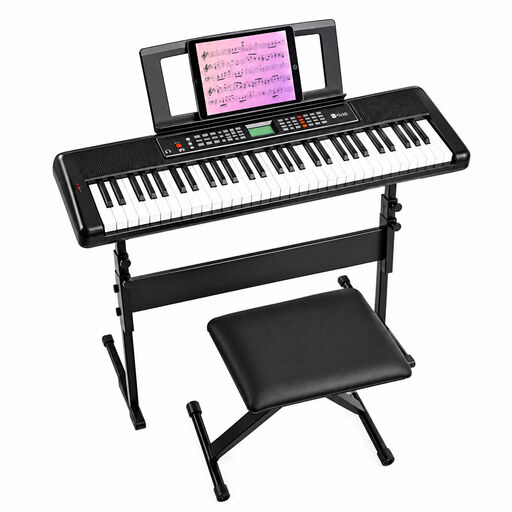 No image available
Could suit you if you’re looking for a set with a stand and bench, and want to use rhythms while practising.
The product name lists 300 rhythms; the description mentions a headphone socket and USB-MIDI.
With 61 keys, its range is smaller than that of an 88-key piano.
Not every piece needs the same range. Compare the instrument with the melodies and chord voicings you want to practise; the manufacturers list both the Yamaha P-145 and Roland FP-10 as having an 88-key or 88-note keyboard.
Measure the space for the complete playing setup and check which stand and pedal arrangement are included. The 232 mm listed by Casio for the PX-S1100 is just the depth of the cabinet and doesn’t include the space for your seat.
Check which accessories are included and keep your proof of purchase. If a product bought in the Netherlands doesn’t meet reasonable expectations under normal use, the seller is responsible for the statutory guarantee, according to ACM ConsuWijzer. This isn’t the same as one fixed guarantee period for every piano.
Using headphones doesn’t give you blanket permission to cause noise nuisance. The Dutch government recommends discussing the issue and agreeing on a solution first, and lists the landlord, residents’ association and local council among possible next steps.
For an online consumer purchase in the Netherlands, ACM ConsuWijzer says you generally have a statutory cooling-off period of up to 14 days after delivery, with some exceptions. Check the terms that apply to your purchase, and remember that this right is separate from the statutory guarantee for a faulty product.