What should you look for when choosing?
Start with the keyboard and how you want to practise, then check the headphone setup, practice features and space you’ll need. What matters most depends on how you’re learning the jazz standard.
| What to consider |
What should you check? |
Who is this important for? |
| Touch and dynamics |
Compare the keyboard type and touch settings on the exact model. Also check the number of keys and which pedal you’ll need. |
If you want to practise melodies and chords with nuance, you’ll want to know how the keyboard responds to your touch. Around 33% of consumers put touch and dynamics first. |
| Quiet practice |
Check the number of headphone outputs and whether the sockets are compatible with the headphones you want to use. |
If you want to practise in a shared music room without using the speakers, the headphone setup matters. Around 27% of consumers prioritise quiet practice. |
| Timing and repetition |
Check whether the model has a metronome, recording function or built-in rhythms that suit the way you practise. |
If you want to repeat passages at tempo or listen back to them, these features are useful. Around 20% of consumers put timing and repetition first. |
| Space and setup |
Measure the available space and check which pedals and components, such as a stand, are included or available separately. |
If the piano needs to fit in a shared space and you want to complete the setup, check its dimensions and included components. Around 20% of consumers prioritise space and a complete setup. |
Joybuy product picks
These picks are digital pianos and keyboard pianos with 61 keys. Compare this range with the pieces you want to practise, and check which practice features and accessories are included with each version.
 No image available
MLS-931 digital piano, 61 keys
The headphone socket and metronome may be useful if you want to practise on your own and keep to the beat.
The product name lists a weighted keyboard, 300 tones, 300 rhythms, an LCD display and USB-MIDI. This version has 61 keys; check that this range suits the pieces you want to learn.
Joybuy
 No image available
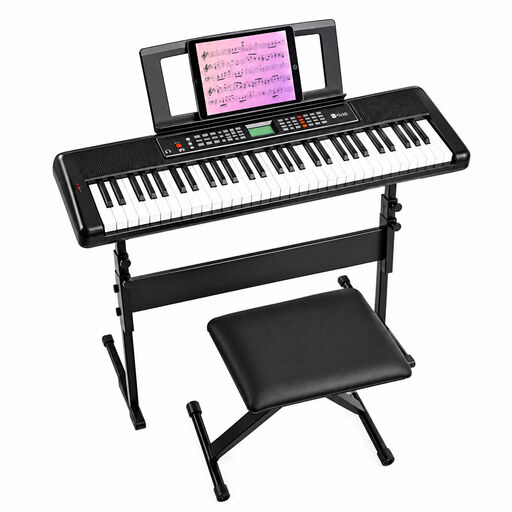
Keyboard piano, 61 keys, set with stand and bench
The listed headphone socket and rhythms may suit practising on your own at different tempos.
The product name lists 300 tones, 300 rhythms, a three-level learning mode, an LCD display and USB-MIDI. The set name includes a stand, bench and music stand; check the contents of the exact version. This piano has 61 keys.
Joybuy
Frequently asked questions
Do I need built-in drum rhythms to learn a jazz standard?
No, built-in drum rhythms aren’t essential for learning a jazz standard. If you mainly want to practise keeping time, a metronome may suit your approach; Kawai also lists 100 drum rhythms for the ES120. Decide for yourself whether those rhythms suit the music you’re learning.
Can I listen through headphones at the same time as a teacher?
Roland lists two headphone outputs for the FP-30X. For other exact models, check the number of outputs and the plugs required. A single PHONES socket listed in the specifications doesn’t mean two listeners can connect at once.
What should I check before setting up and connecting the piano?
Measure the available space and check which adapter, stand and pedals are included with each version. Korg lists an adapter and damper pedal for the B2+; the stand and PU-2 pedal unit are separate accessories.
What are my rights if a piano bought online doesn’t work properly?
For a consumer purchase in the Netherlands, the seller must provide an appropriate free solution under ACM ConsuWijzer guidance if the product doesn’t do what you could reasonably expect during normal use. A manufacturer’s warranty doesn’t replace your statutory rights. Online purchases generally come with a 14-day cooling-off period from delivery, subject to statutory exceptions.
What product regulations apply to an electric piano in the Netherlands?
Electrical and electronic equipment placed on the market in the Netherlands must meet the applicable European product requirements. Business.gov.nl explains that CE marking and an EU declaration of conformity are required where the applicable requirements stipulate them. This framework alone doesn’t prove that a specific piano on sale, or its included adapter, complies.


